August 24, 2026
VA Is Exploring AI for Disability Claims. It Has 2,950 Fewer Claims Examiners.
VA's oldest claims backlog has fallen even as its covered claims-examining workforce declined 14% from September 2024 through June 2026.
By Evan Mercer
Published August 24, 2026Last edited August 24, 2026
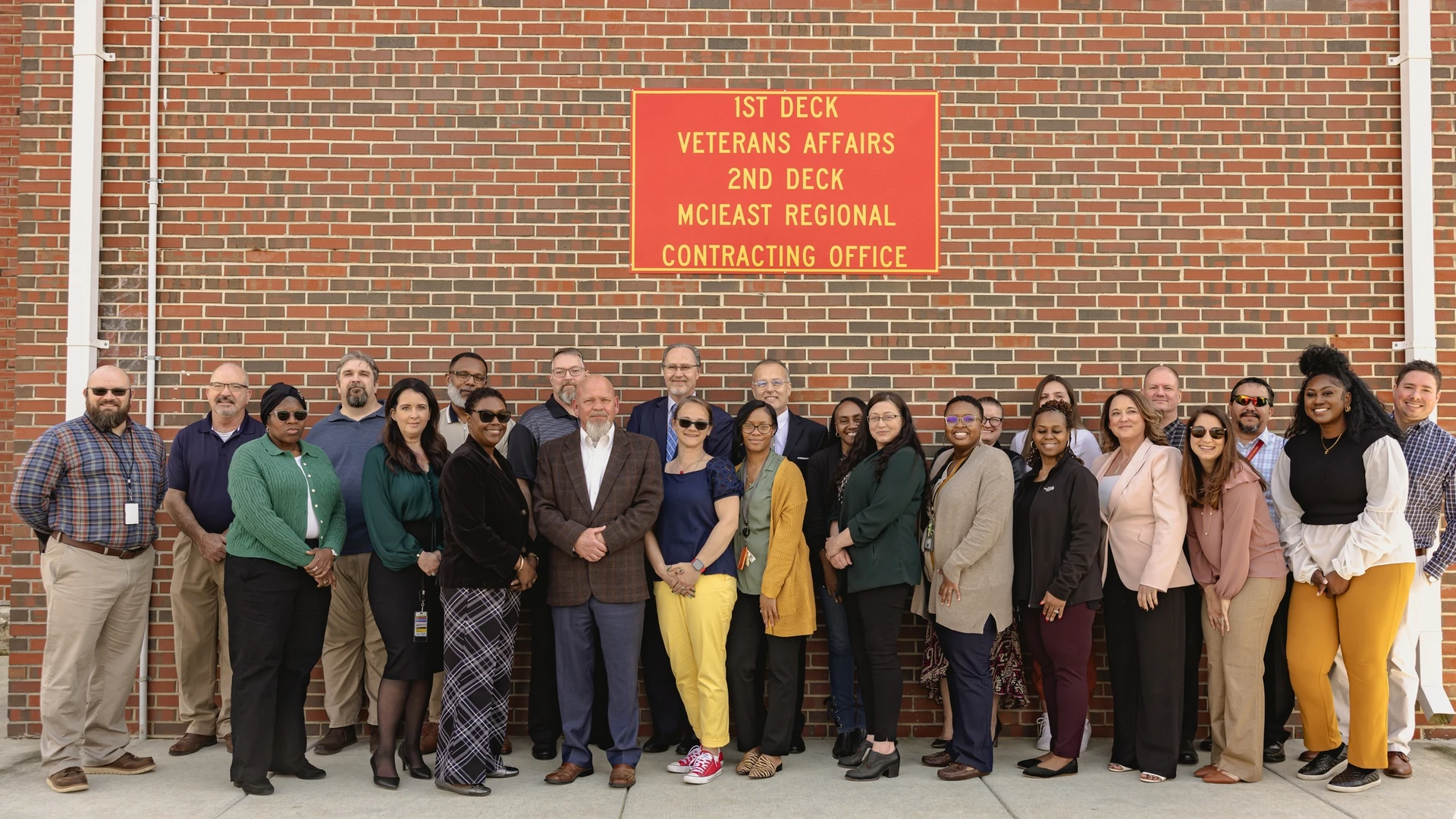
The Department of Veterans Affairs is exploring whether artificial intelligence can help process one of the federal government's largest and most consequential workloads. In fiscal 2025, VA paid more than $195 billion in disability compensation to more than 6.9 million veterans and family members. Each award depends on evidence, trained judgment and a record that can withstand review or appeal.
The workforce behind that system is now smaller than it was during the peak of the post-PACT Act staffing build. Public Office of Personnel Management files show that the Veterans Benefits Administration had 21,004 employees in the Veterans Claims Examining occupation series in September 2024. By June 2026, it had 18,054, a reduction of 2,950 employees, or 14.0%.
VA has also reported genuine operational improvement. Its Aug. 15 workload report listed 71,391 rating claims pending longer than 125 days, down from 235,962 at fiscal 2024 year-end. The average time to complete a rating-bundle claim was 76.48 days in fiscal 2026 through that date, compared with 152.1 days in fiscal 2024. VA had completed nearly 2.7 million claims during the partial fiscal year.
Those results are important counterevidence to a simple story about staff cuts and service collapse. They do not establish that AI caused the improvement, or that a smaller workforce can sustain it. The public record supports a more exact conclusion: automation may reduce clerical work and help identify risk, but disability decisions still depend on trained adjudicators, reliable medical exams, complete records, quality review, functional technology and accountable management.
VBA built capacity for the PACT Act, then gave some of it back
The recent decline followed a long expansion. FederalHiringData analyzed OPM's public FedScope and Enterprise Human Resources Integration files for VBA agency subelement VALA. Covered headcount increased from 11,806 in September 2000 to 25,810 in September 2022, just after enactment of the PACT Act. It reached 31,825 in September 2023 and 34,806 one year later.
By June 2026, the count had fallen to 29,504. That was 5,302 fewer employees than in September 2024, a decline of 15.2%, but still more than double the 2000 level.

Claims examiners made up more than half of VBA's June 2026 covered workforce. OPM series 0996 includes veterans service representatives, rating veterans service representatives and other employees classified as Veterans Claims Examining. It does not identify a worker's office, assignment, proficiency or individual production.
That occupation grew rapidly as VA prepared for PACT Act claims. Headcount rose from 15,260 in September 2022 to 19,223 in September 2023 and 21,004 in September 2024. It then declined to 19,212 in September 2025 and 18,054 in June 2026.

Point-in-time headcount is not full-time-equivalent employment or productive hours. It does not count overtime, training time, contractor labor or employees outside OPM's public coverage. It does establish the scale and direction of the federal staffing change: the adjudication workforce expanded for the PACT Act surge, reached a peak in 2024 and was materially smaller by mid-2026.
The shape of that change matters for any claim that technology can substitute for people. AI does not arrive in a workforce with static skills and capacity. It arrives while experienced employees must keep deciding claims, newer employees must learn a complex body of law and evidence, and managers must train staff on both benefit rules and new tools.
Output rose while the oldest backlog fell
The PACT Act expanded eligibility for veterans exposed to burn pits, Agent Orange and other toxic substances. It added presumptive conditions and brought a large new volume of disability work into VBA. VA's weekly reports show the rating-bundle pending inventory rising from 641,694 near the end of fiscal 2022 to 1,091,853 at fiscal 2023 year-end. The subset pending longer than 125 days more than doubled, from 148,507 to 303,307.
The inventory subsequently declined. The Aug. 15, 2026 report showed 632,308 pending rating-bundle claims, close to the 634,240 recorded at fiscal 2025 year-end. The over-125-day backlog fell more sharply, to 71,391, or 11.3% of pending claims.

The current system cannot be summarized by one number. VA publishes inventory, backlog, completion time and two different forms of accuracy. The latest public values available when this article was prepared were:
| Measure | Latest value | What it means |
|---|---|---|
| Pending rating-bundle claims | 632,308 | Claims received that normally require development and a processor decision |
| Pending longer than 125 days | 71,391 | VBA's rating-related backlog definition |
| Fiscal 2026 completions through Aug. 15 | 2,699,723 | Completed rating-bundle claims in the partial fiscal year |
| Average days to complete through Aug. 15 | 76.48 days | Fiscal-year-to-date average for completed rating-bundle claims |
| Three-month issue-level accuracy | 93.08% | Accuracy of individual medical issues in reviewed compensation claims |
| Three-month claim-level accuracy | 82.12% | Share of reviewed claims with no identified error at the claim level |
Issue-level and claim-level accuracy answer different questions. A claim can contain several medical issues; one error can make the claim fail the all-or-nothing claim-level measure even when most issues were correct. Neither measure identifies the effect of a particular AI tool.
FederalHiringData also calculated an approximate incoming workload from the weekly snapshots: fiscal-year completions plus ending pending inventory minus the prior year's ending pending inventory. That estimate rose from about 1.71 million claims in fiscal 2022 to 2.43 million in fiscal 2023 and 2.63 million in fiscal 2025. For fiscal 2026 through Aug. 15, the same calculation produces about 2.70 million.

This is not VA's official receipts measure. The calculation uses the nearest available weekly reports and can be affected by inventory adjustments. It is useful because it places completions against the amount of work entering or remaining in the system. Through mid-August, completions were roughly keeping pace with the calculated inflow while the oldest backlog declined.
That performance means staffing losses cannot be assumed to have caused slower processing. It also means that the smaller workforce is operating against a historically elevated workload. Whether the gains persist is an operational question, not one that the headcount series can settle by itself.
A claim is only as usable as its evidence
For many disability claims, adjudicators need a medical examination before they can decide service connection or assign a disability rating. That evidence pipeline is now overwhelmingly contracted.
The Government Accountability Office reported that contractors conducted 93% of VA disability medical exams in fiscal 2024: more than 3 million exams at a cost of more than $5 billion. Those figures describe exams and spending, not the number of contractor employees.
GAO found that VA's Medical Disability Examination Office used exam-error data, focused reviews and stakeholder feedback to oversee quality, but its controls were incomplete. Manual data-entry mistakes caused more than $2 million in erroneous incentive payments in one quarter of fiscal 2024. Reviews of complex exam types were overdue. VA did not collect feedback directly from contracted examiners.
VA later implemented two of GAO's four recommendations. It adopted procedures to validate incentive calculations and created a direct examiner-feedback mechanism. Two recommendations remained open in the public GAO record, including documentation of recalculated incentives and the schedule for focused reviews of complex claims.
| Contracted-exam measure | Verified finding | Why it matters to claims capacity |
|---|---|---|
| Share of exams performed by contractors, FY2024 | 93% | Most medical-exam evidence was produced outside the federal workforce |
| Exam volume and cost, FY2024 | More than 3 million exams; more than $5 billion | Scale makes quality control and rework operationally significant |
| Incentive-payment error | More than $2 million in overpayments identified for one quarter | Administrative controls affect whether performance incentives are reliable |
| Complex-claim reviews | Reviews were overdue; VA later moved to a three-year cycle | Traumatic brain injury, military sexual trauma and Gulf War illness exams require sustained oversight |
An incomplete or internally inconsistent exam can create rework for processors, delay a decision or complicate an appeal. AI that classifies documents faster does not make weak evidence stronger. A capacity strategy therefore has to include exam quality, contractor oversight and the federal staff who decide whether the record is sufficient.
Federal Hiring Data Weekly
Get the biggest federal workforce changes in your inbox.
Subscribe to Federal Hiring Data Weekly for federal hiring trends, salary data, agency movements, and original investigations, with email confirmation before delivery.
VA is exploring generative AI, not delegating final decisions in the public record
The strongest current description of VA's AI plans comes from GAO's July 2026 testimony. VA reported 40 AI use cases in 2023, 229 in 2024 and 367 in December 2025. A use-case inventory is not a count of systems proven effective in production, and it is not limited to disability claims.
For disability compensation, GAO said VA was exploring generative AI that could further automate document intake, classification and preliminary adjudication. The wording matters. The report describes capabilities VA is exploring; it does not say a generative system independently makes final benefit decisions.
GAO also described a more concrete example. VA reported that its Payment Redirect Fraud model uses AI to identify direct-deposit changes likely to be fraudulent, then refers those incidents to team investigators for review and remediation. The model narrows a risk queue. Humans investigate and act.
| AI activity described by GAO | Publicly supported status | Human role that remains visible |
|---|---|---|
| Document intake and classification | Explored capability for disability-claim processing | Staff must verify that evidence is associated with the correct claim and issue |
| Preliminary adjudication | Explored generative-AI capability | The public report does not establish autonomous final decisions |
| Payment Redirect Fraud model | VA-reported operational use | Team investigators review and remediate referred incidents |
| VA-wide AI inventory | 367 reported use cases in December 2025 | Inventory listing does not establish deployment, effectiveness or claim-level impact |
The difference between triage and adjudication is central. Sorting a record, extracting a date or flagging a suspicious payment can reduce repetitive work. Determining whether a condition is connected to service, weighing conflicting evidence and assigning a legally supported rating are decisions with financial and personal consequences. Veterans can appeal them, so the reasoning and record have to remain reviewable.
GAO warned that generative systems can operate as black boxes, making errors or misuse difficult to detect and accountability harder to assign. It also identified a shortage of federal AI expertise and reported that VA had difficulty attracting and developing generative-AI talent. That is another workforce constraint: the agency needs employees who understand benefit law and employees who can test, secure, monitor and explain the technology.
Since 2021, GAO has made 43 recommendations on VA's disability compensation program. VA had implemented 28 and had not fully implemented 15 by July 2026. The open work spans program management, training, contracted exams and modernization. Adding a model does not close those management gaps by itself.
The staffing decline extends beyond claims examiners
Claims processing is not performed by series 0996 alone. Between January 2025 and June 2026, VBA's covered legal-administration workforce fell by 647 employees, or 20.9%. Management and program analysis fell by 390, miscellaneous administration and program by 234, clerical support by 178, and hearings and appeals by 122. Human resources, financial administration, inspection and compliance, and claims-assistance series also became smaller.

Occupation is not assignment. These agencywide counts cannot identify who worked on disability compensation, AI, quality review or contractor exams. They show that the contraction was broad rather than confined to a single job series.
The age profile raises a separate pipeline question. Among series 0996 employees, the number age 20 through 39 fell from 5,434 in January 2025 to 3,846 in June 2026, a decline of 29.2%. The count age 40 and older fell from 15,251 to 14,208, or 6.8%. Age is not experience, skill or tenure, and the data do not identify why people left. The uneven decline nevertheless matters because a claims operation needs a continuing pool of employees who can be trained and developed over time.
In June 2026, 15,586 of the 18,054 claims-examining employees were in OPM's career or unrestricted tenure group. Another 2,460 were career-conditional or serving appointments with a probationary or trial period. The distribution says nothing about training completion or claim quality, but it shows that nearly one in seven was not yet in the unrestricted group.
GAO's claims-processor training review found in 2021 that VBA lacked an integrated training plan, complete monitoring policies and consistent evaluation. VA has since implemented eight of GAO's ten recommendations. Two remained open: the comprehensive plan did not explain how training would be prioritized under competing demands, and VA had not demonstrated that evaluation plans covered key aspects of experienced-worker training.
Related research
Put this finding in context
Data investigationsAugust 24, 2026
EPA Has $10.2 Billion in IRA Awards to Oversee. Its Workforce Is 26% Smaller.
EPA entered years of post-award monitoring with $10.2 billion in unaffected IRA obligations and 4,326 fewer covered employees than in September 2024.
Data investigationsAugust 18, 2026
FEMA's Public Workforce Count Fell 22% as GAO Warned of Readiness Risks
FEMA had 5,793 fewer covered civilian employees in June 2026 than in January 2025. GAO says the agency cut staff without the workforce planning needed to assess mission capacity.
That unfinished work is directly relevant to AI. A new tool can change the sequence in which an employee sees evidence, the information emphasized on screen and the point at which a human catches an error. Training evaluation must measure more than whether a worker completed a course. It must test whether people can recognize incorrect output and make accurate decisions under production conditions.
Recruiting history is a signal, not a replacement count
The FederalHiringData historical USAJOBS archive contains 4,900 distinct VBA announcements tagged to series 0996 from the archive's March 2017 starting point through Aug. 13, 2026. The archive recorded 987 in 2017 despite the partial starting year, 1,140 in 2019, 588 in 2020, 306 in 2022, 328 in 2023 and 330 in 2024.
The 2025 count is one, an implausibly sharp break from adjacent years. FederalHiringData could not determine from the available archive whether that reflects source coverage, a changed posting pattern or another cause. It is therefore labeled as a coverage break, not interpreted as a collapse in recruiting. The 2026 count of 76 runs through Aug. 13 and is also incomplete.

An announcement is not a hire, a vacancy or an employee. One announcement can cover multiple grades or locations, and a hiring action can be canceled or filled in ways the public posting count does not reveal. Public OPM accession records after January 2025 also did not reconcile well enough with headcount and separation data to support a replacement ratio. This article does not invent one.
The defensible observation is narrower: VA built a much larger claims workforce after the PACT Act, then lost a meaningful share of it. Public recruiting records do not yet provide a reliable measure of how quickly that capacity is being replenished.
The test for AI is measurable, but it has not been answered
VA's recent performance shows that a large workforce is not the only path to faster output. Process changes, overtime, digitized records, contracted exam capacity, shifts in case mix and technology can all affect completions. The public data reviewed here do not isolate their contributions.
That uncertainty should make the AI question more disciplined, not more speculative. A useful system should reduce handling time or rework without lowering issue accuracy, claim accuracy, due-process protections or the quality of explanations veterans receive. Its error rate should be measured across conditions and claimant groups. Staff should be able to identify when it was used, inspect the source evidence and override an incorrect result. Managers should know whether a faster first pass simply moves work into correction or appeal.
The stakes are larger than a productivity demonstration. VA's disability program supports millions of households. Its decisions turn service records, medical evidence and law into monthly compensation. The current workforce has proven it can process an enormous volume while reducing the oldest backlog. It is also 2,950 claims examiners below its September 2024 level, supported by smaller legal, program and administrative groups.
AI may help that workforce do more. The public record does not show that it can replace the system around the decision: trained adjudicators, sound exams, quality assurance, secure data, functioning software and managers accountable for the result.
Methodology and limitations
FederalHiringData analyzed public OPM FedScope and Enterprise Human Resources Integration records for Veterans Benefits Administration agency subelement VALA. The long-run headcount series uses September snapshots from 2000 through 2025 and the June 2026 monthly file as the latest observation. Series 0996 uses September 2015 through 2025 and June 2026. January 2025 and June 2026 monthly files support the occupation, age and tenure comparisons.
Covered headcount is not FTE, productive time or staffing assigned to a particular claims function. Occupation does not establish duties. Age is not experience. Tenure group is not proficiency. OPM personnel-action records for accessions after January 2025 did not reconcile sufficiently with the other series, so no replacement ratio is published.
Claims data come from VA Monday Morning Workload Reports for the national Rating Bundle. Fiscal-year-end observations use the nearest weekly reports from 2019 through 2025; the 2026 observation is Aug. 15 and is not a full fiscal year. FederalHiringData's incoming-workload calculation equals completions plus ending pending inventory minus the prior ending inventory. It is an approximation, not VA's official receipts count.
Accuracy definitions and current inventory values come from VBA's detailed claims data page. Contractor-exam findings come from GAO-25-107483 and GAO-26-108789. Training findings come from GAO-21-348. AI and recommendation findings come from GAO-26-109137. The contractor figures are exam counts and costs, not contractor headcount.
The USAJOBS analysis counts distinct control numbers attributed to VBA and tagged to occupation series 0996 in the FederalHiringData historical USAJOBS archive. Coverage begins in March 2017. The 2025 count is anomalous and is not treated as a comparable year; 2026 runs through Aug. 13. Announcements are not hires or vacancies.
This analysis does not establish that workforce reductions caused a change in processing time, backlog or accuracy. It does not establish that AI caused VA's recent operational improvement or that generative AI independently decides claims. Sources were checked through Aug. 24, 2026. Readers can browse current federal openings, review broader federal hiring statistics, explore the agency directory, or read more FederalHiringData investigations.
Continue reading
More from FederalHiringData

Data investigationsAugust 18, 2026
IRS Workforce Fell 29% as GAO Warned of Filing-Season Risks
The IRS had 29,663 fewer covered civilian employees in June 2026 than in January 2025. GAO says workforce-planning gaps and post-filing pressures pose risks to future operations.
Data investigationsAugust 23, 2026
ICE Got 150,000 Applications. Its Workforce Grew by About 9,600 at the Peak.
OPM recorded 10,030 new-hire actions during ICE's surge, but tentative offers were not final hires and covered employment had receded by June.

Data investigationsAugust 22, 2026
IHS Launched Its Largest Hiring Push. Its Covered Workforce Fell 458 by June.
IHS launched against severe provider vacancies, but covered employment fell 458 from January through June and the campaign still lacks a public numeric target.
Federal Hiring Data Weekly
Get the biggest federal workforce changes in your inbox.
Subscribe to Federal Hiring Data Weekly for federal hiring trends, salary data, agency movements, and original investigations, with email confirmation before delivery.