August 25, 2026
CFPB Lost 670 Covered Employees as Complaint Intake Reached 6.6 Million
Covered CFPB employment fell 38.2% while complaint intake reached 6.6 million and leadership narrowed supervision and enforcement priorities.
By Evan Mercer
Published August 25, 2026Last edited August 25, 2026
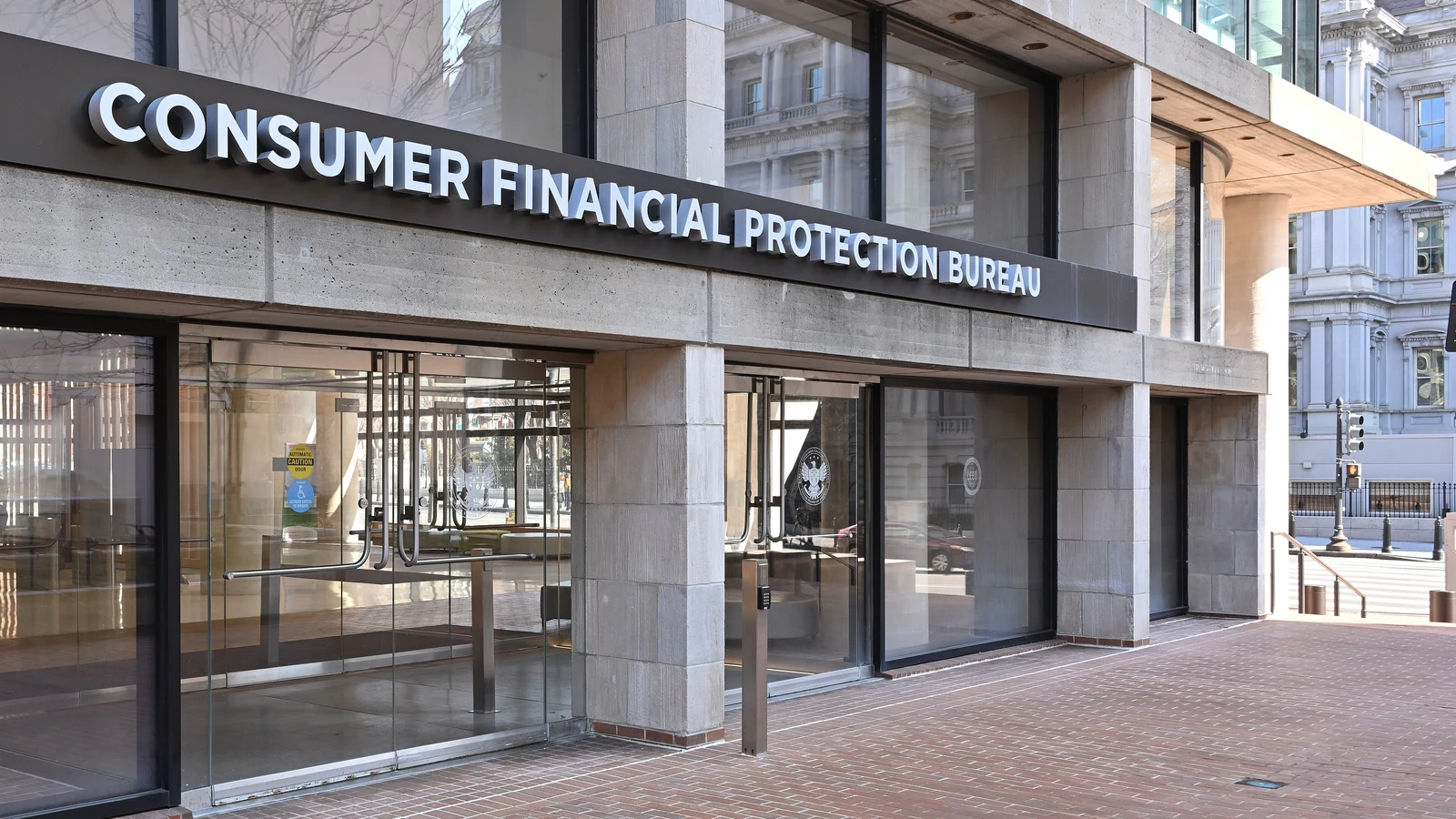
The Consumer Financial Protection Bureau entered 2025 with 1,752 covered employees in Office of Personnel Management records. By June 2026, that count was 1,082. The decline of 670 employees, or 38.2%, took 18 months.
At the same time, the bureau's public complaint system received 6,635,400 complaints in 2025, almost 19 times its 2019 intake. Ninety percent were sent to companies, and the CFPB reported that 99.6% of company responses were timely.
Those facts do not prove that every remaining employee handled 19 times as much work. Complaint intake is heavily concentrated in credit reporting, includes duplicates and does not map neatly onto examinations, enforcement cases or individual assignments. They also do not prove that consumer harm rose as staffing fell.
They do define the question facing the bureau in 2026: can a much smaller organization continue routing complaints, supervising financial institutions, enforcing federal consumer-finance law and producing market intelligence while leadership deliberately narrows the work it chooses to pursue?
FederalHiringData analyzed OPM employment and personnel-action records, CFPB financial and performance reports, its complaint and enforcement data, Government Accountability Office findings, court records and the historical USAJOBS archive. The evidence shows a broad workforce contraction, a near-stop in public recruiting and a major clearing of supervisory and enforcement inventories. It also shows a complaint platform that continued moving millions of submissions to companies.
That is a capacity test, not yet a verdict on outcomes.
The reorganization unfolded through work orders, funding law and litigation
The change did not arrive as one completed personnel action. It unfolded through management directives, voluntary departures, attempted terminations, contract decisions, legislation and court orders.
GAO's chronology begins in February 2025, when new leadership issued stop-work instructions and began assessing how to operate a smaller bureau. The directives affected supervision, enforcement, rulemaking, communications and other mission work. Leadership later permitted selected functions to restart under narrower priorities. The public complaint system remained available.
During the following months, the bureau reviewed open examinations and enforcement matters, ended or modified contracts and pursued workforce reductions. Employees also left through channels separate from the contested reduction in force. That distinction appears in OPM's records: quits and voluntary retirements dominate the 2025 separation count, while only three actions are coded as reductions in force.
On July 4, 2025, the president signed legislation reducing the formula that caps Federal Reserve transfers to CFPB from 12% to 6.5% of the statutory base. The new ceiling constrained future funding independently of any management decision about which case or examination to pursue.
On Aug. 15, a three-judge D.C. Circuit panel vacated the district court injunction that had restricted personnel, contract and downsizing actions, but delayed the order's effect to allow a rehearing request. On Dec. 17, the appeals court granted rehearing en banc and vacated the panel order. The litigation therefore carried into 2026 rather than producing a final resolution.
The administrative record and the payroll record overlap, but they are not the same thing. Courts were deciding what management could do next while employees were already quitting, retiring or otherwise separating. By the time the en banc court issued its later limited remand, the covered workforce had already fallen far below its December 2024 level.
GAO describes this period as a reduction in CFPB's size and scope. The bureau objected that GAO's account was inaccurate, biased and incomplete, and said litigation limited what it could provide. GAO said it had offered multiple opportunities for CFPB input and stood by the facts in its report. Its report covers the status of actions through August 2025; it expressly reserves their effects for later work.
That boundary shapes this analysis. It is possible to measure who left, which occupations declined, how many matters were closed and what public outputs changed. It is not yet possible to isolate the effect of each directive from the effects of funding, attrition, court intervention, automation or changes in market behavior.
Covered employment fell to its lowest level since 2012
CFPB staffing expanded quickly after the bureau began operations in 2011. OPM records show 757 covered employees that December, 1,370 a year later and more than 1,600 by 2016. The count fluctuated after that, then reached 1,752 in December 2024.
The break came in 2025. Covered employment fell to 1,248 by December, then to 1,082 by June 2026.

Official CFPB reports provide additional workforce measures, but they should not be substituted for one another. The bureau's fiscal 2025 financial report lists 1,421 employees in the final pay period of the fiscal year. Its later semiannual report lists 1,366 people on board at the end of fiscal 2025 and 1,234 at the end of the first quarter of fiscal 2026. OPM shows 1,408 in September and 1,248 in December 2025.
The differences reflect timing, coverage and measurement approach. OPM headcount is the consistent series used in this analysis. It is not contractor staffing, a budget full-time-equivalent measure or a count of everyone who may appear in the bureau's internal systems.
All of the measures point in the same direction: CFPB's workforce became substantially smaller.
Separations overwhelmed hiring
The personnel-action data show how that contraction happened. OPM recorded 23 accessions and 559 separations at CFPB during 2025. In the first six months of 2026, it recorded three accessions and 145 separations.

The 2025 separation categories complicate any description of the change as a single mass layoff. Quits made up 368 recorded actions and voluntary retirements another 131. OPM recorded 31 expired appointments and other terminations, 20 transfers out, four other separations, three reduction-in-force actions, one other retirement and one early-out.
| 2025 separation category | Recorded actions |
|---|---|
| Quits | 368 |
| Voluntary retirements | 131 |
| Expired appointments and other terminations | 31 |
| Transfers out | 20 |
| Other separations | 4 |
| Reduction in force | 3 |
| Other retirement and early-out | 2 |
Personnel actions are not a perfect arithmetic bridge to headcount. A transfer, delayed record or appointment timing can affect the totals. The categories also do not reveal why an employee quit or retired. They do establish an extraordinary imbalance: exits continued while entries nearly stopped.
That imbalance was visible in public recruiting. FederalHiringData's USAJOBS archive contains 161 distinct CFPB announcements closing in 2024, seven in 2025 and one in 2026 through Aug. 14.

An announcement is not a vacancy or hire. One control number can cover multiple openings, and agencies can fill positions through internal or specialized paths that do not appear as ordinary public announcements. Still, the archive shows that visible public recruiting operated at a fraction of its prior level while hundreds of employees departed.
Attorneys and examiners accounted for more than half the decline
The contraction extended across the occupations that investigate cases, examine institutions, analyze markets and operate the bureau's systems.
General Attorney, series 0905, fell from 410 covered employees in December 2024 to 175 in June 2026. That loss of 235 was a 57.3% decline. Financial Institution Examining fell from 380 to 259, a loss of 121. Miscellaneous Administration and Program fell by 106.

| Selected occupation | Dec. 2024 | June 2026 | Change | Percent change |
|---|---|---|---|---|
| General Attorney (0905) | 410 | 175 | -235 | -57.3% |
| Financial Institution Examining (0570) | 380 | 259 | -121 | -31.8% |
| Misc. Administration and Program (0301) | 350 | 244 | -106 | -30.3% |
| Financial Administration and Program (0501) | 72 | 18 | -54 | -75.0% |
| Information Technology Management (2210) | 153 | 104 | -49 | -32.0% |
| Economist (0110) | 64 | 40 | -24 | -37.5% |
| Financial Analysis (1160) | 13 | 3 | -10 | -76.9% |
| Paralegal Specialist (0950) | 34 | 24 | -10 | -29.4% |
| Management and Program Analysis (0343) | 68 | 59 | -9 | -13.2% |
Attorneys and examiners together accounted for 356 of the 670-person agency-wide decline. That matters because legal review and examination capacity are central to enforcement and supervision. The reductions in economists, financial analysts and information-technology specialists matter for a different reason: the bureau's work depends on detecting patterns in large consumer and market datasets, maintaining the complaint platform and understanding increasingly digital financial products.
The figures do not reveal how work was redistributed or which employees held specialized expertise. A count of occupation codes cannot measure institutional knowledge. It does show that the contraction was not confined to communications, administration or another peripheral function.
Complaint intake reached 6.6 million
The most visible public service continued operating at enormous scale. CFPB's 2025 Consumer Response annual report says the bureau received approximately 6.64 million complaints in 2025, up from 3.19 million in 2024 and 352,400 in 2019.

Credit or consumer reporting accounted for 88% of 2025 intake. The concentration is important. The raw total is not 6.6 million distinct problems spread evenly across every consumer-finance market, and the report cautions that consumers sometimes submit more than one complaint about the same issue.
The bureau sent about 5,984,100 complaints, or 90%, to more than 4,000 companies for review and response. It reported that approximately 5,416,600 were closed with an explanation or monetary or nonmonetary relief, and 99.6% of company responses were timely.
Federal Hiring Data Weekly
Get the biggest federal workforce changes in your inbox.
Subscribe to Federal Hiring Data Weekly for federal hiring trends, salary data, agency movements, and original investigations, with email confirmation before delivery.
Those measures are meaningful counterevidence to a claim that the complaint operation stopped functioning. They show routing and response throughput. They do not measure whether every response was adequate, how quickly bureau staff reviewed complex cases, whether complaints produced supervisory referrals, or whether consumers received the outcomes they wanted.
The relationship between intake and staffing is best shown as an index rather than a per-worker productivity calculation.

With 2019 set to 100, complaint intake reached 1,883 in 2025 while covered headcount ended that year at 88. Automation, company portals and the credit-reporting concentration allow a system to process more submissions without a matching rise in staff. The divergence nevertheless raises a practical question about the analytical and follow-up work that sits behind the intake system.
It should not be described as an employee productivity ratio. It is workload context.
Supervision was narrowed, not merely left unfinished
CFPB's 2025 reorganization changed which supervisory work remained open. According to the bureau's semiannual report, leadership reviewed 1,946 outstanding Supervisory Actions and closed 1,477, or 76%. It reviewed 80 open examinations and closed 66.
| Reviewed inventory | Starting inventory | Closed | Remaining |
|---|---|---|---|
| Supervisory Actions | 1,946 | 1,477 | 469 |
| Open examinations | 80 | 66 | 14 |
The word “closed” needs context. The bureau said some institutions had completed remediation, while other matters did not fit the administration's priorities. Leadership described a move toward fewer, more targeted examinations based on tangible consumer harm and clearer statutory authority. It also said the bureau would reduce duplication with state and federal regulators.
That is different from asserting that 1,543 matters were abandoned or that each represented unresolved misconduct. Public data do not support either claim.
The fiscal 2026-2027 performance plan preserves supervision, enforcement, complaint routing, market monitoring and financial education as operating goals. It also formalizes a narrower approach: risk-based exams, an emphasis on servicemembers and veterans, and enforcement tied closely to the bureau's statutory authority.
The operating model therefore combines two propositions. CFPB says it can meet its legal obligations with fewer people by focusing on higher-priority harms. The reduced staffing and smaller inventories mean that the selection of those priorities carries more weight.
Public enforcement filings fell sharply
FederalHiringData counted the filing dates on CFPB's public enforcement-actions index. The list contains 28 actions filed in 2024 and nine in 2025, down from 55 in the 2015 peak.

The annual count is a measure of public filings, not investigations, settlements, recoveries or the severity of conduct. A complex action and a routine order each count once. Filing dates also do not identify when the underlying work began.
CFPB's own 2025 enforcement lookback describes a broader reset between Jan. 31 and Dec. 31. The bureau reported 19 public actions dismissed or withdrawn, 22 orders terminated or modified or no-action letters issued, seven matters resolved and eight pending at year end. It also said roughly 40% of open investigations were closed.
| 2025 enforcement disposition | Matters |
|---|---|
| Public actions dismissed or withdrawn | 19 |
| Orders terminated or modified, or no-action letters issued | 22 |
| Matters resolved | 7 |
| Pending at year end | 8 |
Leadership presents those decisions as correction of overreach and a return to identifiable consumer harm and unambiguous law. Critics see the same actions as a retreat from enforcement. The available counts can document the change in output and inventory; they cannot, by themselves, establish which interpretation better predicts consumer outcomes.
A lower filing count does not prove that misconduct declined. It also does not prove that enforcement became ineffective. A defensible evaluation would need case outcomes, recoveries, remediation, investigation age, repeat violations and market conditions over time.
Funding fell under a new legal cap, while spending measures differ
The bureau's funding structure also changed. CFPB receives transfers from the Federal Reserve rather than annual appropriations. Legislation enacted in 2025 reduced the statutory transfer cap from 12% to 6.5% of the relevant Federal Reserve operating-expense base.
Related research
Put this finding in context
Data investigationsAugust 25, 2026
EEOC Lost 447 Covered Employees. Its Federal Hearings Docket Rose 24%.
EEOC's private charge throughput held up as covered employment fell 21%, but its federal hearings docket rose while available judges declined.

Data investigationsAugust 24, 2026
NOAA Lost 2,630 Employees. Its Technical Workforce Was Still Thinner in June 2026.
NOAA's covered workforce fell 21.1% from December 2024 through June 2026, with broad losses across science and technical occupations and only selective rebuilding.
CFPB's financial report lists a 2025 statutory cap of $446 million, compared with $785 million in 2024. It reports $494 million in transfers and $693 million in obligations for fiscal 2025, with timing and available balances affecting the relationship among those amounts.
The bureau continued posting fund-transfer requests in fiscal 2026. That is evidence of continued operations, not evidence that every program retained its prior capacity.
Two other official financial numbers should remain separate. CFPB's semiannual report describes approximately $692.7 million in fiscal 2025 spending. GAO's financial audit reports $867.5 million in gross program costs. Spending and gross program costs are different accounting concepts. Treating them as competing estimates of one number would be misleading.
The bureau also reported $164.8 million in “Other Contractual Services” for fiscal 2025. Contractors can provide technology, support and specialized services, but contract spending is not federal headcount. It cannot be added to or used as a substitute for OPM's employee series.
GAO documented the disruption but has not yet measured its effects
The Government Accountability Office's January 2026 status report documented stop-work directives, closed examinations, terminated employees and contracts, and dismissed or modified enforcement matters through August 2025. CFPB disputed the report's characterization and accuracy; GAO said it stood by the work.
The report was not GAO's final effects evaluation. It did not establish what the changes did to consumer protection, regulated institutions or financial markets. GAO said a separate report would address effects.
That limitation matters. The record is already strong enough to say CFPB became smaller and intentionally narrowed its activities. It is not yet strong enough to quantify the effect on compliance, deterrence, consumer relief or market conduct.
The workforce litigation remains unresolved
The planned reduction in force is still tied up in court. On June 19, 2026, the en banc U.S. Court of Appeals for the D.C. Circuit sent the revised RIF issue back on limited remand. The appellate court held the broader appeal in abeyance and retained jurisdiction.
On July 10, the district court paused the RIF dispute while the Senate considered the pending director nominee. Under the parties' arrangement, the existing preliminary injunction remained in place. CFPB's official bureau structure page listed Mark Paoletta as acting director when updated Aug. 12.
This was the status as of Aug. 25, 2026. Litigation and nominations can change quickly. The decline already visible in OPM records largely reflects departures that occurred before a final resolution of the proposed RIF.
That distinction helps explain why OPM recorded only three RIF actions in 2025 even though the workforce fell by hundreds. Quits, retirements and other separations reduced the payroll while the larger contested personnel action remained unresolved.
What to watch next
CFPB still has statutory duties. It must receive and process complaints, supervise covered institutions, enforce enumerated federal consumer-finance laws, monitor markets and provide consumer information. Leadership has discretion over priorities, case selection and how resources are deployed, but it cannot erase those legal functions.
The fairest near-term test is not whether the bureau returns to its former headcount. It is whether the smaller model produces measurable service and enforcement results.
Five indicators will be especially useful:
1. Complaint follow-through. Routing and company response timeliness are strong, but future reports should show whether relief, explanations, referrals and issue resolution keep pace with intake. 2. Examination coverage. The number, duration and risk mix of examinations can show whether targeted supervision reaches the institutions and products with the greatest potential harm. 3. Enforcement outcomes. Filings alone are insufficient. Resolutions, restitution, penalties, remediation and repeat conduct are better tests of the smaller program. 4. Specialized capacity. Attorneys, examiners, economists, technologists and financial analysts fell substantially. Future OPM records will show whether those occupations stabilize or continue shrinking. 5. Recruiting. One archived USAJOBS announcement through Aug. 14 is not a replenishment pipeline. A sustained return of public postings would be an early sign that the bureau is rebuilding selected skills.
The evidence through August 2026 does not support a simple declaration that CFPB has ceased functioning. Millions of complaints moved through its system, company-response timeliness remained high, funding requests continued and formal mission goals remained in place.
Nor does it support describing the change as ordinary attrition. Covered employment fell 38.2% in 18 months. Public recruiting nearly disappeared. Attorneys, examiners, analysts and technologists all declined. Supervision and enforcement were deliberately narrowed.
The consequential question is now empirical: whether a bureau with 670 fewer covered employees can convert a sharply focused strategy into durable consumer protection. The next complaint, examination and enforcement reports will provide the first meaningful answer from comparable public data.
Methodology and limitations
FederalHiringData calculated covered headcount, occupation counts and personnel actions from OPM's Federal Workforce Data. December snapshots are used through 2025, with June used for 2026. OPM data exclude contractors and do not equal budget FTE.
Complaint figures come from CFPB's 2025 Consumer Response report. Supervision, enforcement, staffing and spending descriptions come from the bureau's fiscal 2025 financial report, October 2024-December 2025 semiannual report, fiscal 2026-2027 performance plan and enforcement lookback. Public enforcement filing counts were calculated from the bureau's enforcement index. GAO reports provide the reorganization status and audited financial context. Court posture is dated explicitly because it can change.
USAJOBS figures are distinct archived announcements by closing year, not vacancies, applicants or hires. The 2026 count runs through Aug. 14 and is incomplete. All comparisons are descriptive. No staffing change is treated as proof of a consumer outcome.
Hero photograph: CFPB headquarters entrance in Washington, D.C., by G. Edward Johnson, Wikimedia Commons, licensed under CC BY 4.0.
Continue reading
More from FederalHiringData
Data investigationsAugust 24, 2026
Federal Student Aid Lost 46% of Its Workforce. Two Loan-Servicer Checks Stopped.
Federal Student Aid stopped two contractor-oversight checks as its covered workforce fell by nearly half while the loan portfolio reached $1.724 trillion.

Data investigationsAugust 25, 2026
WHD Has 883 Investigators for 155 Million Workers. Its Newer-Tenure Bench Collapsed.
Wage and Hour retained consequential enforcement results as investigator ranks fell 36% from their 2012 peak and its newer-tenure bench thinned sharply.
Data investigationsAugust 23, 2026
USCIS Had 12.1 Million Cases Pending. Its Formal Backlog Was 7 Million.
Receipts exceeded completions by 929,000 in the first half of fiscal 2026 as covered employment remained 11% below its January 2025 peak.
Federal Hiring Data Weekly
Get the biggest federal workforce changes in your inbox.
Subscribe to Federal Hiring Data Weekly for federal hiring trends, salary data, agency movements, and original investigations, with email confirmation before delivery.