August 25, 2026
WHD Has 883 Investigators for 155 Million Workers. Its Newer-Tenure Bench Collapsed.
Wage and Hour retained consequential enforcement results as investigator ranks fell 36% from their 2012 peak and its newer-tenure bench thinned sharply.
By Evan Mercer
Published August 25, 2026Last edited August 25, 2026
The Wage and Hour Division is the federal office responsible for enforcing minimum-wage, overtime, child-labor, family-leave, migrant-worker and government-contract labor standards across much of the American workplace. Its latest public mission statement says those laws reach nearly 155 million workers in more than 12 million workplaces.
The federal team assigned to that terrain has become substantially smaller.
Office of Personnel Management records show 1,195 covered Wage and Hour Division employees in June 2026. Of them, 883 were in occupational series 1849, Wage and Hour Investigation. That investigator count was 489 below its March 2012 peak, a decline of 35.6%.
The most recent contraction was unusually abrupt. Between December 2024 and June 2026, WHD lost 220 covered employees. Investigators accounted for 146 of those losses. In calendar 2025, the division recorded 10 accessions and 255 separations, including 164 retirements and 75 quits. The investigator tenure group that includes many career-conditional, probationary and trial-period employees fell from 111 people to 27.
But the enforcement record does not support a simple collapse narrative. WHD recovered $259.3 million in back wages for 176,957 workers in fiscal 2025, a 27.9% increase in nominal dollars from the prior year. Civil money penalties reached $58.7 million. The division also reported 976 child-labor cases involving 5,272 minors employed in violation of the law.
The more defensible conclusion is narrower and more consequential: WHD retained meaningful enforcement results while its investigator workforce, entry pipeline and annual action volume contracted. The agency is covering a vast labor market with fewer investigators, and the public data leave important questions about complaints, case age and unaddressed violations unanswered.
Investigator ranks fell 36% from their 2012 peak
FederalHiringData combined legacy FedScope files with OPM Federal Workforce Data to reconstruct the covered Wage and Hour investigator series. Series 1849 reached 1,372 employees in March 2012. In June 2026, WHD had 883.

Total covered WHD employment followed almost the same long decline. It reached 1,890 in June 2012 and stood at 1,195 in June 2026, down 695 employees, or 36.8%.
| Workforce measure | Earlier peak | June 2026 | Change |
|---|---|---|---|
| Series 1849 investigators | 1,372 in March 2012 | 883 | -489 (-35.6%) |
| All covered WHD employees | 1,890 in June 2012 | 1,195 | -695 (-36.8%) |
| Investigators since Dec. 2024 | 1,029 | 883 | -146 (-14.2%) |
| All WHD employees since Dec. 2024 | 1,415 | 1,195 | -220 (-15.5%) |
The long investigator series is government-wide through 2014 because the legacy files do not always provide the same organizational detail as current OPM data. Nearly all observed series-1849 positions were in WHD, and the current counts use the exact Wage and Hour Division subelement code, DLWH. The line is therefore useful for scale and direction, but it should not be read as a perfect monthly organizational ledger across every vintage.
Headcount also is not the same as budget full-time equivalents. Headcount measures covered people on the payroll at a point in time. FTE measures the amount of labor funded or used across a period. Contractors are outside the OPM employee series. A budget request is a proposal, not an accomplished staffing level.
Those distinctions matter because DOL's fiscal 2027 budget book lists 1,370 WHD FTE for fiscal 2025, 1,212 enacted for fiscal 2026 and 1,175 requested for fiscal 2027. OPM's June 2026 headcount of 1,195 sits near those planning numbers, but the measures are not interchangeable.
The independent series nevertheless point in the same direction: the division entered the second half of 2026 with hundreds fewer employees and investigators than it had during the early 2010s.
A 2025 departure shock overwhelmed hiring
OPM personnel-action records show a stark imbalance behind the recent fall. WHD recorded only 10 accessions in calendar 2025 and 255 separations. The first six months of 2026 contained no recorded accessions and 38 separations in the available data.

Retirement was the largest source of 2025 departures, but it was not the only one.
| Calendar 2025 separation category | Actions |
|---|---|
| Voluntary retirement | 117 |
| Quit | 75 |
| Early-out retirement | 44 |
| Individual transfer out | 10 |
| Expired appointment or other termination | 4 |
| Other retirement | 3 |
| Other separation | 2 |
| Total | 255 |
Personnel actions do not bridge mechanically to the difference between two headcount snapshots. An employee can arrive and depart between snapshots, effective dates can differ from reporting dates, and later corrections can change the action series. The actions do establish the underlying direction: WHD recorded more than 25 separations for every accession in 2025.
Investigators carried most of the recent net loss. Series 1849 fell by 146 between December 2024 and June 2026, accounting for 66.4% of WHD's 220-person decline. Miscellaneous Administration and Program fell by 35, Compliance Inspection and Support by 21, and several smaller investigative, analytical and information occupations also declined.

| Covered occupation | Dec. 2024 | June 2026 | Change |
|---|---|---|---|
| Wage and Hour Investigation, 1849 | 1,029 | 883 | -146 |
| Miscellaneous Administration and Program, 0301 | 166 | 131 | -35 |
| Compliance Inspection and Support, 1802 | 139 | 118 | -21 |
| General Inspection and Enforcement, 1801 | 10 | 3 | -7 |
| Management and Program Analysis, 0343 | 39 | 33 | -6 |
| Government Information Specialist, 0306 | 10 | 6 | -4 |
These occupational labels describe federal job series, not a complete map of organizational assignments or actual daily tasks. They do show that the decline was concentrated in the occupation at the center of WHD's fact-finding and compliance work rather than being limited to back-office administration.
The OPM qualification standard for series 1849 describes work that can require interviewing workers and employers, examining and reconstructing payroll records, applying multiple labor statutes, evaluating employment relationships, and negotiating corrective action. Replacing a departed investigator is therefore not just a matter of filling a generic seat. It requires recruiting, training and retaining people who can conduct legally and financially complex investigations.
The newer-tenure bench thinned fastest
The composition of the remaining investigator workforce changed more sharply than the overall count.
Among series-1849 employees, OPM Tenure Group 1 fell from 914 in December 2024 to 856 in June 2026, a decline of 58. Tenure Group 2 fell from 111 to 27, a decline of 84, or 75.7%. Four investigators outside the first three tenure groups fell to zero.

| OPM tenure group | Dec. 2024 | June 2026 | Change |
|---|---|---|---|
| Group 1: career or no restriction/condition | 914 | 856 | -58 |
| Group 2: career-conditional, probationary or trial | 111 | 27 | -84 |
| Outside Groups 1-3, including temporary/SES categories | 4 | 0 | -4 |
Tenure Group 2 is not a count of every employee affected by one probationary-workforce policy. It combines career-conditional appointments with other appointments that require probationary or trial periods. It is best understood as a composition measure, not a policy-impact total.
Even with that limit, the pattern is notable. The part of the investigator workforce containing many newer and conditional employees contracted far faster than the established career group. That can leave an agency with experienced staff in the near term while narrowing the bench from which future senior investigators, supervisors and subject-matter specialists would ordinarily emerge.
Age data point in the same direction without proving cause. Investigators under 40 fell from 252 in December 2024 to 179 in June 2026, a 29.0% decline. Investigators 40 and older fell from 777 to 704, a 9.4% decline. The agency retained a larger share of its older workforce while retirements simultaneously made up most of the 2025 separations.
The public data cannot show how much expertise left with each person, how cases were reassigned or how long it takes a new investigator to reach independent proficiency. They do show why a headcount stabilization alone would not answer the capacity question. The experience distribution and replenishment pipeline matter too.
Enforcement actions fell by nearly half
WHD publishes annual enforcement statistics across all the laws it administers. Concluded compliance actions fell from 33,146 in fiscal 2013 to 16,924 in fiscal 2025, a decline of 49.0%. The number of workers receiving back wages fell from 269,250 to 176,957, a decline of 34.3%.

| Enforcement measure | FY2013 | FY2019 | FY2024 | FY2025 |
|---|---|---|---|---|
| Concluded compliance actions | 33,146 | 26,876 | 17,300 | 16,924 |
| Workers receiving back wages | 269,250 | 313,941 | 151,989 | 176,957 |
| Back wages, nominal | $250.0M | $322.5M | $202.7M | $259.3M |
| Civil money penalties | $16.2M | $19.5M | $35.9M | $58.7M |
The action count is the clearest evidence that the division is doing fewer completed compliance actions than it did a decade ago. It is not, by itself, proof that enforcement effectiveness fell by the same percentage.
Cases vary. One investigation may cover one worker at one workplace; another may cover hundreds of employees, multiple locations and several laws. The mix between complaint-driven and agency-initiated work can also change. A targeted investigation in a high-violation industry may take more resources or reach more workers than a smaller complaint case. Conversely, a falling action count can matter even when the remaining cases are well targeted, because fewer workplaces receive direct federal examination.
The public series also cannot tell us how many complaints arrived, how many were declined, how old open cases are, how many investigator hours each matter required or how many violations were never reported. Those omissions are important. A closed-case chart describes completed activity, not the full demand placed on the enforcement system.
Federal Hiring Data Weekly
Get the biggest federal workforce changes in your inbox.
Subscribe to Federal Hiring Data Weekly for federal hiring trends, salary data, agency movements, and original investigations, with email confirmation before delivery.
Recoveries and penalties provide real counterevidence
Fiscal 2025 was not a year of uniformly falling output. Nominal back wages rose from $202.7 million in fiscal 2024 to $259.3 million, the highest total since fiscal 2019. Civil money penalties rose to $58.7 million, the highest figure in the published fiscal 2013-2025 series.

Inflation changes the historical comparison. Adjusted to 2025 dollars using the Bureau of Labor Statistics annual CPI-U, fiscal 2025 recoveries remained below fiscal 2013 and fiscal 2019. The rebound was substantial, but it did not restore the purchasing-power value of the earlier peaks.
Money recovered is also not investigator productivity. Back wages depend on the facts, number of affected workers, wage rates, statutory limits, employer records, settlement timing and litigation posture in a particular set of cases. Penalties depend on the violations and legal authorities involved. Dividing either amount by investigator headcount would turn case outcomes into a misleading employee score.
The fiscal 2025 results still matter. They show that a smaller division continued to obtain material remedies. DOL reported 976 child-labor cases, 5,272 minors employed in violation and 773 minors employed in hazardous occupations. Child-labor civil money penalties exceeded $37 million. Those cases carry stakes that cannot be summarized by an action count alone.
WHD's authority also extends well beyond the Fair Labor Standards Act. The division enforces the Family and Medical Leave Act, farm-labor and migrant-worker protections, prevailing-wage and labor-standard provisions on federal contracts, worker protections in several temporary-visa programs, and other statutes. A compliance action can involve more than one law, so program-level case figures cannot simply be added together as if they were independent investigations.
The right reading is therefore dual: action volume has fallen sharply, while recoveries, penalties and selected program outcomes show that consequential enforcement continues.
A smaller workforce can preserve casework, up to a point
The Government Accountability Office documented an earlier version of this tension. In a 2020 review of Fair Labor Standards Act enforcement, GAO found that the number of WHD investigators declined 25% between fiscal 2010 and fiscal 2019 while annual FLSA casework remained within a range of roughly 23,000 to 30,000 cases.
WHD told GAO that it used procedural flexibilities and distributed work across district offices. It also increased the share of agency-initiated investigations. Directed investigations can reach workers who are unlikely to complain and can focus resources on industries or employers where data suggest elevated risk.
That is meaningful counterevidence to the assumption that headcount and case totals must move together. Workload sharing, triage, compliance assistance, technology and targeting can preserve or even improve selected results with fewer people.
GAO also found a limit that raw case totals do not capture. From fiscal 2014 through 2019, about 20% of complaints were filed without WHD taking action, and the rate varied from 4% to 46% among district offices. GAO recommended that WHD review those differences and better assess whether workers received consistent service. DOL implemented the recommendation in 2023.
That historical finding should not be carried forward as a current 2026 complaint rate; the public data needed for such a calculation are not available. It demonstrates why action counts alone are insufficient. An enforcement system can maintain completed casework while demand is screened, redistributed or left unaddressed in ways the public annual totals do not reveal.
Office geography is similarly difficult to evaluate. GAO examined a 54-district structure during the fiscal 2014-2019 period. DOL's current local-office directory is an operational contact list, not a staffing census, and it cannot support a comparable office-closure or office-capacity trend. OPM duty station identifies work location, not necessarily the district, case territory or organizational assignment an employee supports.
The mission denominator is scale context, not caseload
DOL's latest budget materials say WHD-administered laws cover nearly 155 million workers in more than 12 million workplaces. Dividing those broad figures by 883 investigators yields roughly 175,500 workers and 13,600 workplaces per investigator.
Those ratios illustrate scale. They are not individual caseloads, service standards or evidence that every worker and workplace requires an investigation. Many employers comply without intervention. Complaints and directed investigations are unevenly distributed. Managers, technicians, attorneys, analysts, state partners and other agencies also contribute to enforcement and compliance.
The denominator itself changed between budget vintages. DOL's fiscal 2026 book described 165 million workers and 11 million workplaces; the fiscal 2027 materials say nearly 155 million and more than 12 million. That likely reflects source, definition or timing changes. FederalHiringData uses the latest description and does not present the difference as a workforce or establishment trend.
| Budget/workload context | Reported amount |
|---|---|
| FY2025 WHD FTE book figure | 1,370 |
| FY2026 enacted WHD FTE | 1,212 |
| FY2027 requested WHD FTE | 1,175 |
| June 2026 OPM covered headcount | 1,195 |
| June 2026 series-1849 investigators | 883 |
| Latest mission scope | Nearly 155M workers; more than 12M workplaces |
The budget request would not rebuild the division to its 2012 covered headcount. It proposes fewer FTE than the fiscal 2026 enacted level and far fewer than the fiscal 2025 figure shown in the newer book. Congress can change the request, and actual staffing can differ from enacted FTE. The proposal nevertheless points to continued operation at a smaller scale rather than a rapid return to the earlier workforce.
Related research
Put this finding in context
Data investigationsAugust 23, 2026
DOD Has a $285 Billion Maintenance Backlog. Its Facilities Workforce Is Shrinking.
DOD's reported repair backlog rose 80.8% after inflation while a selected civilian facilities-and-trades workforce proxy fell 11.4% after January 2025.
Data investigationsAugust 19, 2026
The Federal Workforce Shrunk by 286,000. DOGE's Savings Are Harder to Prove
FederalHiringData finds a 12.4% workforce contraction and an estimated $22.8 billion decline in annualized basic-pay cost, while the public savings ledger remains incomplete.
Public recruiting nearly vanished in 2025
FederalHiringData's historical USAJOBS archive provides a separate view of public recruiting for series 1849. It contains 113 distinct announcements closing in 2022, 52 in 2024 and only eight in 2025. Twenty-three announcements closed in 2026 through Aug. 21.

The partial 2026 increase does not yet represent a broad early-career pipeline. Of those 23 announcements, 22 began at GS-13 or above. Only one began at GS-9 or below. In 2022, 62 of 113 announcements began at GS-9 or below.
| Closing year | Series-1849 announcements | Entry ladder, grade low <= 9 | Senior, grade low >= 13 |
|---|---|---|---|
| 2022 | 113 | 62 | 48 |
| 2024 | 52 | 19 | 32 |
| 2025 | 8 | 2 | 6 |
| 2026 through Aug. 21 | 23 | 1 | 22 |
Announcements are not vacancies, applications, offers, onboard hires or net headcount. One announcement may advertise multiple positions or locations, while another may produce no hire. Internal movement and hiring paths that are not represented like ordinary public postings can also affect the workforce.
The archive begins around March 2017, so it cannot support a recruiting comparison with the 2012 workforce peak. The 2026 count is partial. It does show that the visible public pipeline contracted sharply in 2025 and that its partial return in 2026 was concentrated in experienced grades.
DOL announced an initiative to hire 100 Wage and Hour investigators in 2022, a year in which the archive recorded the series' highest announcement total. Four years later, the workforce data show why posting announcements and rebuilding capacity are different stages. The June 2026 investigator count remained below both December 2024 and the 2012 peak.
Readers looking for current opportunities can search active federal jobs, compare broader federal workforce statistics, or explore hiring by occupation and agency. Historical announcement totals in this investigation should not be read as a list of jobs that remain open.
What to watch next
The strongest evidence does not say that Wage and Hour enforcement stopped. It says the division is producing consequential outcomes with a smaller investigative workforce and a much thinner newer-tenure bench, while completing roughly half as many annual compliance actions as it did in fiscal 2013.
Four measures would show whether that model is durable.
First is workforce replenishment. Monthly OPM records can establish whether accessions return, whether the series-1849 count stabilizes and whether Tenure Group 2 rebuilds. Senior-grade announcements can fill important expertise gaps, but a long-term pipeline also requires viable entry and developmental paths.
Second is the composition of enforcement work. WHD should continue publishing action counts, workers receiving back wages, recoveries and penalties, but comparable complaint receipts, declined complaints, directed-investigation shares and case-age measures would reveal more about access and timeliness.
Third is geographic service. Public data should make it possible to distinguish an office contact point from an adequately staffed enforcement operation and to evaluate whether workers receive reasonably consistent service across districts.
Fourth is the gap between budget plans and actual staffing. The fiscal 2027 request proposes 1,175 FTE. OPM monthly headcount and personnel actions will show whether the division can retain its current workforce, continue absorbing retirements and hire enough investigators to replace the experience leaving the payroll.
The current record is neither a story of vanished enforcement nor ordinary continuity. WHD recovered more back wages in fiscal 2025 than in the prior year and imposed substantial penalties. At the same time, it had 883 covered investigators in June 2026, a newer-tenure group reduced by three-quarters, and an annual action count nearly half its fiscal 2013 level.
That combination is the capacity test: not whether a smaller workforce can still produce notable results in a given year, but whether it can sustain consistent, accessible and strategically targeted labor-law enforcement across millions of workplaces over time.
Methodology and limitations
FederalHiringData calculated covered WHD headcount, series-1849 investigator counts, occupation changes, tenure composition, age composition and personnel actions from OPM Federal Workforce Data and legacy FedScope files. Current WHD records use exact agency subelement code DLWH. OPM headcount excludes contractors and is not budget FTE. June 2026 is the latest loaded workforce snapshot.
Enforcement actions, workers receiving back wages, nominal back wages and civil money penalties come from DOL Wage and Hour Division enforcement statistics for all acts. Inflation-adjusted back wages use the BLS annual CPI-U series CUUR0000SA0. Fiscal 2025 child-labor figures come from DOL's FY2025 performance report and FY2027 performance plan.
Budget FTE and current mission-scope statements come from DOL's FY2027 congressional budget justification and FY2027 Budget in Brief. Prior mission language is from the FY2026 budget justification. FTE, requests, enacted plans and payroll headcount are reported separately.
Historical casework and complaint-handling context comes from GAO-21-13. Occupational duties come from OPM's Wage and Hour Investigation Series 1849 qualification standard.
USAJOBS figures are distinct archived series-1849 announcements by closing year. FederalHiringData's historical archive begins around March 2017; 2026 runs through Aug. 21 and is incomplete. Announcements do not equal vacancies, applications, offers, hires or net employment. Compliance actions, recoveries and penalties do not measure violation prevalence or individual employee productivity. Broad worker and workplace ratios are scale context, not caseloads.
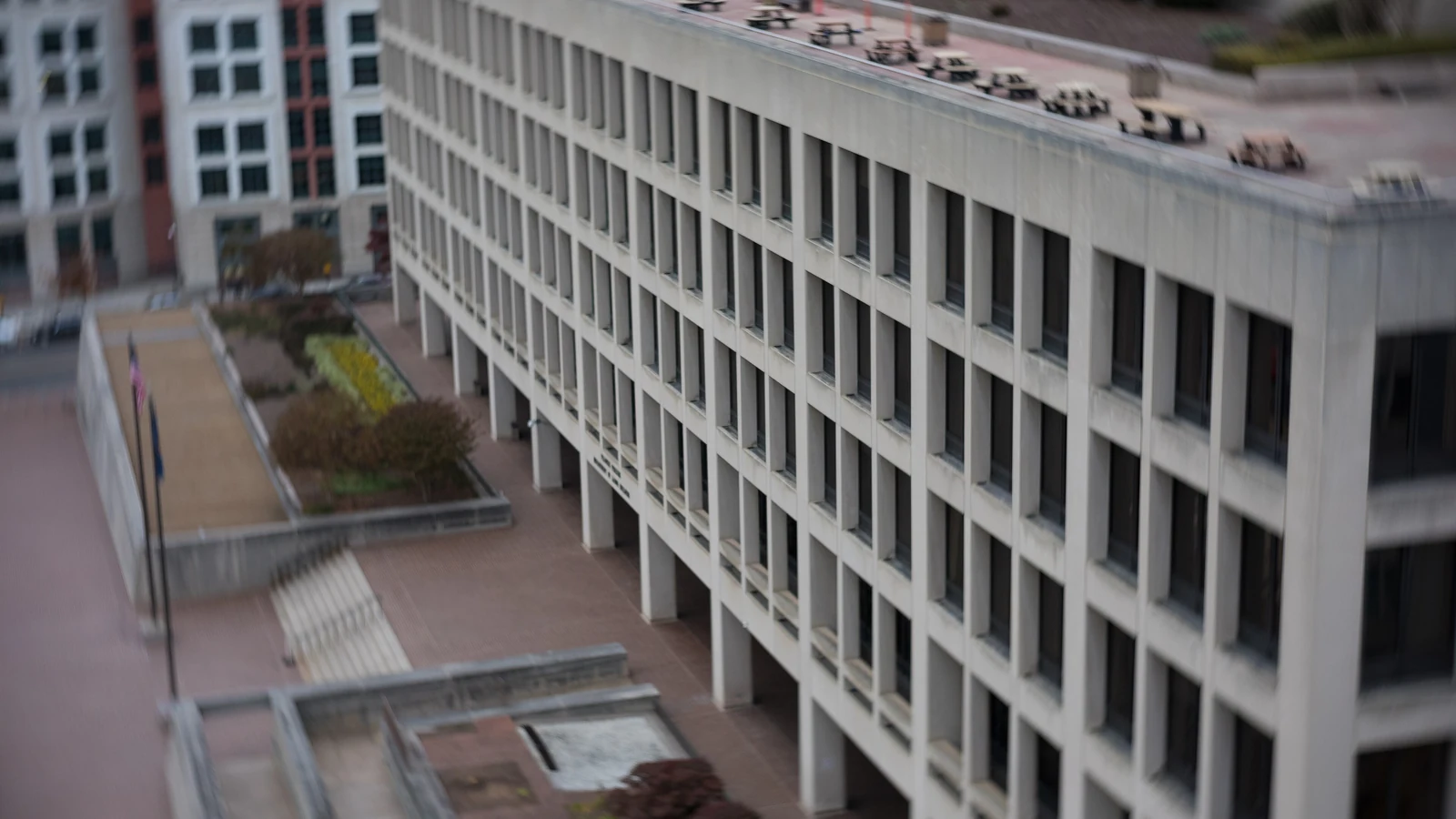
Hero photograph: the Frances Perkins Building, headquarters of the U.S. Department of Labor, photographed by Shawn T. Moore for the Department of Labor. Wikimedia Commons, licensed under CC BY 2.0. The image was cropped for presentation.
Continue reading
More from FederalHiringData

Data investigationsAugust 25, 2026
CFPB Lost 670 Covered Employees as Complaint Intake Reached 6.6 Million
Covered CFPB employment fell 38.2% while complaint intake reached 6.6 million and leadership narrowed supervision and enforcement priorities.
Data investigationsAugust 25, 2026
MSHA Recorded One Mine Inspector Accession and 140 Separations in 2025. Training Takes Two Years.
MSHA's newer inspector bench thinned sharply while the agency maintained a large mandatory-inspection program whose completion data remain difficult to verify.
Data investigationsAugust 23, 2026
USCIS Had 12.1 Million Cases Pending. Its Formal Backlog Was 7 Million.
Receipts exceeded completions by 929,000 in the first half of fiscal 2026 as covered employment remained 11% below its January 2025 peak.
Federal Hiring Data Weekly
Get the biggest federal workforce changes in your inbox.
Subscribe to Federal Hiring Data Weekly for federal hiring trends, salary data, agency movements, and original investigations, with email confirmation before delivery.