August 26, 2026
DOJ's Attorney-Misconduct Office Received 1,666 Complaints. It Opened Seven Investigations.
DOJ's attorney-misconduct intake reached a 21-year high as OPR opened seven investigations and the separate inspector general lost 99 covered employees.
By Evan Mercer
Published August 26, 2026Last edited August 26, 2026
The Justice Department's office for policing attorney conduct received more complaints in fiscal 2025 than in any other year covered by its public reports since 2005. It opened fewer full investigations than in any year in FederalHiringData's 15-year case-flow series.
The Office of Professional Responsibility received 1,666 complaints and opened seven investigations, according to its fiscal 2025 annual report. It also opened 35 preliminary inquiries. Complaints were up 24% from 1,346 in fiscal 2024 and 54% from 1,085 in fiscal 2023.
Those numbers describe a widening intake-to-investigation gap, but they do not show that 1,659 valid complaints were ignored. OPR says most incoming matters do not warrant further review because they are outside its jurisdiction, facially frivolous, vague or unsupported. A complaint can arrive in one year and produce an inquiry or investigation in another. One case can involve several allegations or attorneys. Seven investigations divided by 1,666 complaints is therefore a workload ratio, not a rejection rate, substantiation rate or measure of case quality.
The workforce context is harder to dismiss. Reuters reported on Aug. 6 that OPR's staff fell from 29 employees to 16, citing Justice Department records obtained through a public-records request. FederalHiringData could not independently reproduce that office-level series because public Office of Personnel Management records bundle OPR inside a larger Justice Department subelement.
The department's separate Office of the Inspector General is visible in OPM data. Its covered workforce fell from 577 employees in December 2024 to 478 in June 2026, a decline of 99, or 17.2%. Criminal investigators, student trainees, auditors and attorneys all declined. Yet the OIG continued issuing reports and closing investigations through March 2026. Its latest semiannual report counted 42 reports and 104 investigations closed.
That combination is the central finding: the Justice Department's two watchdog systems entered 2026 with fewer people and constrained intake or case-opening indicators, but the public record does not support the simpler claim that oversight stopped. It shows a capacity test whose consequences cannot be measured by one number.
Two offices, two different oversight jobs
OPR and OIG are often described together, but they are not interchangeable.
OPR is an internal Justice Department office established in 1975 after Watergate-era misconduct. Its principal jurisdiction covers professional misconduct by DOJ attorneys in the exercise of their authority to investigate, litigate or provide legal advice. It also covers related conduct by law-enforcement personnel when tied to attorney misconduct, as well as immigration judges and members of the Board of Immigration Appeals.
The OIG is a statutory inspector general. It audits and evaluates DOJ programs, investigates fraud, waste, abuse and misconduct involving other department personnel, runs a hotline, protects whistleblowers and reports to the attorney general and Congress. It has audit, investigations, evaluation and inspections, oversight and review, information technology, and management divisions.
| Oversight body | Core public jurisdiction | What its workload counts mean |
|---|---|---|
| Office of Professional Responsibility | Professional misconduct by DOJ attorneys in investigating, litigating or giving legal advice; related law-enforcement conduct | Complaints are intake. Inquiries are preliminary reviews. Investigations are full cases. Those stages are not one-to-one. |
| Office of the Inspector General | Waste, fraud, abuse, program performance and most non-attorney employee misconduct across DOJ | Reports, recommendations, employee complaints and investigations measure different products and caseloads. |
| Professional Misconduct Review Unit and component management | Reviews or acts on certain sustained OPR findings and discipline | A completed OPR investigation is not itself the final employment or bar outcome in every matter. |
That boundary matters when interpreting the numbers. OPR's 1,666 complaints cannot be added to OIG hotline complaints as if they came from one queue. OIG headcount cannot be used as a proxy for OPR staffing. And a reduction in one office does not establish what happened in the other.
OPR's complaint load reached a 21-year high
FederalHiringData transcribed complaint totals from every OPR annual report covering fiscal 2005 through 2025. The series ranged from a low of 636 in fiscal 2017 to 1,666 in fiscal 2025.
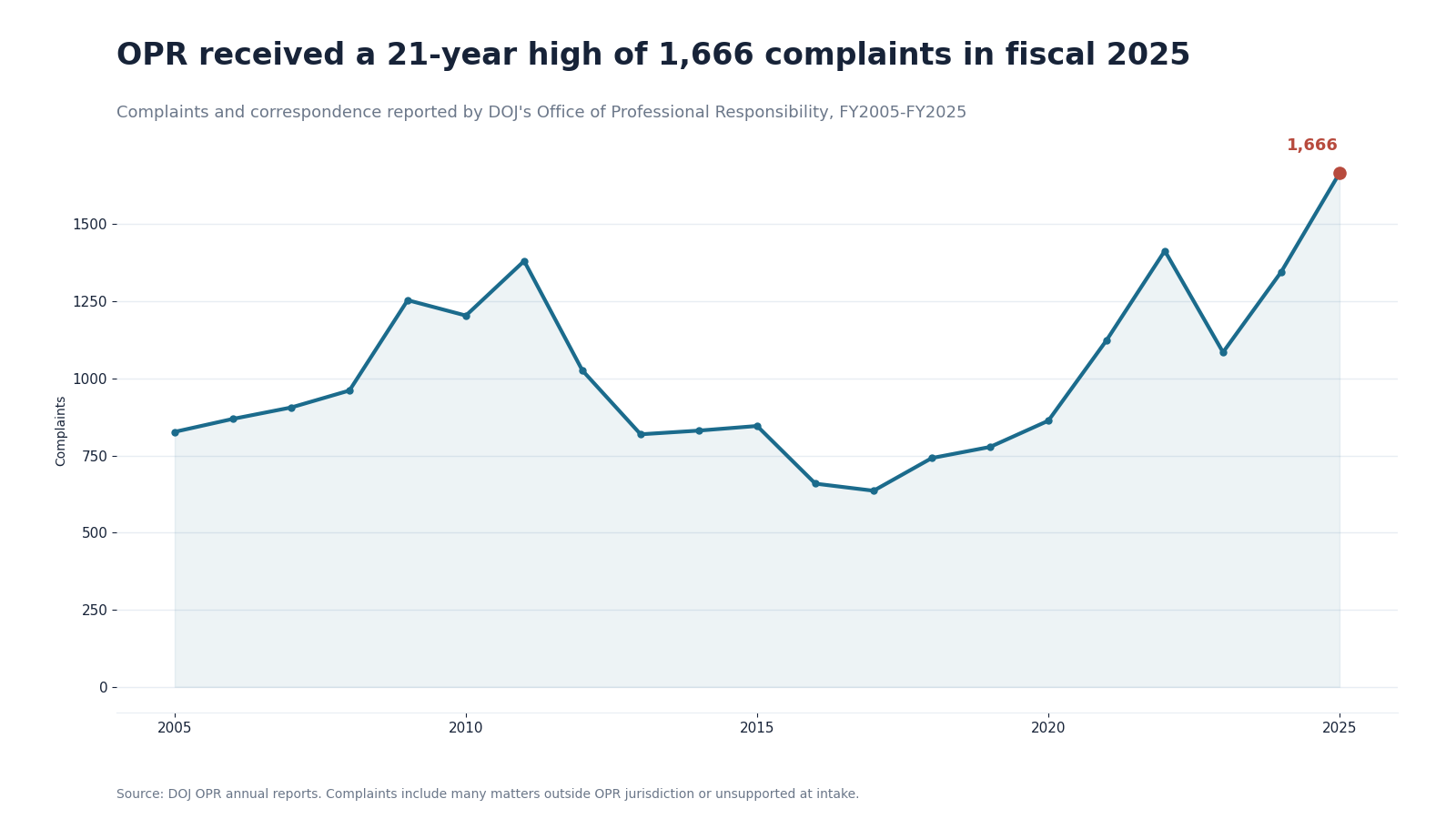
The latest increase was not a one-year break from an otherwise flat line. Complaints rose from 863 in fiscal 2020 to 1,124 in 2021 and 1,414 in 2022. They fell to 1,085 in 2023, then climbed to 1,346 in 2024 and 1,666 in 2025.
The annual reports do not publish a severity-adjusted intake measure. They also do not provide a public, complaint-level dataset showing source, date, subject, jurisdiction decision and final disposition. OPR says complaints can come from courts, DOJ components, department employees, Congress, private attorneys, litigants, criminal defendants, other agencies, media reports and members of the public. OPR also searches legal databases for judicial criticism and findings.
That breadth makes complaint volume a useful measure of intake pressure but a poor stand-alone measure of misconduct. A surge can reflect more alleged wrongdoing, greater public attention, repeated low-quality submissions, changes in referral practice, or some combination. The annual totals cannot separate those explanations.
The fiscal 2025 report identifies another contributor: an increase in FBI whistleblower-retaliation complaints. OPR closed 59 such matters during the year without finding retaliation, generally because the complainant had not made a protected disclosure or because evidence did not establish that an action was retaliatory. Those matters are part of OPR's wider responsibilities but are not identical to professional-misconduct investigations of department attorneys.
Seven investigations were the end of a longer decline
OPR's case-flow reports allow a 15-year comparison beginning in fiscal 2011. That year, the office opened 149 inquiries and 20 investigations. In fiscal 2013 it opened 93 inquiries and 33 investigations. Full investigation openings remained between 21 and 29 annually from fiscal 2014 through 2018, then dropped to 14 in 2019, 13 in 2020 and 10 in 2021.
The office opened 11 investigations in 2022, 10 in 2023, 18 in 2024 and seven in 2025.
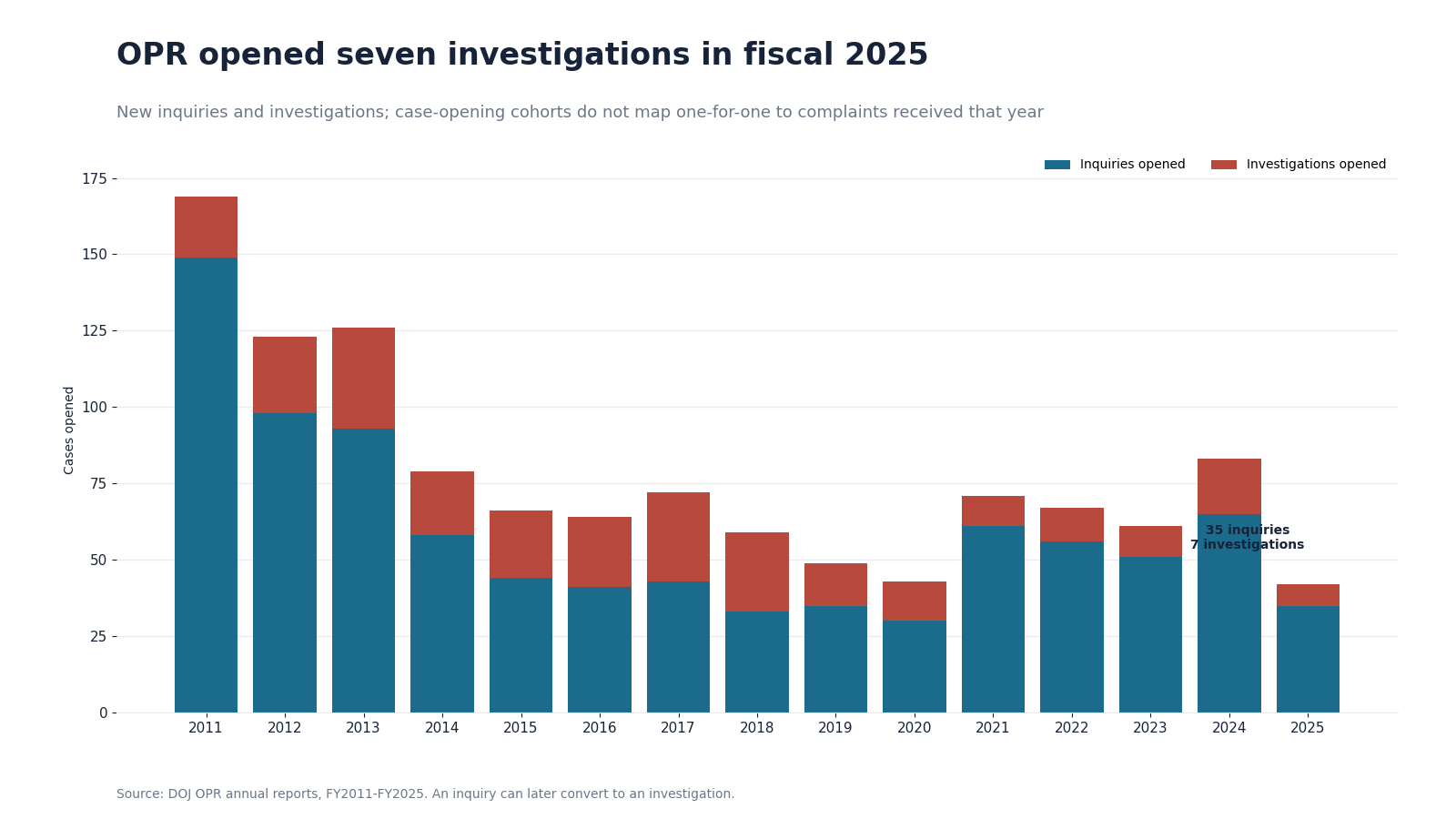
The decline is not fully explained by complaint volume. OPR received fewer complaints in 2017 than in any other year in the 21-year series, yet opened 29 investigations. In 2025, with record intake, it opened seven.
Expressed as a workload ratio, OPR opened about 0.42 investigations for every 100 complaints received in fiscal 2025. The comparable ratio was 4.56 per 100 in 2017, 3.50 in 2018, 1.80 in 2019 and 1.34 in 2024.
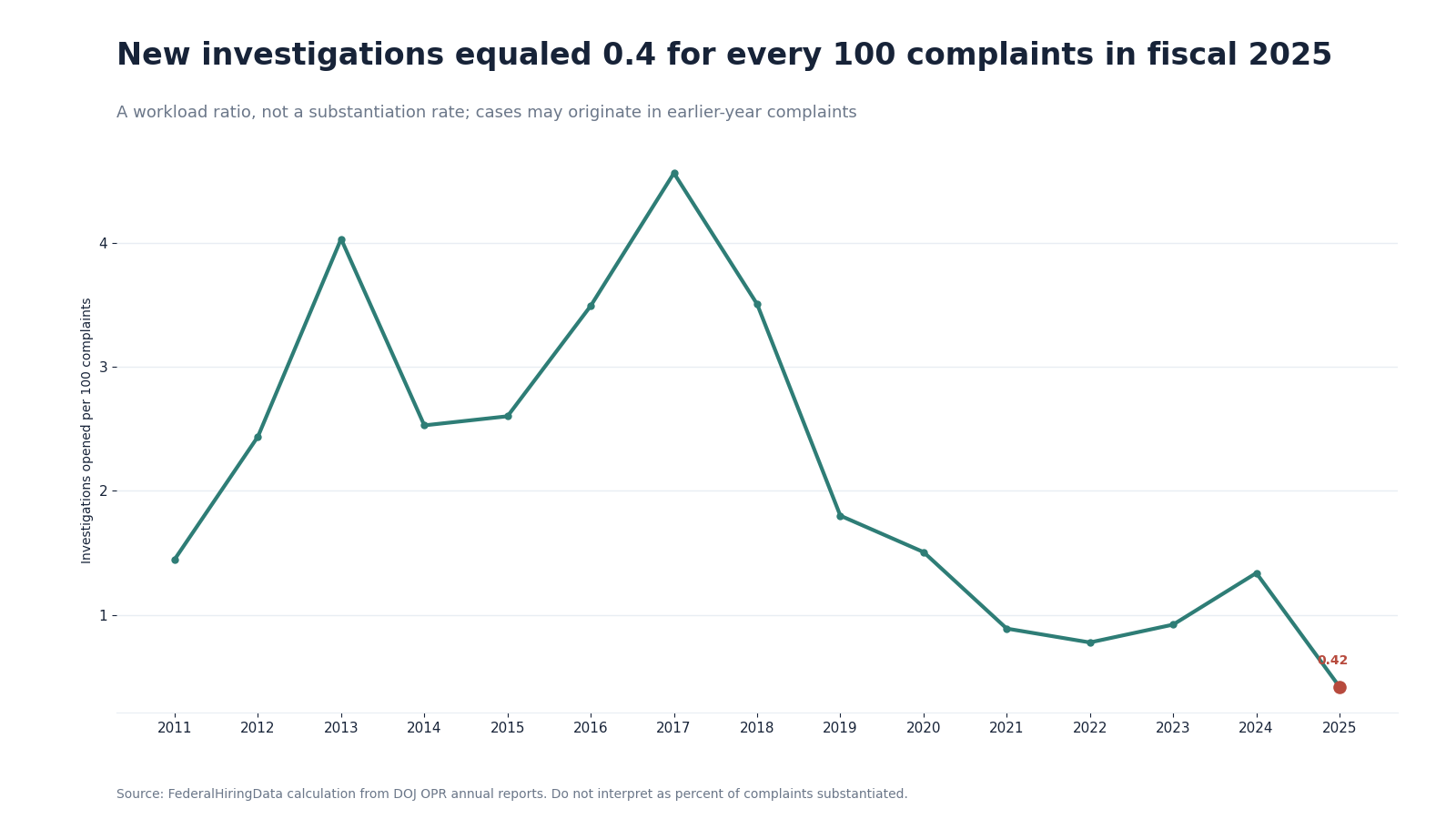
This ratio must be handled carefully. A complaint received late in September may not become a case until the next fiscal year. An inquiry can convert to an investigation. Several complaints can concern the same conduct, and a single case can contain several allegations. The line is best read as the relationship between annual intake pressure and annual new full-case workload, not as a funnel conversion rate.
OPR's closed-case results provide important counterevidence to a narrative of indiscriminate inaction. It completed 10 investigations in fiscal 2025 and found professional misconduct in nine. Six involved at least one finding of intentional misconduct and three involved reckless disregard of a clear obligation. The tenth resulted in a finding of poor judgment.
That 90% misconduct finding rate applies only to the 10 investigations closed, not to 90% of complaints. It shows how selective the full-investigation stage is. It does not tell the public whether selection was too narrow, how old those cases were, how many investigator hours they required or whether a larger staff would have opened more meritorious cases.
OPR staffing is material, but the public series is incomplete
Reuters reported that OPR shrank from 29 employees to 16 after January 2025, a 45% reduction. The news organization said it derived the figure from DOJ data obtained through a records request and interviewed former employees about departures.
FederalHiringData did not recreate that number from public OPM data. OPR is included within the broader OPM subelement labeled Offices, Boards and Divisions, alongside other DOJ offices. Treating that entire subelement as OPR would be wrong.
Older OPR annual reports also do not supply a comparable total-staff series. The fiscal 2012 and 2013 reports said OPR operated with 16 line attorneys assigned to investigations, down from 18 line attorneys plus four detailed or contract attorneys in fiscal 2011. That is an attorney-staff measure from a different period and definition. It should not be spliced onto Reuters' recent total-employee figures.
The defensible conclusion is narrower: a credible current report based on DOJ records indicates a steep OPR staff decline, while public data prevent outsiders from building a consistent long-run staffing series. That opacity itself limits accountability. OPR publishes extensive case narratives and annual flow counts, but not routine total staffing, workload age, time-to-close or caseload-per-investigator measures.
DOJ told Reuters that OPR remained committed to accountability and rigorously investigated misconduct allegations. The fiscal 2025 report says the office replaced obsolete case and document systems with new software providing stronger search and storage capabilities. Better systems may improve throughput, but the public record does not quantify any productivity gain from that upgrade.
The Inspector General lost 99 covered employees
Unlike OPR, the Office of the Inspector General has a distinct OPM organization code: DJ10. That makes its workforce measurable through monthly Federal Workforce Data.
OIG headcount rose from 444 in January 2015 to a peak of 583 in October 2024. It stood at 577 in December 2024, 530 in September 2025 and 478 in June 2026. The 99-person decline after December 2024 equals 17.2% of the office's covered workforce.
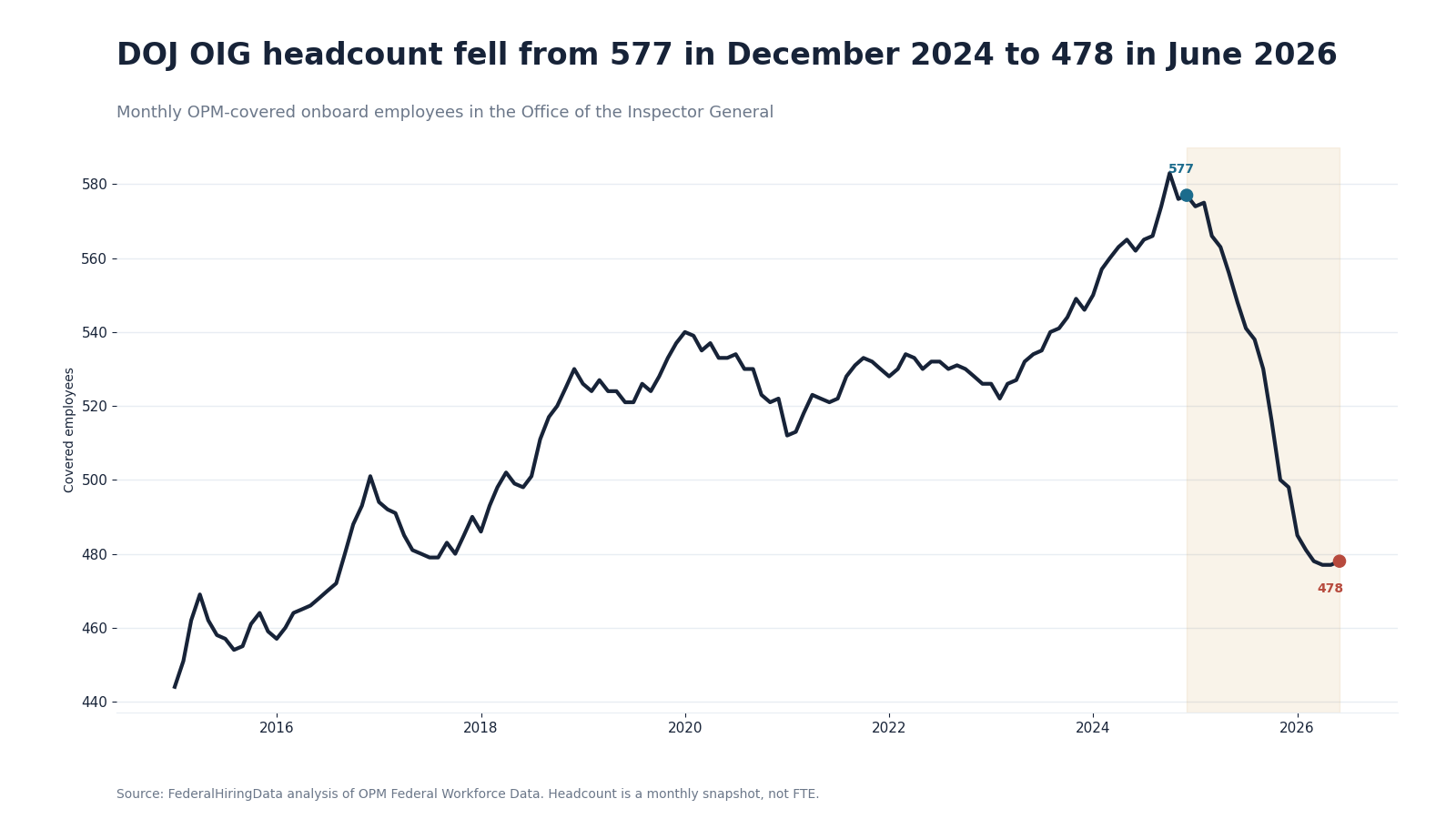
These are onboard employees in monthly snapshots, not full-time-equivalent staffing. A decline between snapshots is not a count of departures because hires and transfers can offset separations. The data also do not identify contractors or every reimbursable position.
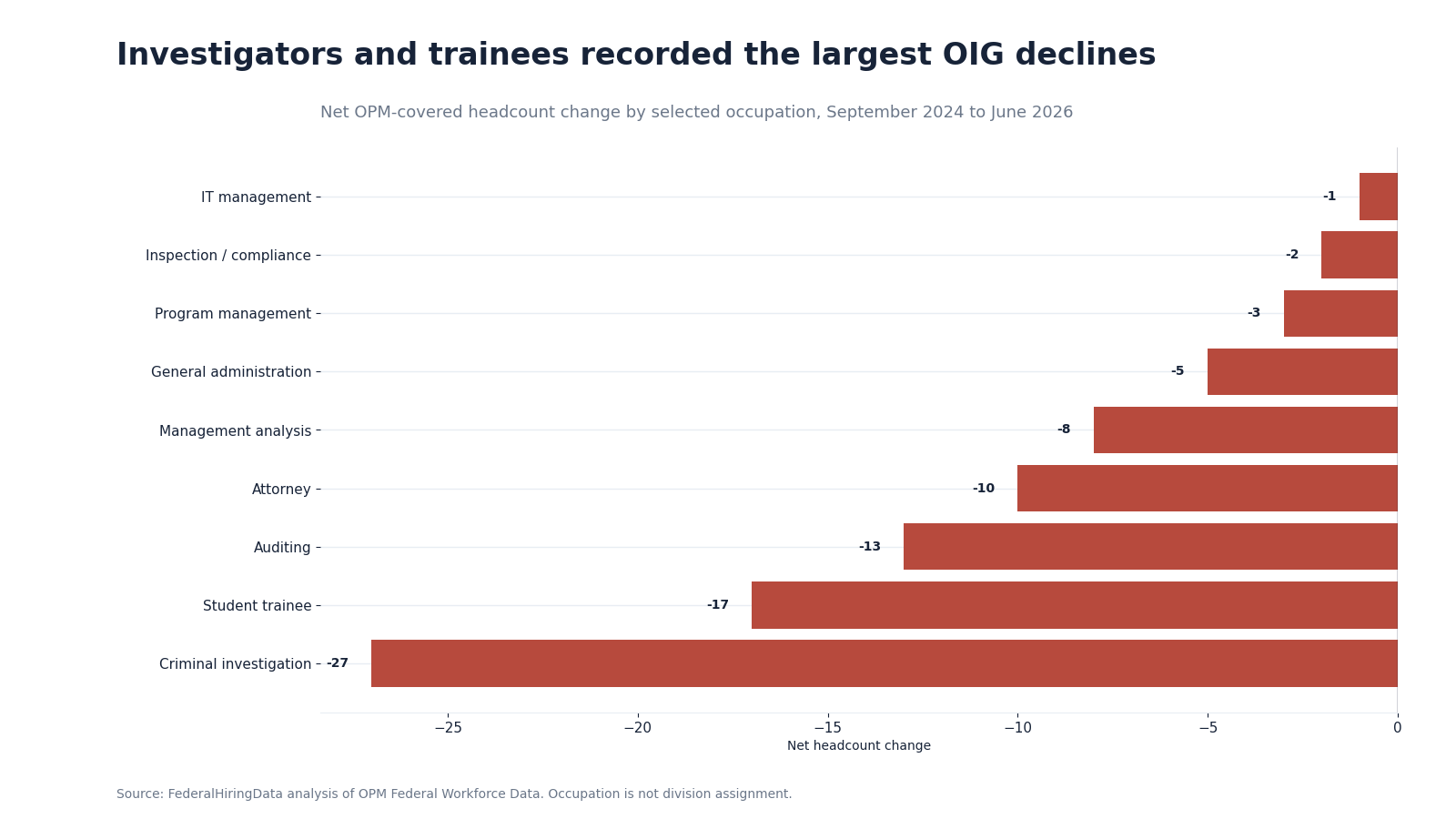
The occupational record shows where the net change occurred between September 2024 and June 2026. Series 1811 criminal investigators declined from 130 to 103. Student trainees fell from 22 to five. Auditors declined from 159 to 146, attorneys from 37 to 27 and management and program analysts from 43 to 35.
| Selected OIG occupation | September 2024 | June 2026 | Net change |
|---|---|---|---|
| Criminal Investigation, series 1811 | 130 | 103 | -27 |
| Student Trainee, series 0399 | 22 | 5 | -17 |
| Auditing, series 0511 | 159 | 146 | -13 |
| General Attorney, series 0905 | 37 | 27 | -10 |
| Management and Program Analysis, series 0343 | 43 | 35 | -8 |
| Information Technology Management, series 2210 | 42 | 41 | -1 |
Occupation is not division. An auditor may work on financial, performance or contract oversight; an attorney may support investigations, audits or management; and series 1811 employees do not represent every investigator. Still, the losses reached the professional groups that produce and support oversight work rather than falling only in generic administration.
Personnel actions show the replacement problem
OPM's accessions and separations data provide a second perspective. From fiscal 2016 through 2024, OIG accession and separation actions were generally much closer. In fiscal 2024, the office recorded 77 accessions and 49 separations.
Federal Hiring Data Weekly
Get the biggest federal workforce changes in your inbox.
Subscribe to Federal Hiring Data Weekly for federal hiring trends, salary data, agency movements, and original investigations, with email confirmation before delivery.
In fiscal 2025, it recorded 20 accession actions and 86 separations, a negative action balance of 66. In fiscal 2026 through June, it recorded 16 accessions and 56 separations. The partial-year figures cannot be compared directly with a completed fiscal year, but they show that the imbalance continued.
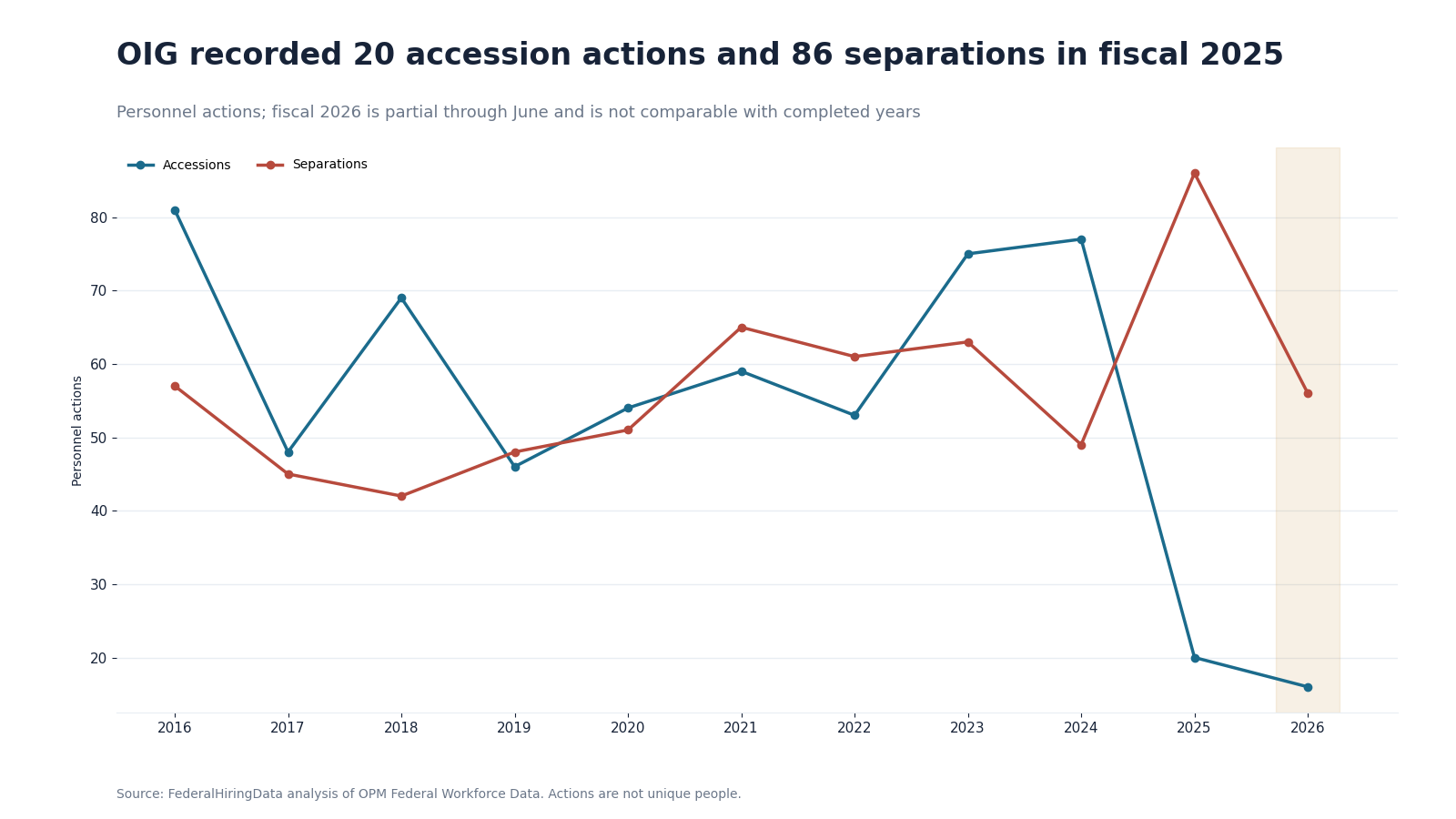
Actions are not unique people. An employee can appear in transfer categories, and aggregate action totals need not reconcile exactly to a pair of headcount snapshots. They nevertheless show the mechanism behind the net decline: incoming actions did not keep pace with outgoing actions.
The separation mix also matters. Calendar-year 2025 records include 31 quits, 29 voluntary retirements, 14 early retirements and 12 transfers out. Those categories do not establish why each person left, and they should not all be called layoffs or firings.
OIG output did not collapse with headcount
The latest five OIG semiannual reports complicate any claim that a smaller staff produced no oversight.
OIG issued 42 reports from October 2023 through March 2024, 44 in the next half-year, and 42 in each of the following three periods through March 2026. It closed 106 investigations in the first period, 116 in the second, 98 in the third and 104 in each of the two most recent periods.
New investigation openings declined from 133 in October 2023-March 2024 to 129, 95, 92 and 87 across the next four periods. Employee complaints received were 294, 348, 293, 314 and 238. Investigations in progress ended March 2026 at 521, down from 547 a year earlier.
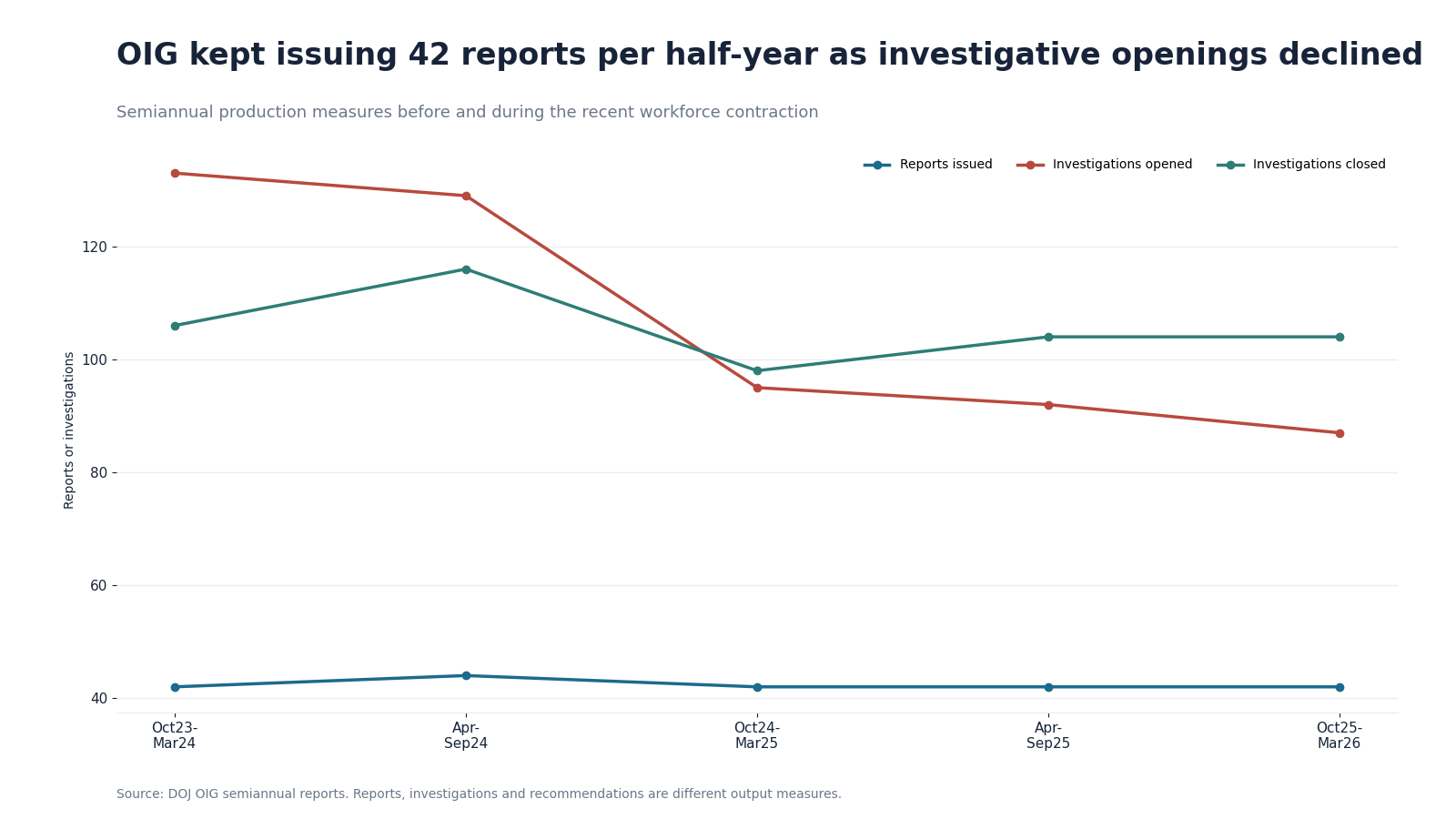
These measures do not establish productivity per employee. A report can be a complex departmentwide review or a narrower grant audit. Investigations can differ greatly in duration and difficulty. Some work completed after the workforce decline was produced by employees who had already left. Maintaining report counts for several periods does not prove that reduced staffing has no future consequence.
It does establish that the office remained operational. In the latest period, OIG issued 108 recommendations, opened 87 investigations, closed 104 and reported 521 still in progress. As of June 30, 2026, its public tracker listed 595 open recommendations across DOJ. A smaller workforce must not only produce new oversight; it must also monitor whether components implement prior recommendations.
On Aug. 14, the Senate-confirmed inspector general, Don Berthiaume, was sworn in. He simultaneously released principles for effective oversight, including independence, evidence-based matter selection, disciplined scope, balanced reporting and attention to limited resources. Leadership stability is relevant, but it does not replace workforce capacity.
The budget request would make the constraint larger
DOJ's fiscal 2027 OIG budget exhibits show 560 direct positions enacted for fiscal 2026 and an estimated 541 direct full-time equivalents, plus 22 reimbursable FTE. The fiscal 2027 request proposes 403 direct positions and 403 direct FTE, plus 22 reimbursable FTE.
That is a request, not enacted law and not current headcount. Positions are authorized slots; FTE measures labor time over a year; OPM headcount counts covered people on board at a monthly snapshot. The three measures should not be treated as interchangeable.
If enacted and executed as requested, however, 403 direct positions would be 157 below the 560 enacted for fiscal 2026, a 28% reduction in direct positions. The request therefore points toward a smaller authorized structure than the one already associated with the workforce decline through June.
Public recruiting slowed, then reappeared in early 2026
FederalHiringData's historical USAJOBS archive contains 861 distinct announcements from DOJ OIG opened between March 2017 and April 2026. Annual counts rose from 65 in the partial 2017 period to 128 in 2023 and 108 in 2024. The archive contains nine opened in 2025 and 32 in 2026 through April.
The early 2026 announcements included criminal investigators, IT cybersecurity specialists, attorneys, an auditor, a statistician/data scientist, an investigative specialist and management roles. Nine were tagged to series 1811 Criminal Investigation and eight to series 2210 Information Technology Management.
Announcements do not equal vacancies or hires. One posting can seek multiple people, produce no selection or fill future needs. Recruiting can also occur outside public competitive announcements. The archive therefore cannot show that OIG planned to replace exactly 32 people. It does show that the office was publicly recruiting for oversight and technical roles after the steep 2025 slowdown.
The action data are the stronger staffing measure: 16 accession actions through June 2026 versus 56 separations. Public postings alone had not restored the onboard workforce by the latest OPM snapshot.
Congress is still debating who should investigate DOJ attorneys
The workforce question sits inside a longstanding jurisdictional dispute.
Related research
Put this finding in context
Data investigationsAugust 25, 2026
CFPB Lost 670 Covered Employees as Complaint Intake Reached 6.6 Million
Covered CFPB employment fell 38.2% while complaint intake reached 6.6 million and leadership narrowed supervision and enforcement priorities.
Data investigationsAugust 23, 2026
Commerce Has 49 CHIPS Projects to Monitor. Its Program Office Lost More Than Half Its Staff.
Commerce's semiconductor awards have become a years-long monitoring operation, but the program office entered that phase after losing more than half its employees.
Under current law, DOJ OIG is the only major federal inspector general barred from independently investigating certain professional misconduct by agency attorneys acting as lawyers. Those allegations go to OPR. A bipartisan Inspector General Access Act of 2025 would remove that carveout and allow OIG to investigate attorney misconduct. The bill was introduced in December 2025 and referred to the Senate Judiciary Committee; it had not become law by publication.
OPR's fiscal 2025 annual report states DOJ's opposing position. The department argues that OPR has specialized attorney-ethics expertise and that extending OIG jurisdiction would add bureaucracy, duplicate resources and undermine a system developed over five decades. OIG supporters argue that statutory inspector-general independence should cover lawyers as it covers other DOJ employees.
The data do not settle that institutional question. They do show why capacity has become part of it. Expanding OIG's jurisdiction without resources could move workload rather than solve it. Preserving exclusive OPR jurisdiction without publishing adequate staffing and performance measures leaves the public unable to assess whether the office can handle record intake.
A useful reform debate should therefore ask two questions together: which office should have authority, and what staff, case-management capacity, transparency and independence does that office need to exercise it credibly?
What the evidence supports
The evidence supports five conclusions.
First, OPR's complaint intake reached a genuine high. The 1,666 complaints in fiscal 2025 exceeded every annual total in the published 2005-2025 series.
Second, new full investigations reached a genuine low in the available case-flow record. Seven was below every annual count from fiscal 2011 through 2025, and Reuters' broader annual-report review described it as the lowest in two decades.
Third, the complaint-to-investigation comparison is not a measure of ignored valid cases. Intake contains many matters outside OPR's remit or unsupported on initial review. Closed investigations were highly selected: nine of 10 produced misconduct findings in fiscal 2025.
Fourth, DOJ's separate inspector general experienced a measurable workforce contraction. It had 99 fewer covered employees in June 2026 than in December 2024, with losses among investigators, trainees, auditors and attorneys. Accessions remained below separations.
Fifth, OIG's published output did not disappear. It continued issuing reports, recommendations and investigative products, while carrying more than 500 investigations in progress and hundreds of open recommendations requiring follow-up.
What the evidence does not show is whether any specific allegation should have been opened, whether staff losses caused an individual case decision, whether report quality changed, or whether misconduct increased in direct proportion to complaint volume. Those questions require complaint-level and case-management information that is not public.
What stronger oversight reporting would disclose
OPR could improve public accountability without naming subjects or compromising investigations. A useful annual table would report total staff and investigative staff, vacancies, complaint age, inquiries and investigations by source cohort, median time to disposition, pending-case age, referrals, final department action and the number of matters outside jurisdiction. Historical definitions should remain stable enough to compare across administrations.
OIG already publishes considerably more operational detail, but it could connect workforce capacity to output more clearly: staffing and vacancies by division, report and investigation age, recommendation follow-up workload, hotline intake dispositions and how lapses in appropriations or hiring constraints affected timeliness.
Both offices could explain handoffs between them and publish aggregate counts of referrals accepted, declined or returned. That would make the jurisdictional boundary visible in practice rather than only in policy.
The objective is not a scoreboard that rewards more investigations regardless of merit. Effective oversight should screen weak complaints, protect subjects and whistleblowers, prioritize serious risks and produce fair findings. The public needs enough consistent information to distinguish disciplined selection from capacity-driven retreat.
Today, it cannot fully do that. It can see record OPR intake, seven new investigations, a reported 45% staff reduction, a 17% OIG headcount decline and continued OIG output. Those facts establish pressure. They do not reveal how close either office is to its operational limit.
Methodology and limitations
FederalHiringData transcribed OPR complaint totals from the office's fiscal 2005 through 2025 annual reports and inquiry and investigation flows from fiscal 2011 through 2025. Annual reports can revise terminology and presentation. The archived tables preserve each year's published figures.
Complaints, inquiries and investigations are not sequential annual cohorts. A complaint can be outside jurisdiction or unsupported; an inquiry can later become an investigation; and a case can involve multiple allegations or subjects. The investigations-per-100-complaints figure is a workload ratio only.
The 29-to-16 OPR staffing figure is attributed to Reuters and DOJ records obtained through a public-records request. Public OPM data do not isolate OPR, so FederalHiringData did not blend that figure with older annual-report counts of line attorneys.
OIG workforce estimates use agency subelement DJ10 in OPM Federal Workforce Data. Headcount is covered employees on board in a monthly snapshot. Occupation does not reveal division or assignment. Accessions and separations are personnel actions rather than unique people and need not exactly reconcile to changes between snapshots.
OIG workload measures come from five consecutive semiannual reports covering October 2023 through March 2026. Reports, recommendations, complaints and investigations describe different work products and cannot be combined into one productivity score.
USAJOBS counts are distinct control numbers in the FederalHiringData archive. Coverage begins in March 2017, and 2026 is partial through April for DOJ OIG announcements. Postings are not applications, vacancies or hires.
Budget figures are from DOJ's fiscal 2027 congressional justification. The fiscal 2027 request was not enacted at publication. Position, FTE and headcount figures use different definitions.
FederalHiringData preserves the source inventory, evidence ledger, analysis SQL, extracted tables and chart inputs for this investigation. Readers can also explore current federal jobs, federal workforce statistics, department and agency records and other data investigations.
Continue reading
More from FederalHiringData
Data investigationsAugust 25, 2026
The Civil Rights RIF Was Rescinded. OCR's Workforce Still Fell 50%.
Education rescinded its Office for Civil Rights RIF, but OPM data show the component had 298 fewer covered employees by June 2026 as complaint timeliness worsened.

Data investigationsAugust 26, 2026
DOJ Runs 1,663 Task Forces. The Four Components Leading Them Have Shed 3,444 Employees Since 2024.
DOJ's task-force network extends federal authority through thousands of nonfederal officers, but public records cannot measure the full hybrid workforce.
Data investigationsAugust 25, 2026
CDC Lost 3,636 Covered Employees. Health Science Took the Largest Hit.
CDC's covered workforce fell 28% after December 2024. Health-science and public-health program roles led the losses, while recruiting nearly stopped.
Federal Hiring Data Weekly
Get the biggest federal workforce changes in your inbox.
Subscribe to Federal Hiring Data Weekly for federal hiring trends, salary data, agency movements, and original investigations, with email confirmation before delivery.