August 26, 2026
DOJ Runs 1,663 Task Forces. The Four Components Leading Them Have Shed 3,444 Employees Since 2024.
DOJ's task-force network extends federal authority through thousands of nonfederal officers, but public records cannot measure the full hybrid workforce.
By Evan Mercer
Published August 26, 2026Last edited August 26, 2026
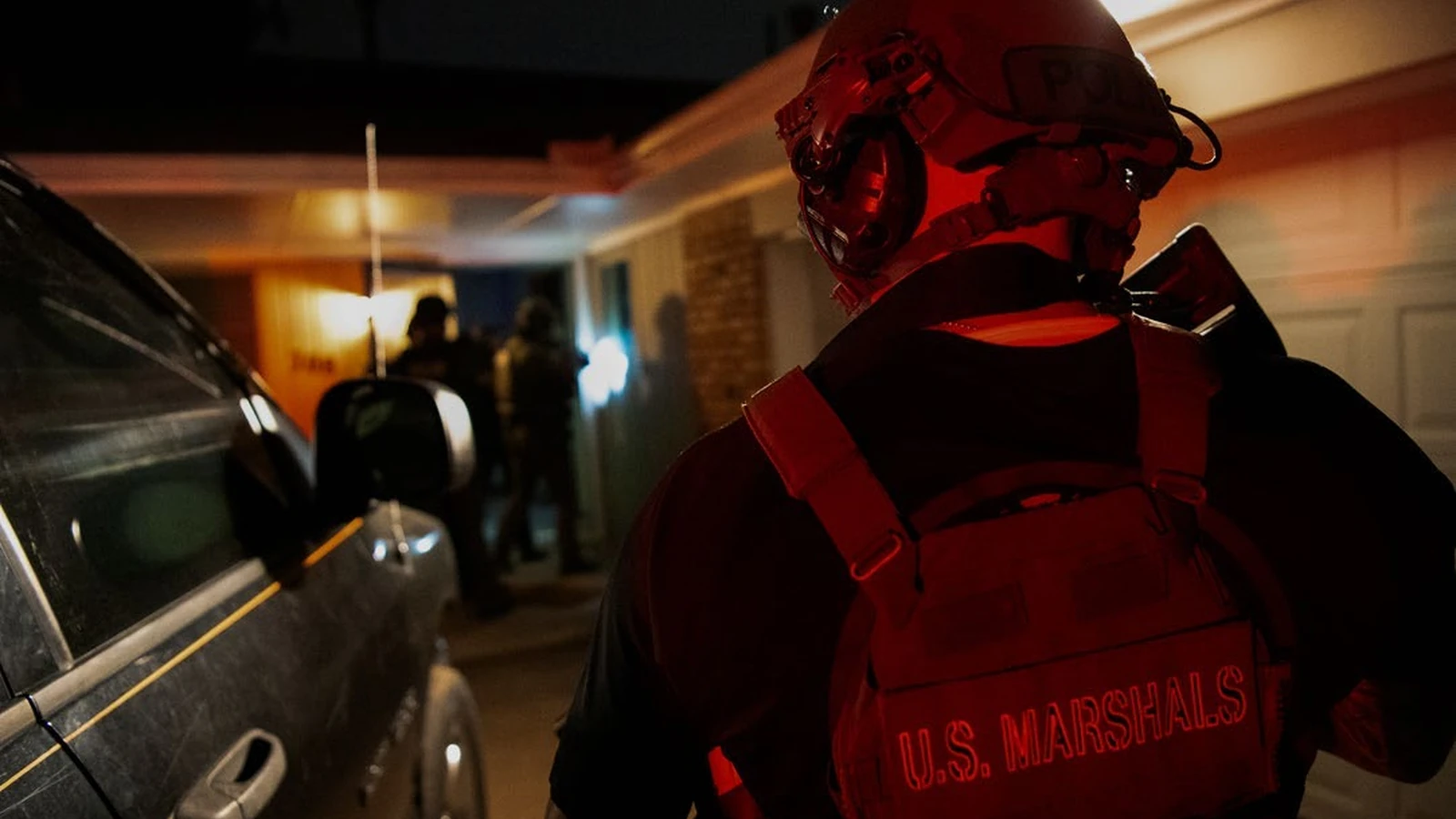
The Justice Department's task-force system is larger than the federal workforce figures normally used to describe it.
The FBI, Drug Enforcement Administration, Bureau of Alcohol, Tobacco, Firearms and Explosives, and U.S. Marshals Service led 1,663 active task forces as of April 2026, according to a new Government Accountability Office review. Those operations paired federal personnel with thousands of deputized officers from state, local, tribal and territorial agencies. The four components allocated nearly $2 billion to task forces in fiscal 2025 from several funding sources.
Yet there is no public, comparable headcount for the hybrid workforce carrying out that work. Federal employment data count federal employees. Deputation records count grants and renewals of legal authority, not unique people. Task-force lists count teams, not staffing. The public cannot add those measures together and arrive at a defensible number of officers.
That measurement gap has become more important as the federal side of the network has contracted. FederalHiringData's analysis of Office of Personnel Management records found that the four lead components had 53,724 covered civilian employees in June 2026, down 3,444, or 6.0%, from September 2024. Their criminal-investigator workforce fell by 1,156 over the same period. The decline does not prove that task-force staffing or operational capacity fell by the same amount. OPM does not identify task-force assignments, and a smaller federal workforce could be distributed differently among missions.
The timing nevertheless sharpens the oversight question raised by GAO. Nonfederal task-force officers can exercise federal authority, participate in federal investigations and work under federal supervision. GAO found that ATF, DEA and the FBI did not require those officers to finish initial training on federal authorities and policies before participating in operations that used their deputation authority. The Marshals Service did.
DOJ agreed with all seven GAO recommendations. As of Aug. 26, each recommendation remained open.
The issue is not whether partnerships are useful. GAO said local officers provide regional knowledge and investigative help that federal components value. The issue is whether a vast, distributed workforce is being measured, trained and overseen with safeguards proportionate to the authority it exercises.
A national network with four federal anchors
The FBI led 772 task forces, nearly half of the total. DEA led 422 and ATF led 404. The Marshals Service led 65.
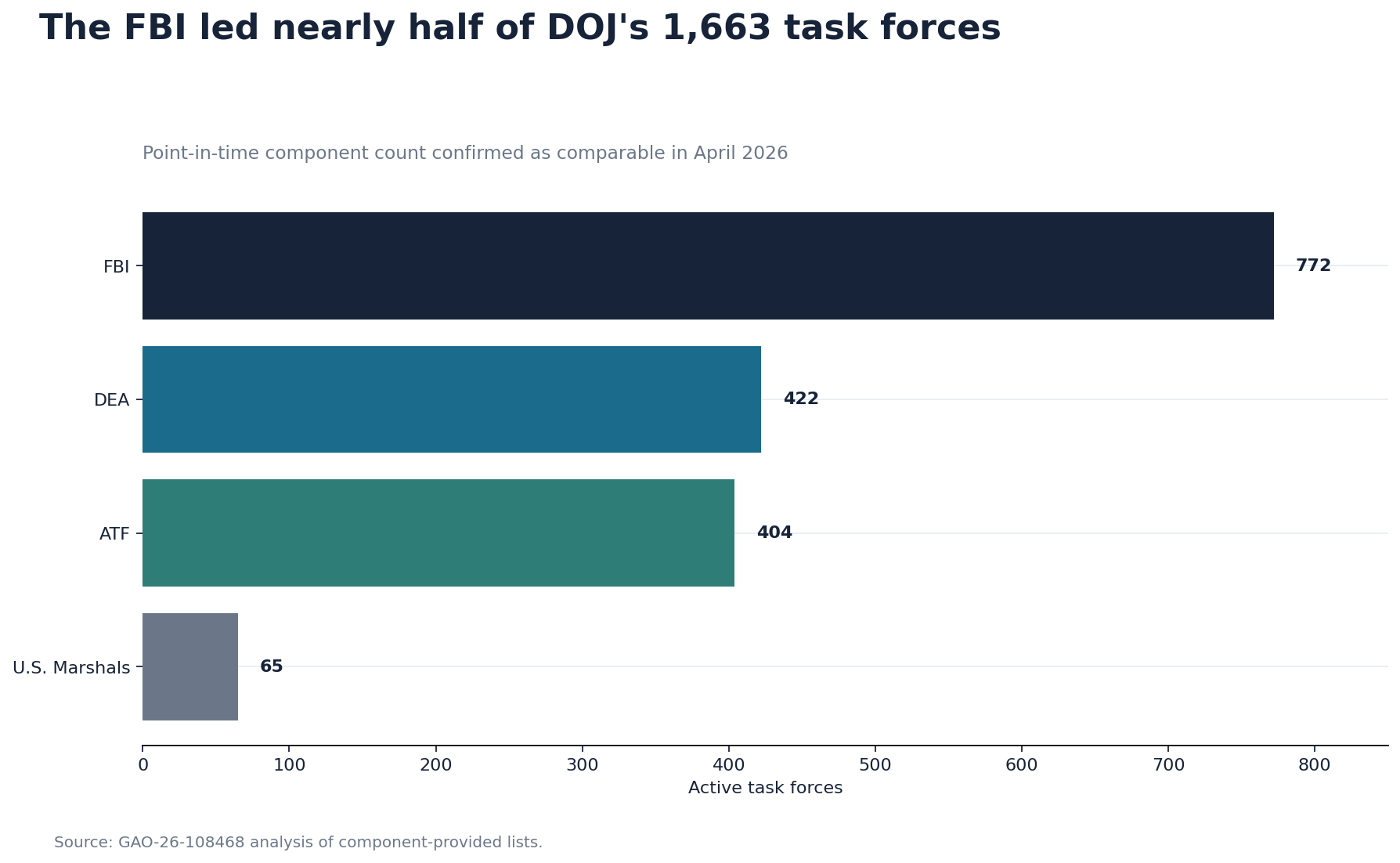
GAO did not derive the 1,663 total from one live departmentwide database. It collected component lists between May and December 2025 and asked the components to confirm in April 2026 that the figures remained comparable. The count is therefore a carefully reconciled point-in-time inventory, not a continuous operating total.
| Lead component | Active task forces | June 2026 covered employees | June 2026 criminal investigators, series 1811 | June 2026 intelligence employees, series 0132 |
|---|---|---|---|---|
| FBI | 772 | 35,334 | 12,792 | 3,570 |
| DEA | 422 | 8,488 | 4,075 | 220 |
| ATF | 404 | 4,504 | 2,312 | 136 |
| U.S. Marshals Service | 65 | 5,398 | 3,631 | 89 |
| Total | 1,663 | 53,724 | 22,810 | 4,015 |
The columns describe different universes. A task force can be large or small. Covered employee counts include occupations that may never work on a task force. Series 1811 and 0132 identify job families, not assignments. Nonfederal officers do not appear in the OPM headcount.
The mission inventory shows where the network is concentrated. Drug crime accounted for 436 task forces, violent crime for 283, gun crime for 220 and gang crime for 192. Together those four categories represented 1,131 task forces, or 68.0% of the total. Financial, fraud and theft investigations accounted for 118; organized crime, 103; child exploitation, 85; cyber and technology, 69; counterintelligence and counterterrorism, 56 each; and arson and explosives, 45.
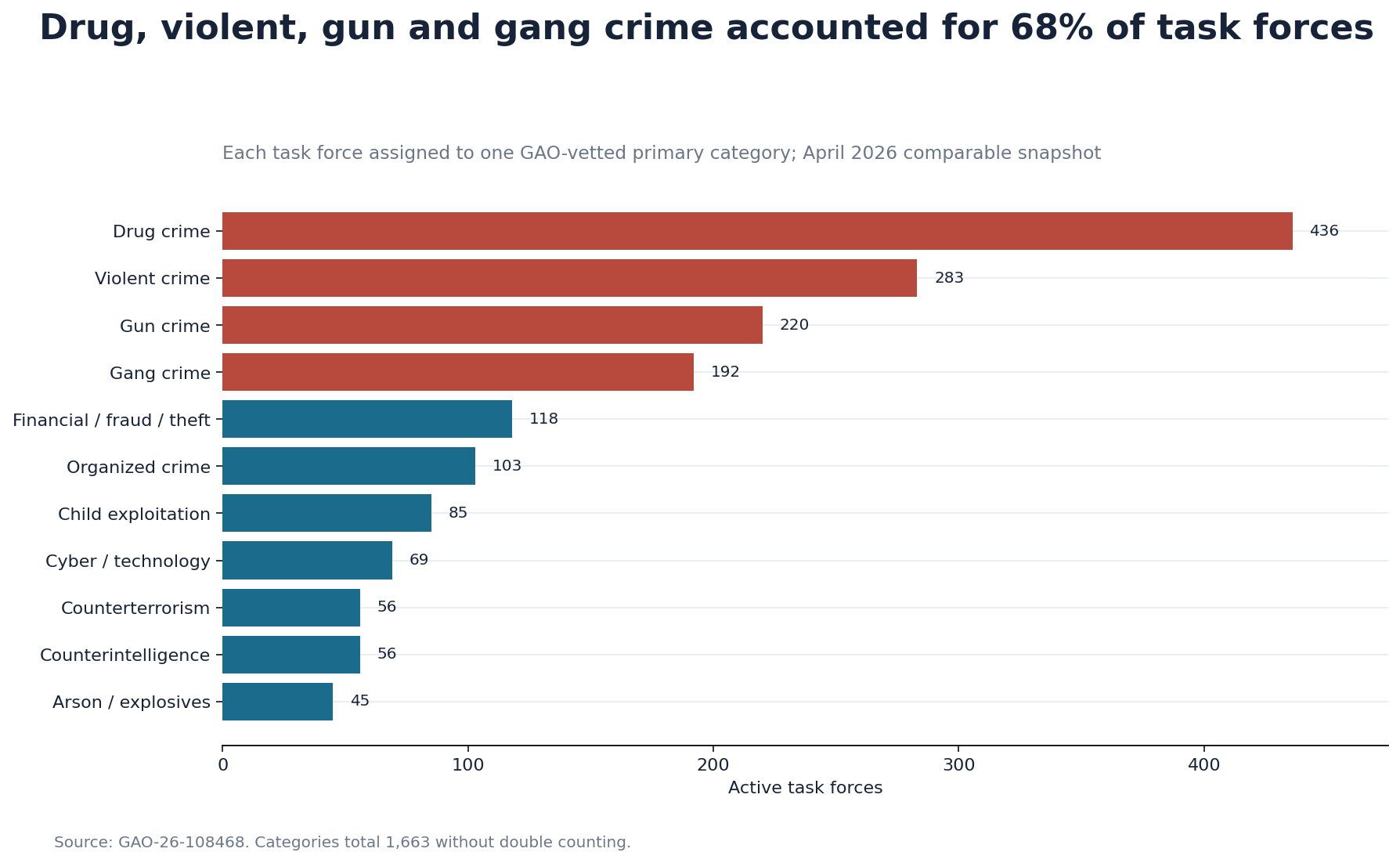
GAO assigned each task force to one primary category so the mission bars sum to 1,663 without double counting. Real investigations can cross those boundaries. A violent-crime task force may encounter guns, drugs or gangs; a cyber case can include fraud or national-security concerns. The chart describes the official primary classification, not every activity undertaken by each team.
The nonfederal workforce is visible only in fragments
Deputation is what makes the hybrid model possible. A state or local officer may receive authority to perform specified federal law-enforcement functions while serving under federal supervision. Different statutes and components create different records.
GAO reported that the Marshals Service issued approximately 25,000 Title 18 deputations from fiscal 2021 through 2025. DEA issued nearly 10,000 Title 21 deputations over that period. The FBI issued nearly 13,000 Title 21 deputations.
Those numbers cannot be added into 48,000 officers.
The Marshals Service series includes renewals. The FBI series includes renewals and federal officers, not only nonfederal participants. One person can receive both Title 18 and Title 21 authority or appear more than once over five years. ATF's process also differs and does not create a fourth directly comparable series in the report.
| Public measure | What it establishes | What it does not establish |
|---|---|---|
| 1,663 active task forces | Number of component-led teams in GAO's comparable April 2026 inventory | Officers assigned, hours worked or workload per team |
| Approximately 25,000 USMS Title 18 deputations, FY2021-25 | Volume of recorded grants and renewals of authority | Unique currently serving nonfederal officers |
| Nearly 10,000 DEA Title 21 deputations, FY2021-25 | Volume of DEA deputations over five fiscal years | A point-in-time DEA task-force workforce |
| Nearly 13,000 FBI Title 21 deputations, FY2021-25 | Volume including renewals and federal officers | A unique nonfederal-officer count |
| OPM employment headcount | Covered federal civilian employees on board in a monthly snapshot | State, local, tribal or territorial task-force officers |
This is more than a technical footnote. The number most readers want to know is how many people are actually working in the network, how that staffing varies by mission and whether the mix has changed as federal headcount changed. The public records reviewed for this article cannot answer those questions.
GAO's fieldwork provides a small window. At five of the eight task forces in its nongeneralizable sample, supervisors oversaw between four and 14 nonfederal task-force officers. All eight had federal supervision. The sample was designed to examine policies and practices, not to estimate national staffing, so multiplying those figures across 1,663 task forces would be invalid.
The result is a system whose legal reach is documented more clearly than its human scale. DOJ can identify the teams and components can identify deputations. OPM can identify federal employees. No public bridge joins those records into one workforce measure.
Federal headcount grew over decades, then turned down
The longer federal record differs substantially by component.
The FBI's covered civilian headcount rose from 27,362 in September 2000 to 37,414 in September 2024, before falling to 35,334 in June 2026. DEA rose from 8,850 to a 2010 level of 9,939 and ended June 2026 at 8,488, below its 2000 count. The Marshals Service rose from 4,024 in 2000 to 5,398 in June 2026. ATF's Justice Department series begins in 2003, after its transfer from Treasury; it moved from 4,728 then to 5,298 in September 2024 and 4,504 in June 2026.
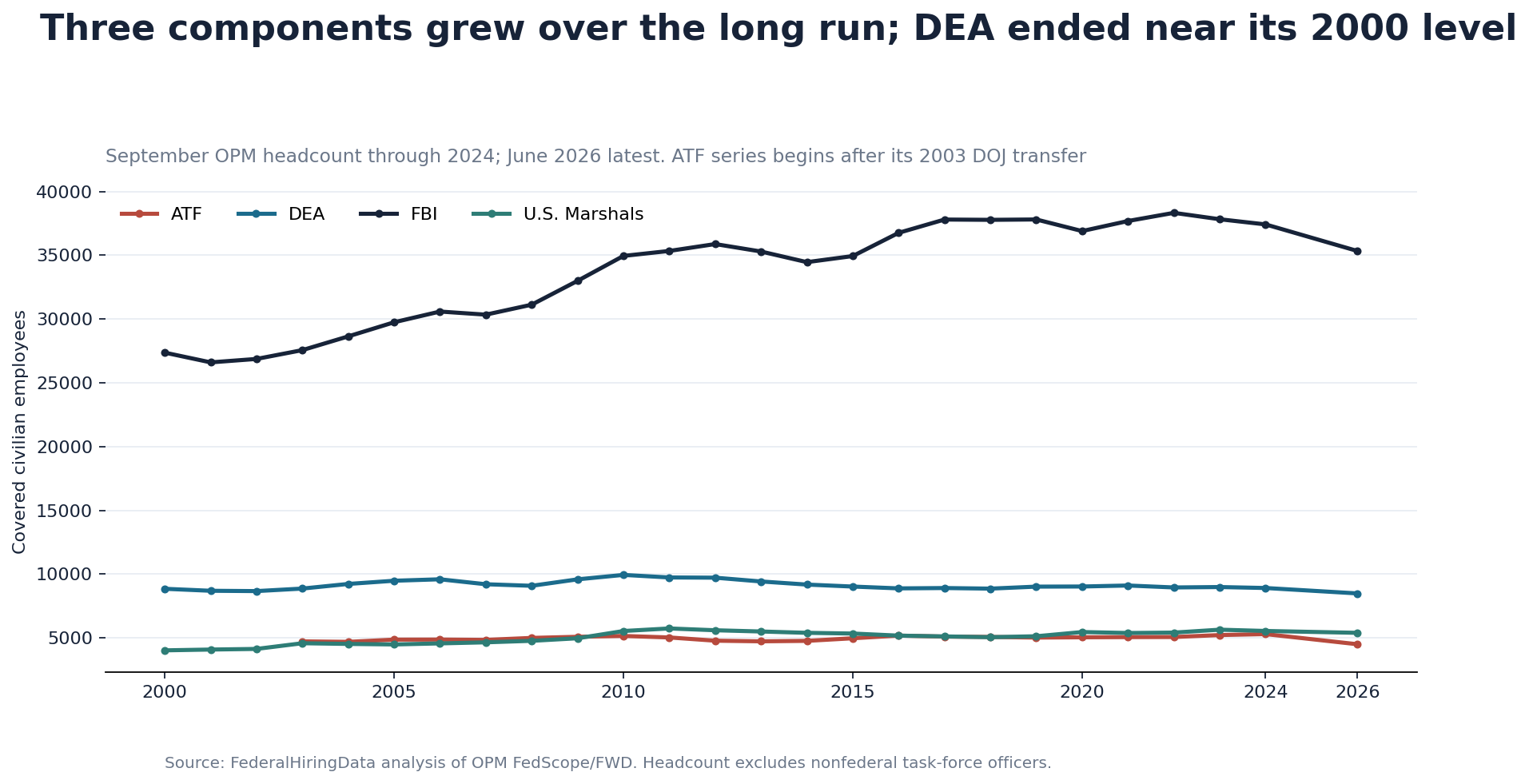
The four-component total fell from 57,168 in September 2024 to 55,936 a year later and 53,724 in June 2026. Every component was lower in the latest snapshot: the FBI by 2,080, ATF by 794, DEA by 424 and the Marshals Service by 146.
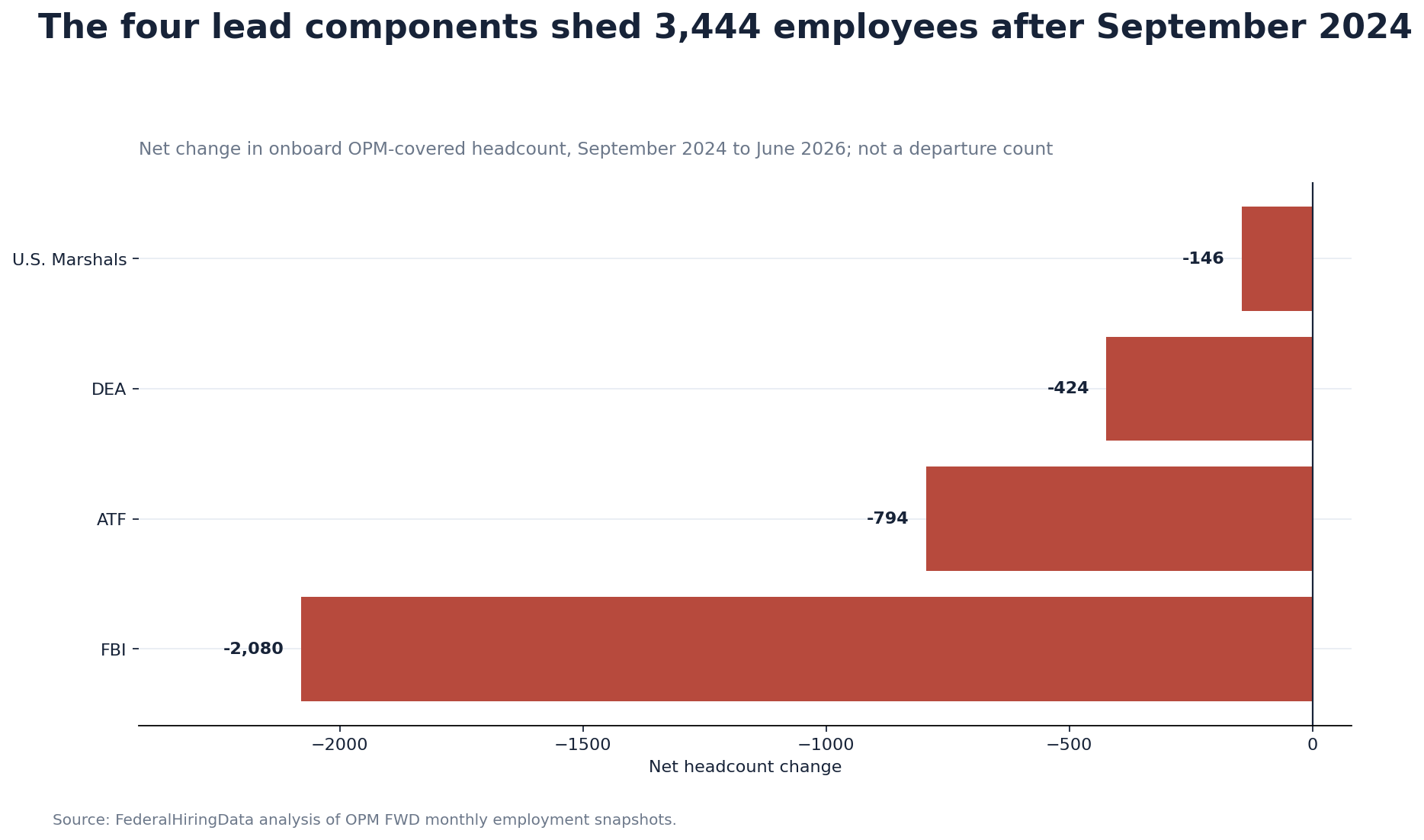
These are net changes between employment snapshots, not counts of people who left. Accessions, transfers and other gains offset some separations. Organizational and coverage changes can also affect a series. The 6.0% decline should not be described as 3,444 departures or as a direct reduction in task-force staffing.
The occupational detail still shows that the contraction reached the federal job families most plausibly connected to investigative work. Series 1811 criminal investigators declined from 23,966 across the four components in September 2024 to 22,810 in June 2026, a reduction of 1,156, or 4.8%. Series 0132 intelligence employees declined from 4,411 to 4,015, a reduction of 396, or 9.0%.
Those groups are not interchangeable with task-force personnel. Criminal investigators can work many matters outside formal task forces, and a task force can include attorneys, analysts, administrative staff, local detectives and officers from other federal agencies. The occupational trend is relevant context, not a staffing census.
Fiscal 2025 produced an unusually large personnel-action gap
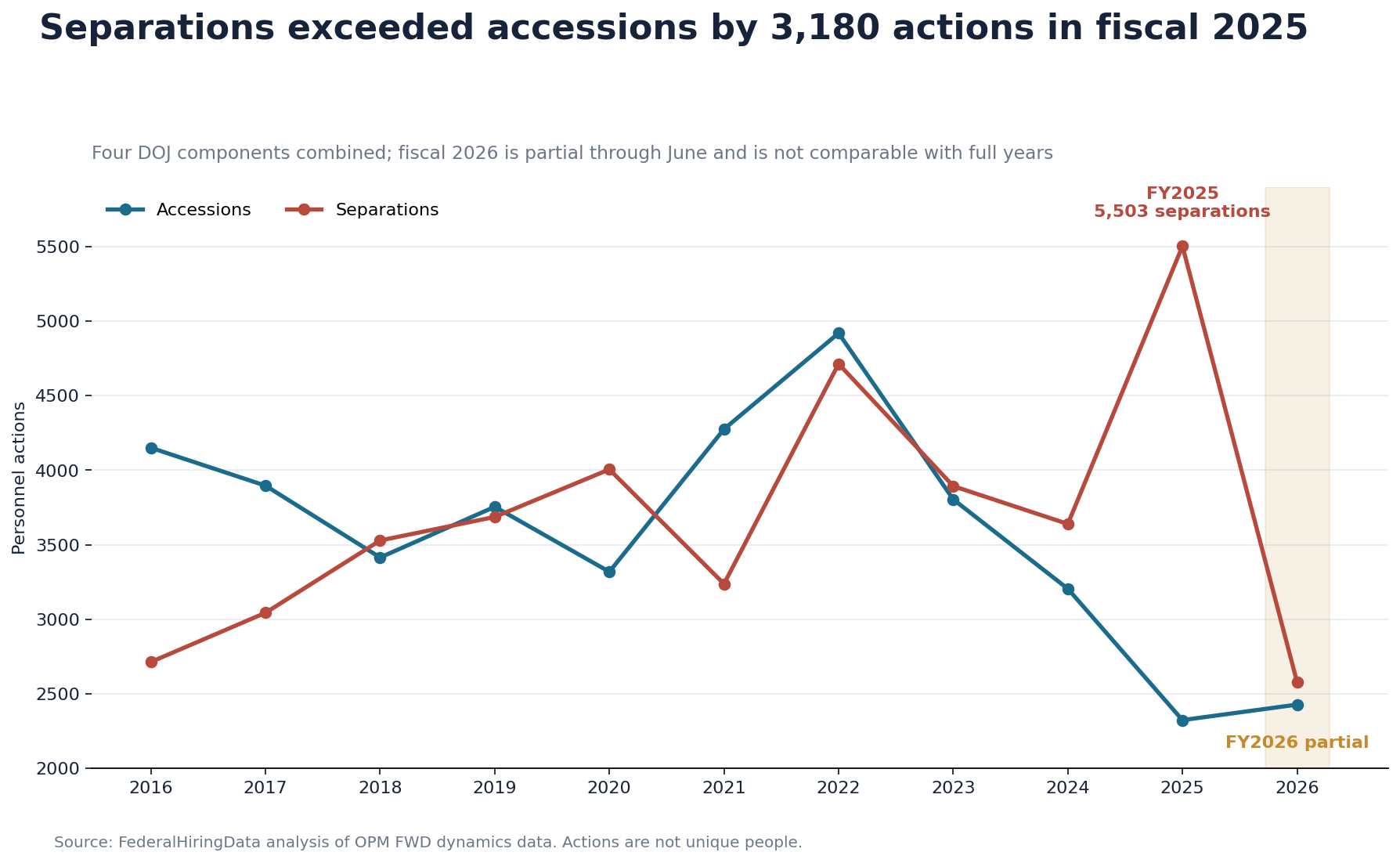
OPM's workforce dynamics data provide a second view: accessions and separations processed by the four components. The records count personnel actions, not necessarily unique people, and they do not always reconcile exactly to a pair of point-in-time headcounts.
From fiscal 2016 through 2024, the combined annual flows were usually much closer than they were in fiscal 2025. Accessions exceeded separations in fiscal 2016, 2017, 2019, 2021 and 2022. Separations were modestly higher in 2018, 2020, 2023 and 2024.
In fiscal 2025, the four components recorded 2,323 accession actions and 5,503 separation actions, a negative balance of 3,180. Fiscal 2026 was much closer through June, with 2,427 accessions and 2,578 separations, but that partial year is not comparable with completed fiscal years.
Federal Hiring Data Weekly
Get the biggest federal workforce changes in your inbox.
Subscribe to Federal Hiring Data Weekly for federal hiring trends, salary data, agency movements, and original investigations, with email confirmation before delivery.
The chart does not show why people moved. The public aggregate includes separations with different causes and accessions through different authorities. It does not identify whether the person worked on a task force before or after the action. It also does not measure state and local partner turnover.
That last omission matters operationally. A task force can preserve staffing by adding partner officers, lose experience when federal or local personnel rotate, or change its mix without changing its official existence. A count of 1,663 teams can remain stable while the people inside them change substantially.
The hiring archive shows recruiting activity, not hires
FederalHiringData's historical USAJOBS archive contains 13,035 distinct announcements opened by the four components from March 2017 through Aug. 14, 2026. Of those, 3,256 were associated with series 1811 criminal-investigation jobs.
DEA accounted for 6,841 announcements, ATF for 3,476, the Marshals Service for 2,400 and the FBI for 318. The FBI total is especially incomplete as a measure of recruiting because the bureau also directs applicants through its own careers system.
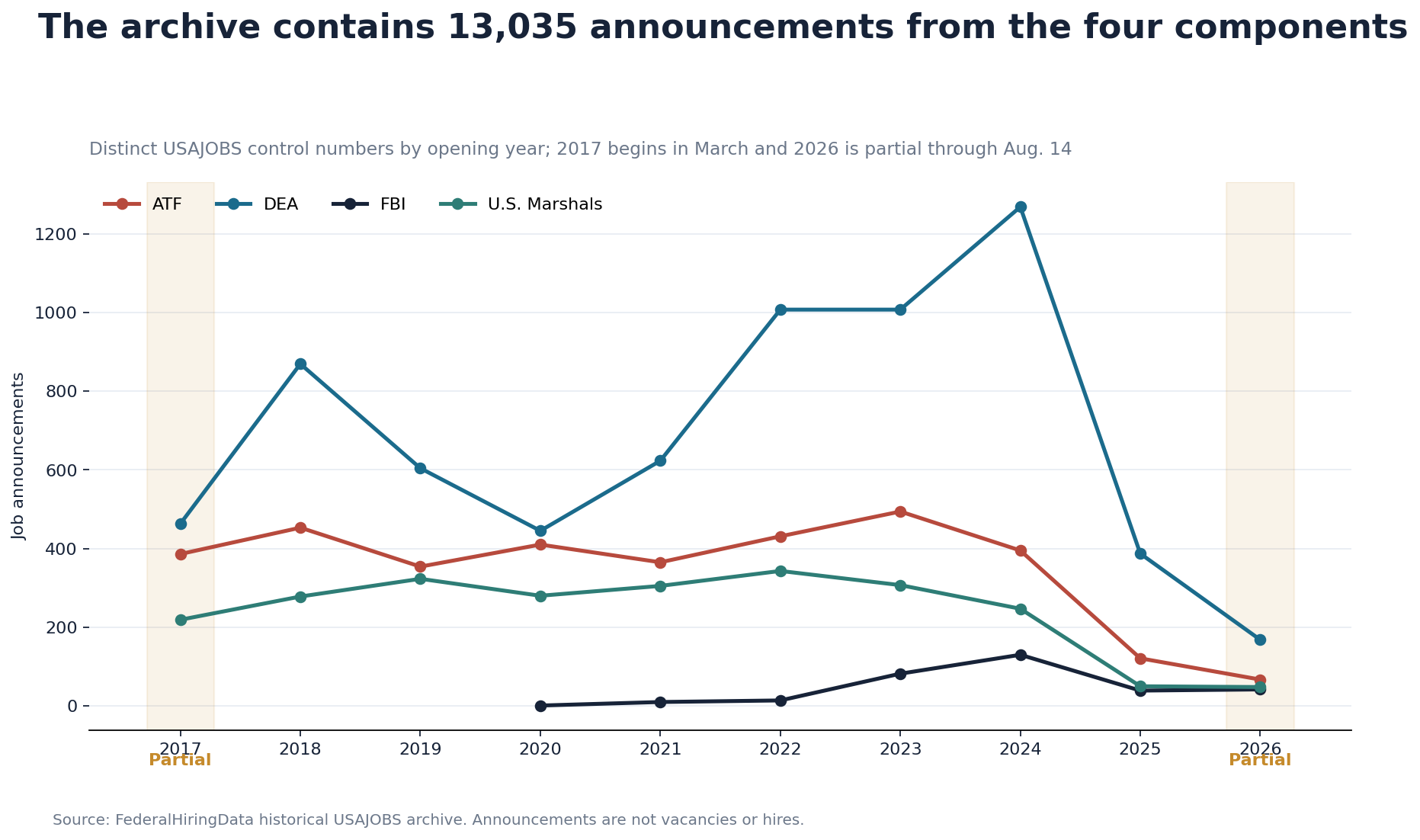
An announcement is not a vacancy and not a hire. One announcement may advertise multiple positions, accept applications at multiple locations or fill a continuing need. The same occupation can appear in many announcements. The series measures public recruiting activity captured by the archive, not staffing outcomes.
The sharp drop after 2024 is nevertheless notable. Across the four components, the archive contains 2,050 announcements opened in 2024 and 597 in 2025. The partial 2026 count through Aug. 14 is 325. Coverage and agency recruiting channels limit that comparison, especially for the FBI, but the archive does not show a public USAJOBS surge large enough to offset the recent federal headcount decline on its face.
Recruiting volume alone could not prove such an offset anyway. Agencies can fill multiple jobs from one announcement, make no selection, cancel a posting or hire through channels outside USAJOBS. The proper next step would be to connect announcement-level recruiting, personnel accessions and task-force assignments with a common, privacy-protective reporting framework. Those links are not publicly available now.
Three components let operations begin before initial federal training
GAO's clearest control finding concerned timing.
All four components trained nonfederal officers on roles, responsibilities, federal authorities and policies. All required at least one year of prior law-enforcement experience, and all eight sampled task forces had federal supervision. But only the Marshals Service required completion of its initial training before an officer engaged in operations using federal deputation authority.
| Component | Initial format reported by GAO | Expected completion window | Required before deputation-dependent operations? |
|---|---|---|---|
| ATF | In person | Within two years | No |
| DEA | In person | Within one year | No; GAO found the formal requirement incomplete for officers who had passed one year |
| FBI | Virtual | Within six months | No |
| U.S. Marshals Service | Virtual | Within 15 days | Yes |
ATF officials said in-person instruction and scheduling made immediate completion difficult. DEA and FBI officials pointed to officers' prior law-enforcement experience and direct federal supervision as safeguards. GAO acknowledged those controls but concluded they were not substitutes for training on the specific federal authority the officers would exercise.
The completion windows differ sharply. An ATF task-force officer could be expected to complete initial training within two years. DEA's expectation was one year, but GAO found its policy did not fully establish a requirement for officers who had already served longer. The FBI's window was six months. The Marshals Service required virtual training within 15 days and before relevant operations.
GAO recommended that ATF, DEA and the FBI require the training first. It also recommended that DEA complete a formal requirement for overdue officers and that ATF, the FBI and the Marshals Service improve mechanisms for tracking whether officers had completed training.
The distinction is not a judgment about whether a veteran local detective is unqualified. It is a control question. State law-enforcement experience does not by itself teach a component's federal warrant procedures, limits of authority, reporting rules or department policies. Federal supervision can reduce risk in a particular operation, but a national system should not depend on every supervisor recognizing and correcting every knowledge gap in real time.
Misconduct decisions lacked common field guidelines
GAO identified a second gap after an allegation is made. All four components had processes for reporting and reviewing misconduct involving nonfederal task-force officers. None had guidelines for field managers to use when deciding the outcome, such as the conditions under which an officer should be suspended or removed from a task force.
That matters because a nonfederal officer remains employed by another government while exercising federal authority through the task force. The employing agency may investigate or discipline the person under its own rules. The federal component must separately decide whether the officer can continue to participate, retain access or exercise deputed authority.
Related research
Put this finding in context
Data investigationsAugust 20, 2026
OPM's 35% Cut Was Its Deepest Since It Transferred an Entire Bureau
The federal government's HR agency now has fewer employees than at any reviewed point since 1998 while directing agencies to rebuild hiring and workforce planning.

Data investigationsAugust 24, 2026
NOAA Lost 2,630 Employees. Its Technical Workforce Was Still Thinner in June 2026.
NOAA's covered workforce fell 21.1% from December 2024 through June 2026, with broad losses across science and technical occupations and only selective rebuilding.
Without common criteria, similar conduct can produce different task-force outcomes across field offices. GAO warned that inconsistent adjudication could damage operational integrity and public trust. It recommended that all four components develop guidelines for field management.
DOJ concurred. The recommendations were still open at publication, so this article does not describe the changes as implemented. An open recommendation can reflect work in progress, but GAO had not yet recorded sufficient action to close any of the seven.
There is also counterevidence to simplistic claims of an uncontrolled network. Every task force in GAO's sample had federal supervision. Components used written agreements and had reporting channels. Nonfederal participants brought law-enforcement experience and local knowledge. The report did not find that every untrained officer misused authority or that every misconduct decision was wrong.
The finding is narrower and more actionable: the department could not show that three components consistently put role-specific training before the exercise of federal authority, or that all four gave field managers a common framework for deciding task-force consequences after misconduct allegations.
Nearly $2 billion does not reveal a workforce count
The components allocated nearly $2 billion to task forces in fiscal 2025, according to GAO. That figure includes multiple funding sources and different kinds of support. ATF and the Marshals Service largely used the Assets Forfeiture Fund, which can cover overtime, travel, fuel, training, equipment and similar expenses incurred by state and local officers in joint operations. The FBI reported that most of its task-force funding supported federal personnel.
The total is consequential, but it should not be divided by an assumed number of officers to create a cost-per-worker figure. The denominator is unknown and the numerator mixes labor with operations, travel, equipment and other costs. It is an allocation measure, not a payroll total for nonfederal task-force officers.
Better public reporting would separate federal personnel costs, partner overtime, equipment, travel, training and other support. It would also connect spending to mission categories and basic output measures without disclosing operationally sensitive case information. At present, the public can see scale without being able to compare unit cost or staffing intensity across components.
What the data can and cannot say about capacity
The evidence supports four conclusions.
First, DOJ operates a task-force network of national scale. The 1,663 teams span criminal and national-security missions, with 68% concentrated in drug, violent, gun and gang crime.
Second, the federal workforce inside the four lead components is smaller than it was in September 2024. The covered headcount decline was 3,444, including 1,156 fewer criminal investigators and 396 fewer intelligence employees. That is a measurable contraction in the component workforces, not a measured change in task-force staffing.
Third, partner officers extend the network beyond the federal headcount, but the available deputation records cannot establish how many unique nonfederal officers are active at one time. Claims that the deputation totals prove a 48,000-person partner workforce would be false.
Fourth, GAO found process weaknesses that matter regardless of headcount. Three components did not require initial federal-authority training before relevant operations, and all four lacked field adjudication guidelines for task-force misconduct allegations.
What the evidence does not support is equally important. It does not show that crime outcomes changed because federal headcount fell. It does not show that partner officers replaced federal investigators one for one. It does not measure task-force productivity, case quality, civil-rights compliance or the workload carried by individual teams. It does not establish that an officer without completed initial training acted improperly.
Those questions need better joined data. A useful departmentwide dashboard would report active task forces, federal and nonfederal staffing ranges, deputations issued and active, initial and recurring training completion, partner turnover, misconduct allegations and task-force administrative outcomes. Reporting could be aggregated enough to protect investigations and individual privacy while still showing whether the safeguards work.
The current system asks the public to infer workforce capacity from separate ledgers that were not built to reconcile. That was already a weak foundation. A 6% federal headcount decline makes it harder to ignore.
Methodology and limitations
FederalHiringData transcribed component and mission counts from GAO-26-108468. The 1,663 task forces are a point-in-time total based on component lists supplied between May and December 2025 and confirmed by the components in April 2026 as comparable. GAO assigned every task force to one primary mission category.
Federal workforce estimates use OPM FedScope September snapshots for 2000 through 2024 and the June 2026 Federal Workforce Data snapshot. ATF's Justice Department series begins in 2003 after its transfer from Treasury. Headcount is the number of covered employees on board in a monthly snapshot. It excludes nonfederal task-force officers, contractors and other personnel outside the covered OPM data.
Occupational counts use OPM series codes, principally 1811 Criminal Investigation and 0132 Intelligence. OPM does not identify task-force assignments. Accessions and separations are personnel actions, not unique people, and need not equal the change between two headcount snapshots.
USAJOBS counts are distinct control numbers in the FederalHiringData historical archive. Coverage begins in March 2017 and the 2026 count is partial through Aug. 14. Announcements are not applications, vacancies or hires. The FBI's USAJOBS series understates its full recruiting activity because the bureau also uses its own careers system.
GAO's deputation figures are reported separately because their definitions differ. The Marshals Service data include renewals, FBI data include renewals and federal officers, and the same person can receive more than one kind of deputation. The article never sums those records into a unique-person count.
Recommendation status was checked on GAO's official page immediately before publication. All seven recommendations were open and DOJ had concurred. FederalHiringData preserves the source inventory, evidence ledger, analysis SQL, extracted data and chart inputs for this investigation. Readers can also explore current federal job announcements, federal workforce statistics and other FederalHiringData investigations.
Continue reading
More from FederalHiringData

Data investigationsAugust 22, 2026
The Government Can Count $1.2 Trillion in Grants. It Still Cannot Count the Workforce Managing Them.
The identifiable GS-1109 workforce fell 28% after December 2024, but the government still cannot count everyone responsible for its grant portfolio.
Data investigationsAugust 26, 2026
DOJ's Attorney-Misconduct Office Received 1,666 Complaints. It Opened Seven Investigations.
DOJ's attorney-misconduct intake reached a 21-year high as OPR opened seven investigations and the separate inspector general lost 99 covered employees.
Data investigationsAugust 25, 2026
CDC Lost 3,636 Covered Employees. Health Science Took the Largest Hit.
CDC's covered workforce fell 28% after December 2024. Health-science and public-health program roles led the losses, while recruiting nearly stopped.
Federal Hiring Data Weekly
Get the biggest federal workforce changes in your inbox.
Subscribe to Federal Hiring Data Weekly for federal hiring trends, salary data, agency movements, and original investigations, with email confirmation before delivery.