August 25, 2026
DOD Cut 81 Civilian Positions From the Office Overseeing 173 Weapon Programs
DOT&E entered 2026 with 45 authorized civilian positions and 173 systems under oversight as remaining Action Officers reported capacity and expertise gaps.
By Evan Mercer
Published August 25, 2026Last edited August 25, 2026

The Pentagon office responsible for independent operational testing entered 2026 with 45 authorized civilian positions. Before a May 2025 reorganization, it had 126.
The 81-position reduction, or 64.3%, did not end the mission. The Office of the Director, Operational Test and Evaluation, known as DOT&E, still had 173 weapon systems on its fiscal 2025 oversight list. Its analysts were expected to judge whether systems were effective, suitable, survivable and lethal under realistic conditions before service members had to rely on them.
The list was substantially smaller than it had been one year earlier. More than 90 systems were removed after completed testing, cancellations, mergers or determinations that continued DOT&E oversight was unnecessary. Leadership also delegated approvals, expanded reporting options and removed a review layer it considered duplicative. Those changes matter. The reorganization cannot be evaluated as if workload and process stood still.
But the Government Accountability Office's June 2026 review found that the remaining mission was not simply a smaller version of the old one. Action Officers inherited more programs than they said they could handle. Some took portfolios outside their expertise. Electronic-warfare expertise was identified as a particular gap. Access to test data held by the Institute for Defense Analyses was interrupted for about two months, and the office lost half of its secure workstations and conference rooms.
DOD narrowed the list and streamlined review. It also left the independent test office with 81 fewer authorized civilian positions than its pre-reorganization baseline. That is the central tension in the public record.
The office went from 126 authorized positions to 30
The change began with a May 27, 2025 memorandum directing DOT&E to eliminate positions described as nonstatutory or redundant. It authorized 30 civilian positions, no more than one Senior Executive Service position and 15 military positions. Contractor personnel support was to end within seven days.
Before that memorandum, DOT&E had 126 authorized civilian positions and 106 were filled, according to GAO. The immediate 30-position authorization represented a reduction of 96 positions, or 76.2%.
In September, DOD restored 15 civilian positions. By January 2026, the authorized total was 45, including 38 Action Officers. The restoration recovered part of the original capacity, but the office remained 81 positions below its earlier authorization.

The chart separates authorized positions from filled positions. GAO reported that 106 of the 126 pre-memorandum positions were filled. It did not publish comparable filled totals for the 30- and 45-position structures, so the later bars should not be read as employee headcounts.
Eight additional civilian employees were recalled in March 2026 while still awaiting final reduction-in-force action. Four remained with the office as of April while DOD reviewed whether they should be retained. They were not included in the January authorization shown above. The uncertainty illustrates why authorization, people on duty and final staffing are different measures.
The memorandum said the associated actions would save $300 million annually and improve lethality and efficiency. FederalHiringData found no public accounting that isolates realized savings from the DOT&E staffing change. The figure should therefore be treated as DOD's stated estimate, not as verified savings from eliminating 81 authorized civilian positions.
The oversight list was the smallest in 26 years
DOT&E's fiscal 2025 annual report listed 173 systems under oversight as of Sept. 30, 2025. FederalHiringData reconstructed the annual total from the office's public reports back to fiscal 2000. The 2025 count was the smallest in that continuous 26-year series. The list peaked at 348 in fiscal 2010.

The abrupt drop from 265 systems in fiscal 2024 to 173 in fiscal 2025 is critical counterevidence to any claim that the same portfolio was handed to a much smaller staff. It was not. DOT&E said removals included systems that had completed testing, were canceled, were merged with related programs or no longer required its oversight. That means the 92-system decline cannot honestly be attributed entirely to the workforce reduction.
Nor does a system count measure effort. A mature program nearing a final report is different from a rapidly changing software-intensive system, a live-fire evaluation or a classified portfolio with multiple test events. One program can require several Action Officers or intermittent attention from specialists; another can be handled with less continuing work. Public annual reports do not publish complexity-adjusted workload.
The criteria for oversight also matter. DOT&E can designate major programs based on statutory dollar thresholds, congressional or departmental interest, critical mission capability and significant changes. The office's list is therefore an oversight decision, not a complete inventory of every DOD test activity.
Even within the smaller list, an acquisition pathway appeared lightly covered. GAO reported that only 15 of roughly 110 Middle Tier of Acquisition efforts were on the oversight list in February 2026. Middle Tier programs are intended to move rapidly through prototyping or fielding. GAO said the limited oversight could create risk because DOT&E might not receive enough information to make timely designation decisions.
Thirty-eight Action Officers for 173 systems
GAO identified 38 Action Officers in the partially restored January 2026 structure. Dividing the 173 systems on the fiscal 2025 list by 38 yields 4.6 systems per Action Officer.
That number is useful only as scale context. It is not an actual assignment roster, a required staffing level or a productivity measure. The program list and staffing point come from different dates. The calculation does not adjust for program complexity, classified work, shared assignments, management duties or specialists who support several portfolios.

GAO's interviews provide stronger evidence than the arithmetic. Remaining Action Officers said they had more programs than they could handle. Some were assigned systems outside their areas of expertise, and GAO reported a shortage of electronic-warfare expertise. Officials said the reductions limited the breadth and depth of review and created a risk that deficiencies in effectiveness, suitability, survivability or lethality would not be documented.
Those statements do not show that a specific system was unsafe or ineffective. GAO did not publish an assignment-level roster or identify a test failure caused by reduced staffing. They do show that the people doing the work perceived capacity and skill constraints after the reorganization.
The exact pre-reorganization Action Officer count was not published. It is therefore not possible to calculate a defensible before-and-after systems-per-officer ratio. Any comparison that uses the full 126-position baseline as if every position were an Action Officer would be wrong.
The steepest reductions were not uniform
GAO presented staffing for comparable office groupings before the memorandum, immediately after it and after the partial restoration. The largest proportional January reduction in those groupings was in land and expeditionary warfare, which went from 19 authorized positions to five, a 73.7% decline.
Air warfare went from 14 to six, a 57.1% decline. Naval warfare went from 15 to eight. Space and strategic systems went from 14 to nine. Cyber assessment went from 10 to nine. The front office went from 17 to seven.

These office-grouping bars sum to 89 positions before the memorandum, not the complete 126-position baseline. GAO's figure was designed to compare selected organizational groups; it does not reconcile every authorized position. FederalHiringData does not use the 89-position subtotal as a substitute for the total.
The pattern still matters because it shows where the partial restoration went. Cyber assessment returned close to its prior authorization. Space and strategic work recovered to nine positions. Land and expeditionary remained at five, while air and naval remained materially below their old levels.
The distribution may reflect leadership's assessment of priorities and available staff. Public records do not provide a program-by-program staffing requirement against which to score that decision. The defensible finding is narrower: the reductions were uneven, and the office area that had the largest pre-memorandum authorization retained about one-quarter of those positions.
Testing was disrupted beyond the federal headcount
Workforce capacity did not depend only on civil servants. GAO found that DOT&E ended contractor personnel support quickly after the memorandum. It did not publish a contractor headcount, so the number of contractor workers affected cannot be established from the report.
One operational consequence was visible. DOT&E relied on the Institute for Defense Analyses to host test data and analytical tools. Access was interrupted for about two months while the office changed its support arrangements. GAO said that limited the office's ability to access historical data, collaborate and conduct analysis.
Federal Hiring Data Weekly
Get the biggest federal workforce changes in your inbox.
Subscribe to Federal Hiring Data Weekly for federal hiring trends, salary data, agency movements, and original investigations, with email confirmation before delivery.
Physical infrastructure also changed. DOT&E lost half of its secure compartmented workstations and conference rooms. For an organization that reviews classified weapon systems, secure workspace is part of productive capacity. A restored billet does not by itself restore access to the systems, data and rooms needed to do the job.
Leadership did take steps intended to keep reviews moving. In October 2025, the director delegated some approvals to deputy directors. In January 2026, the office expanded the kinds of reporting products it could use. It also dissolved an internal review layer described as duplicative. These changes could shorten approval chains and reserve formal reports for the decisions that need them most.
The annual report shows that substantial work continued. In fiscal 2025, DOT&E approved 28 test and evaluation strategies or master plans, disapproved one master plan, approved 87 individual test plans and issued 43 reports. Output did not fall to zero when the organization changed.
Those counts are not a before-and-after performance evaluation. The annual report does not pair them with complexity, timeliness, quality or a comparable workload denominator. They are evidence that the office continued producing plans and reports, not proof that every remaining mission could be covered at the same depth.
The surrounding OSD workforce also contracted
OPM does not publish DOT&E as a separate subelement in Federal Workforce Data. The closest stable public organizational series is DD01, Office of the Secretary of Defense. That category includes DOT&E and many other offices, so it cannot be used as a DOT&E headcount proxy.
It does provide context about the broader civilian talent pool surrounding the test office. OSD had 2,843 covered employees in December 2024 and 2,326 in December 2025. By June 2026, it had 2,512. The June count was 331 lower than the December 2024 count, an 11.6% reduction.

The series is volatile across the decade and can reflect reorganizations, transfers and coding changes as well as accessions and separations. It should not be used to infer that 331 people left DOT&E. It shows that the independently documented DOT&E reduction occurred while the broader OSD covered workforce was also smaller than it had been at the end of 2024.
Selected technical and analytical occupations moved in the same direction. OSD operations-research employment fell from 170 in December 2024 to 146 in June 2026. General engineering fell from 111 to 96, information technology from 71 to 59 and general physical science from 15 to 11. Management and program analysis fell from 584 to 550. Program management was nearly flat at 59 and 60.

Occupation codes do not identify an employee's office, project or skill specialty. An operations researcher coded in OSD may have no connection to operational testing. The value of the data is contextual: several occupations commonly used in analytical and engineering work were smaller across the parent subelement while DOT&E was trying to cover expertise gaps.
Public recruiting shows the kind of expertise DOT&E had sought
FederalHiringData searched its historical USAJOBS archive for tightly matched DD01 announcements with test-and-evaluation titles or DOT&E-related identifiers. It found 10 distinct announcements from 2019 through 2024. Six opened in 2024.
Four of the 2024 announcements sought Test & Evaluation Technical Advisors for air, naval, land and expeditionary, and net-centric, space and missile-defense work. They allowed hiring from operations research, physical science and general engineering series and advertised Senior Level or Scientific and Professional pay ranges of $180,359 to $221,900.
| Announcement opened | Role | Occupational series | Advertised pay range |
|---|---|---|---|
| Feb. 29, 2024 | Program analyst, AI test and evaluation specialist | 0343 | $163,964-$191,900 |
| Sept. 4, 2024 | T&E technical advisor, air warfare | 0801, 1301, 1515 | $180,359-$221,900 |
| Sept. 4, 2024 | T&E technical advisor, naval warfare | 0801, 1301, 1515 | $180,359-$221,900 |
| Sept. 4, 2024 | T&E technical advisor, land and expeditionary warfare | 0801, 1301, 1515 | $180,359-$221,900 |
| Sept. 4, 2024 | T&E technical advisor, net-centric, space and missile defense | 0801, 1301, 1515 | $180,359-$221,900 |
| Dec. 12, 2024 | Program analyst, AI test and evaluation specialist | 0343 | $163,964-$191,900 |
The announcements help define the expertise the organization had recently sought in public recruiting. They do not show how many vacancies existed, how many people were selected or whether a hire entered DOT&E. One announcement can cover more than one opening or produce no selection.
They also do not establish a current recruiting freeze. Jobs can be filled through reassignment, internal merit promotion, noncompetitive authorities or announcements coded at a different DOD component. The bounded archive finding is simply that these six closely matched public announcements opened in 2024, before the 2025 restructuring.
A larger budget account did not replace federal oversight capacity
Related research
Put this finding in context
Data investigationsAugust 21, 2026
DOD Cut 78,375 Civilian Jobs. The Work Did Not Disappear.
The 2025 reduction reached IT, contracting, engineering, logistics and weapons testing. Public records do not show a clean transfer of the work or its full cost.

Data investigationsAugust 18, 2026
The Korea Exercise Was Cut. The Civilian Workforce Behind the Alliance Was Not
The U.S. defense presence in South Korea includes 2,903 appropriated-fund civilians, while 12,428 archived job announcements reveal the year-round system behind the alliance.
The Operational Test and Evaluation, Defense appropriation financed $336.717 million in fiscal 2024 and had $348.709 million enacted for fiscal 2025. The fiscal 2026 request totaled $416.143 million, including a $98 million reconciliation request.

The account supports operational testing, live-fire testing, activities and analyses, contracts and other program work. It is not a payroll measure for DOT&E's federal staff. The chart therefore does not show that each remaining employee had more money, nor can the budget be divided by headcount to measure productivity.
The fiscal 2026 justification itself anticipated lower contract spending and reductions in some civilian full-time-equivalent and travel costs while maintaining the testing program. The requested reconciliation funds also make the 2026 total unlike an enacted recurring baseline. Congress could change the request, and a requested dollar is not the same as an obligated or spent dollar.
The contrast still answers one important question. The civilian authorization did not fall because the entire test-and-evaluation account disappeared. DOD continued to seek hundreds of millions of dollars for the work while changing the mix of federal staff, contracts, testing and analysis used to perform it.
That mix matters for independent oversight. Contractors can supply technical analysis and specialized tools. Federal Action Officers and the statutory director remain responsible for government judgments, access decisions and independent reporting. Budget authority for external support is not interchangeable with experienced federal personnel empowered to make those judgments.
What remains unresolved
DOT&E was conducting a workforce and workload analysis when GAO completed its review. As of June 2026, the analysis was not finished. FederalHiringData searched official DOT&E, DOD and GAO records through Aug. 25, 2026 and did not find a public completed result.
That analysis could answer questions the public data cannot. How many Action Officers are needed for the current list? Which program types require several specialists? Where are the electronic-warfare and other skill gaps? How much work can be supported by contractors without weakening independent federal judgment? What secure facilities and data systems are required for the restored positions to be useful?
The public record does not support saying that the reduction caused a weapon system to fail, exposed service members to a specific hazard or made all oversight inadequate. It also does not support saying that a 92-program reduction made an 81-position reduction operationally harmless.
The most direct evidence comes from the people who remained and the disruptions GAO verified. Action Officers reported portfolios beyond what they could handle and assignments outside their expertise. Data access stopped for about two months. Secure workspace was cut in half. Review breadth and depth narrowed even after 15 positions were restored.
Leadership had real countermeasures: a smaller oversight list, delegated approvals, flexible report formats and a removed review layer. The office also produced dozens of plans and reports during fiscal 2025. Those facts argue against describing DOT&E as inactive.
They do not close the capacity question. The office entered 2026 authorized for 45 civilian positions, 64.3% below its old level, with 173 systems still designated for independent oversight. Until DOD publishes the completed workforce and workload analysis, the government has not publicly shown how that staffing level maps to the mission it kept.
Methodology and limitations
FederalHiringData used GAO-26-108859 for the reorganization timeline, total and area-level authorizations, January 2026 Action Officer count, employee interviews, contractor-support change, IDA data interruption, secure-workspace loss, oversight-list removals, Middle Tier coverage and process changes. Authorized positions are not the same as filled positions or employees on duty.
The annual oversight series comes from DOT&E fiscal 2000 through fiscal 2025 annual reports. The fiscal 2025 total is a Sept. 30 point-in-time list. Program inclusion criteria and organizational practices can change, so the series measures designated systems, not a constant unit of workload. The 4.6-program contextual average divides the fiscal 2025 list by the January 2026 Action Officer count. It is not an actual assignment average or productivity metric.
OSD workforce figures come from OPM Federal Workforce Data, agency subelement DD01. Annual observations use December, with June used for the partial 2026 endpoint. OSD includes many offices beyond DOT&E. Employment and occupation figures are included only as broader organizational context.
The recruiting review uses distinct controls in the FederalHiringData historical USAJOBS archive. It searched DD01-coded announcements for tight test-and-evaluation titles or identifiers. Announcements are not vacancies, positions, applications, selections, hires or employee counts.
Budget values come from DOD's fiscal 2026 Operational Test and Evaluation, Defense justification. Fiscal 2024 is actual, fiscal 2025 is enacted and fiscal 2026 is requested. The account includes federal and contracted activity across multiple testing and analysis programs and is not a DOT&E payroll measure.
The public record does not disclose a pre-reorganization Action Officer count, an assignment-level portfolio roster, contractor headcount, a full realized-savings ledger or classified program details. Analysis was completed Aug. 25, 2026. Article research and writing used no OpenAI API calls.
Official records and further reading
- GAO-26-108859: Reorganization of DOD's Office of the Director, Operational Test and Evaluation
- DOT&E annual reports
- DOD fiscal 2026 Operational Test and Evaluation, Defense budget justification
- OPM Federal Workforce Data downloads
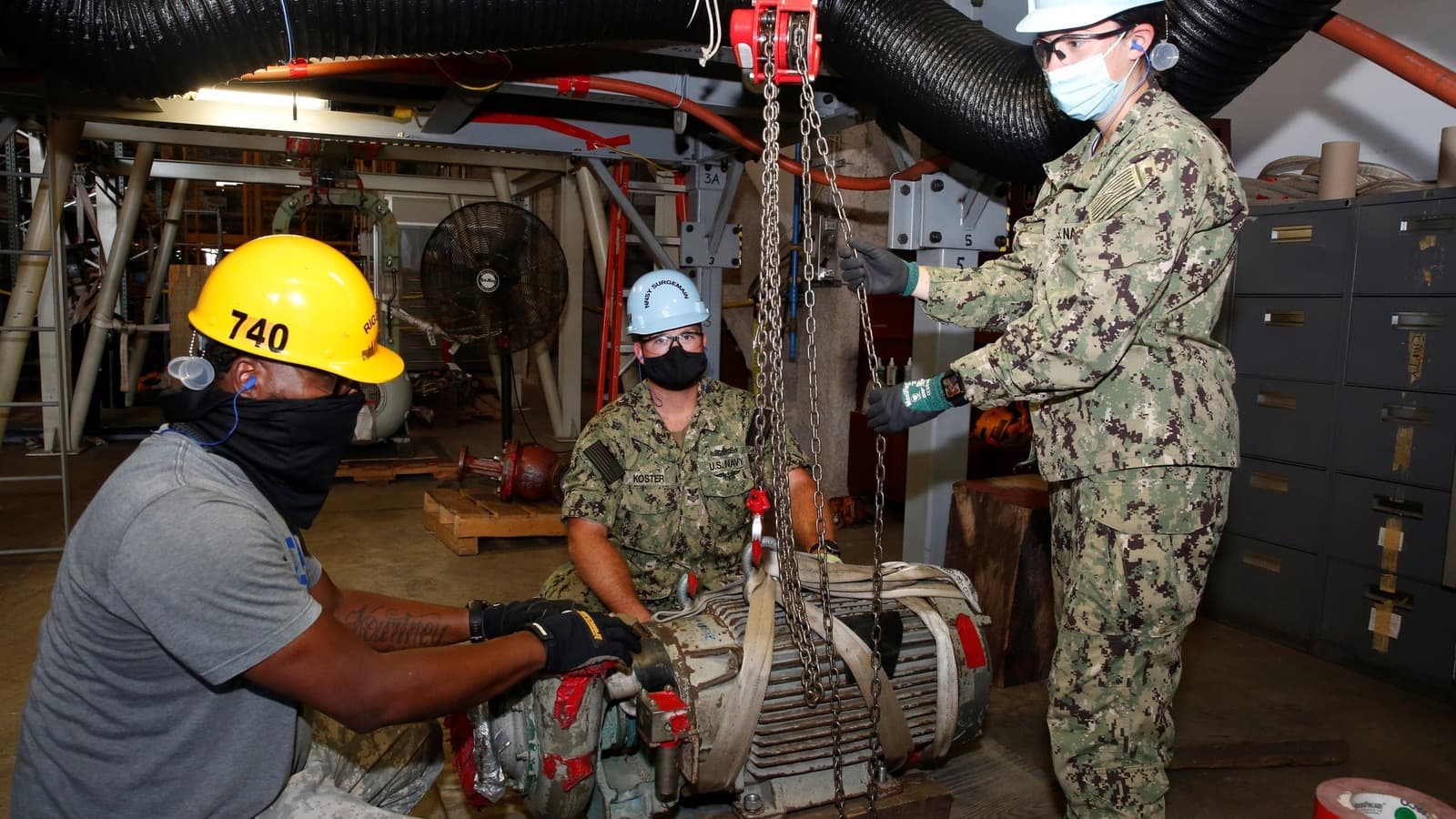
- DVIDS image credit: Katie Archibald, U.S. Navy, public domain
- How the broader DOD civilian workforce changed in 2025
- Browse current federal jobs
- Explore FederalHiringData statistics
- Read more FederalHiringData investigations
Continue reading
More from FederalHiringData
Data investigationsAugust 22, 2026
DOD Identified 19,379 Security-Cooperation Positions. It Still Lacks an Integrated Personnel System.
DOD coded 19,379 positions across nine functions, but its qualifications, assignments and tenure system remains unfinished as reform teams work around vacancies.

Data investigationsAugust 23, 2026
DOD Has a $285 Billion Maintenance Backlog. Its Facilities Workforce Is Shrinking.
DOD's reported repair backlog rose 80.8% after inflation while a selected civilian facilities-and-trades workforce proxy fell 11.4% after January 2025.

Data investigationsAugust 22, 2026
Air Force Depots Filled 90% of Positions. One Delay Metric Reached 73%.
Aggregate staffing looked healthy, but bottleneck skills, unplanned work and revised completion targets concealed a much more complicated maintenance problem.
Federal Hiring Data Weekly
Get the biggest federal workforce changes in your inbox.
Subscribe to Federal Hiring Data Weekly for federal hiring trends, salary data, agency movements, and original investigations, with email confirmation before delivery.