August 25, 2026
FDIC Cut 1,360 Authorized Positions as Insured Deposits Passed $11 Trillion
Covered FDIC headcount fell 23.6%, including 600 bank examiners, while the insured system grew larger and more concentrated.
By Evan Mercer
Published August 25, 2026Last edited August 25, 2026
The Federal Deposit Insurance Corporation entered 2026 with a smaller operating plan and a much smaller workforce. Its approved staffing authorization, including the inspector general, fell from 6,876 positions in the initial 2025 budget to 5,516 in the 2026 plan. That is a reduction of 1,360 authorized positions, or 19.8%.
The people already on the payroll fell faster. FederalHiringData's analysis of Office of Personnel Management records found 6,559 covered FDIC employees in December 2024 and 5,009 in June 2026. The 1,550-person decline was 23.6% in 18 months.
The largest occupation loss was the one closest to the agency's core supervisory work. Financial Institution Examining, series 0570, fell from 2,946 employees to 2,346, a decline of 600 examiners, or 20.4%.
This is not evidence that the banking system has gone unsupervised. The FDIC said it completed required 2025 examinations. Bank failures remained low. The Deposit Insurance Fund reached $157.4 billion in the first quarter of 2026, and its reserve ratio rose to 1.43%.
But the operating context did not simply shrink with the workforce. The number of FDIC-insured institutions has fallen by half since 2006, reducing recurring examination cycles. Over the same period, the industry's nominal assets more than doubled and insured deposits grew from $4.15 trillion to just over $11 trillion. Large-bank oversight, cybersecurity, financial technology and blockchain coordination add work that an institution count alone cannot measure.
The result is a capacity question, not a forecast of failure: what changed inside the FDIC, how much workload disappeared with bank consolidation, and what risks remain for the employees supervising state nonmember banks and protecting the deposit-insurance system?
The budget reduced positions across supervision and support
The FDIC's 2026 operating budget memorandum set a $2.486 billion operating budget excluding the Office of Inspector General. Including the inspector general, the total was $2.533 billion, down $492.7 million, or 16.3%, from the initial 2025 plan.
Staffing authorization fell by nearly one-fifth. The change was not confined to back-office functions.
| Budget measure | Initial 2025 | Proposed 2026 | Change |
|---|---|---|---|
| Operating budget excluding OIG | $2.972B | $2.486B | -$486.7M |
| Total budget including OIG | $3.026B | $2.533B | -$492.7M |
| Authorized staffing excluding OIG | 6,723 | 5,386 | -1,337 |
| Total authorized staffing including OIG | 6,876 | 5,516 | -1,360 |
The agency said workforce-optimization actions eliminated 1,272 positions during 2025. It described the 2026 plan as supporting its statutory responsibilities while streamlining operations, consolidating offices and aligning staffing with a smaller bank population.

Risk Management Supervision had the largest program reduction: 428 authorized positions, from 2,796 to 2,368. Depositor and Consumer Protection fell by 215. Resolutions and Receiverships fell by 146. Insurance and Research fell by 52, and Complex Institution Supervision and Resolution fell by 61.
Corporate support lost 381 authorized positions. Executive support offices lost 51, nearly half their initial authorization. These categories should not be added to FDIC subtotals printed elsewhere in the budget; the chart presents the mutually exclusive division and office rows from the agency's table.
The examiner authorization within the plan moved in the same direction. Risk-management examiners fell from 1,733 positions in the initial 2025 plan to 1,506 in 2026, a reduction of 227. Compliance examiners fell from 479 to 378, a reduction of 101.
There was one important addition inside that smaller total. The budget proposed 65 additional risk examiners to support changes to the Continuous Examination Process and the consolidation of certain large-bank supervisory work. That addition does not reverse the overall decline. It shows that the FDIC was reallocating capacity toward particular risks while reducing authorization elsewhere.
OPM records show the reductions had already reached payroll
Budget authorization is a ceiling, not a count of people at work. OPM employment records provide the more direct measure of covered federal employees.

FDIC employment has moved with banking crises before. The covered workforce fell through the early 2000s, then expanded rapidly during the financial crisis, reaching more than 8,300 in the early 2010s. It declined as the failure and receivership workload receded, then rose again to 6,559 by December 2024.
The latest contraction was unusually fast. OPM records show 5,626 covered employees in December 2025 and 5,009 in June 2026.
FDIC's internal Statistics at a Glance series is lower at the end of that period. It reports 5,137 full-time equivalents for 2025 and 5,056 in the first quarter of 2026. The 2026 workbook notes that its FTE measure excludes employees who accepted the Deferred Resignation Program and certain others on administrative leave.
That boundary helps explain why the two official series do not match. OPM headcount and FDIC FTE measure different populations and dates. The correct conclusion is not that one is wrong. Both show a major decline, and both place the early-2026 workforce near its pre-crisis scale.

The comparison is also a warning against treating 5,516 authorized positions as 5,516 employees. Authorization describes the plan. Headcount describes covered people. FTE describes paid work under FDIC's own methodology. Those numbers can move together without ever being identical.
Bank examiners accounted for 600 of the lost employees
The occupational record identifies where much of the change occurred.

| Selected occupation | Dec. 2024 | June 2026 | Change | Percent change |
|---|---|---|---|---|
| Financial Institution Examining (0570) | 2,946 | 2,346 | -600 | -20.4% |
| Miscellaneous Administration and Program (0301) | 710 | 511 | -199 | -28.0% |
| General Business and Industry (1101) | 434 | 321 | -113 | -26.0% |
| Financial Analysis (1160) | 338 | 241 | -97 | -28.7% |
| Information Technology Management (2210) | 480 | 389 | -91 | -19.0% |
| Financial Management Student Trainee (0599) | 57 | 3 | -54 | -94.7% |
| General Attorney (0905) | 369 | 316 | -53 | -14.4% |
| Human Resources Management (0201) | 177 | 125 | -52 | -29.4% |
The 0570 series alone accounted for nearly 39% of the agency-wide headcount decline. It remains the largest covered FDIC occupation by a wide margin. That matters because bank examination is not a function that can be replaced instantly after a staffing gap emerges.
The FDIC's examiner training program combines formal instruction, on-the-job development and commissioning for risk-management, compliance and information-technology work. FederalHiringData did not find a single official time-to-commission figure that applies to every examiner pathway, so this analysis does not assign one. The practical point is narrower: experienced, commissioned examiners embody training and institutional knowledge that a new posting does not immediately reproduce.
The losses also extended beyond field examination. Financial analysts, IT specialists, attorneys and program staff all contracted. Those occupations support the data analysis, enforcement, legal review, cyber oversight and operational systems that make an examination program work.
A separation wave, not weak arithmetic, drove the 2025 break
The annual personnel-action record makes the timing clearer. FDIC recorded 1,057 accessions and 590 separations in 2024, a net difference of positive 467 actions. In 2025, it recorded 63 accessions and 1,545 separations, a negative difference of 1,482.

| 2025 separation category | Recorded actions |
|---|---|
| Quits | 655 |
| Voluntary retirements | 642 |
| Early-outs | 113 |
| Expired appointments and other terminations | 78 |
| Other separations | 35 |
| Other retirement | 8 |
| Reduction in force | 7 |
| Transfers out | 7 |
The distribution complicates a simple layoff narrative. OPM recorded only seven reduction-in-force actions. Quits and voluntary retirements made up 84% of the separations. Some departures may be associated with workforce programs or pending organizational changes, but the category data do not establish each employee's motive.
The monthly pattern was uneven. Separations reached 326 in June 2025, 190 in September and 476 in December. Accessions remained low throughout the year. In the first six months of 2026, the agency recorded 14 accessions and 208 separations.
Personnel actions are not a perfect bridge to headcount. Transfers, data coverage and the timing of appointments can create differences. They are still strong evidence that the 2025 workforce contraction came from an extraordinary imbalance between entries and exits.
Public recruiting fell 90% after 2024
FederalHiringData's USAJOBS archive supplies another independent measure. It contains 1,586 distinct FDIC announcements that closed in 2024 and 153 in 2025, a decline of 90.4%.

The archive contains 102 FDIC announcements closing in 2026 through Aug. 14. That is partial-year data and should not be compared with a full year without the date qualifier.
An announcement is not a vacancy, applicant, offer or hire. One control number can advertise one opening, multiple openings or a roster. The FDIC can also fill positions through internal or special hiring actions that do not appear as ordinary public announcements. The chart therefore does not mean the agency hired 90% fewer people.
It does show that visible public recruiting did not operate at its prior scale while the agency lost employees. The near-elimination of the Financial Management Student Trainee series, from 57 employees to three, is especially relevant to the long pipeline needed to replenish financial expertise.
Federal Hiring Data Weekly
Get the biggest federal workforce changes in your inbox.
Subscribe to Federal Hiring Data Weekly for federal hiring trends, salary data, agency movements, and original investigations, with email confirmation before delivery.
The number of banks fell, but the insured system grew
The strongest argument for a smaller FDIC workforce is bank consolidation. In 2006, 8,680 FDIC-insured institutions operated in the United States. By the first quarter of 2026, 4,278 remained, a 50.7% decline.
The number for which FDIC was the primary federal regulator fell from 5,220 to 2,694, a 48.4% decline. Fewer institutions mean fewer recurring full-scope examination cycles.
The financial system did not become half as large. FDIC statistics show total industry assets increasing from $11.862 trillion in 2006 to $26.145 trillion in the first quarter of 2026. Domestic deposits grew from $6.631 trillion to $18.828 trillion. Insured deposits grew from $4.154 trillion to $11.007 trillion.

| Industry measure | 2006 | Q1 2026 | Change |
|---|---|---|---|
| FDIC-insured institutions | 8,680 | 4,278 | -50.7% |
| FDIC-supervised institutions | 5,220 | 2,694 | -48.4% |
| Total industry assets | $11.862T | $26.145T | +120.4% |
| Domestic deposits | $6.631T | $18.828T | +184.0% |
| Insured deposits | $4.154T | $11.007T | +165.0% |
The dollar changes are nominal and do not adjust for inflation. Even so, they expose why an institution count cannot stand alone as a workload measure. Consolidation removes duplicate boards, systems and examination cycles. It also concentrates more assets, deposits and operational complexity in the institutions that remain.
The FDIC said about 98% of its supervised institutions still used point-in-time examinations in 2025. The remainder, generally larger or more complex institutions, used continuous examination. The two groups consume staff differently. A community-bank exam can be periodic and field-based. A complex institution may have a dedicated supervisory team working throughout the year.
FDIC does not supervise every insured bank
The $11 trillion insured-deposit figure needs another boundary. FDIC insurance covers deposits at FDIC-insured institutions, but FDIC is not the primary federal supervisor for all of them.
The Office of the Comptroller of the Currency supervises national banks and federal savings associations. The Federal Reserve supervises state-member banks, bank holding companies and other specified institutions. FDIC is the primary federal regulator for state-chartered banks that are not Federal Reserve members, state-chartered savings associations and insured state branches of foreign banks.
FDIC also has backup supervisory authority, operates deposit insurance, plans for resolution of large institutions and manages failed-bank receiverships. It is therefore accurate to compare the agency's workforce with the insured system, but inaccurate to imply that 2,346 FDIC examiners directly conduct the primary examination of every bank holding the $11 trillion.
That division of responsibility is why FederalHiringData reports both 4,278 insured institutions and 2,694 FDIC-supervised institutions. The first describes insurance exposure. The second is closer to the agency's primary examination universe.
Required exams were completed, with a warning inside the result
The FDIC's 2025 annual report says the agency completed statutorily required examinations within prescribed timeframes. Its examination totals changed only modestly from 2024.
| Examination type | 2023 | 2024 | 2025 |
|---|---|---|---|
| Risk management | 1,247 | 1,200 | 1,212 |
| CRA and consumer compliance | 861 | 816 | 788 |
| Specialty examinations | 2,753 | 2,683 | 2,684 |
| Total | 4,861 | 4,699 | 4,684 |
Specialty work included 1,204 information-technology examinations and 1,220 anti-money-laundering and countering-financing-of-terrorism examinations. The agency also initiated 89 formal and 76 informal risk-management enforcement actions in 2025.
Those results are meaningful counterevidence. A smaller workforce did not produce an immediate collapse in reported examination output.
The annual report also discloses strain. In both 2024 and 2025, FDIC used a temporary policy on examination frequency because of a shortage of commissioned examiners. It allowed some consumer-compliance-only examinations to be waived for highly rated banks judged to present low potential consumer harm. The agency said it still conducted all required consumer compliance and Community Reinvestment Act examinations.
That is risk prioritization, not proof of neglect. It is also evidence that staffing availability was already affecting how the program scheduled lower-risk work before the full 2026 reduction.
GAO's open concerns are about process and emerging risk
The Government Accountability Office's 2024 bank-supervision review examined how FDIC, the Federal Reserve and OCC escalate supervisory concerns. It found weaknesses in FDIC's centralized tracking, consultation before large-bank escalation decisions and rotation of large-bank case managers.
FDIC has since implemented the tracking and vetting recommendations. The case-manager rotation recommendation remained open in GAO's latest public status. GAO argued that periodic rotation would strengthen independence; FDIC disagreed that a mandate was necessary.
Related research
Put this finding in context

Data investigationsAugust 22, 2026
CBP Added 206 Northern Agent Positions. The Number of Agents Fell by 125.
CBP authorized a larger northern Border Patrol workforce, but onboard agents fell and support positions remained unfilled as one sector drove the 2024 encounter surge.

Data investigationsAugust 18, 2026
The Korea Exercise Was Cut. The Civilian Workforce Behind the Alliance Was Not
The U.S. defense presence in South Korea includes 2,903 appropriated-fund civilians, while 12,428 archived job announcements reveal the year-round system behind the alliance.
GAO's 2026 priority-recommendations letter continued to identify bank supervision and coordination over blockchain-related risks among the areas needing attention. Those are not simple functions of how many bank charters exist. They require experienced staff, consistent data, interagency coordination and technical expertise.
At the same time, GAO's 2025 financial audit found FDIC's fund statements reliable and its controls over financial reporting effective. A fair assessment has to preserve both findings: supervisory processes still have open improvement work, while the insurance funds' financial controls were sound.
The Deposit Insurance Fund is stronger, and failures are low
The fund's current position is the clearest reason not to turn the workforce decline into a crisis claim.
FDIC Statistics at a Glance reports a $157.4 billion Deposit Insurance Fund balance in the first quarter of 2026 and a 1.43% reserve ratio. The balance was $50.2 billion and the reserve ratio 1.208% in 2006.
Only two institutions failed in 2024 and two in 2025. One failure occurred in the first quarter of 2026. Those counts are nowhere near the 140 failures in 2009 or 157 in 2010, when FDIC staffing expanded rapidly.
Low failures do not eliminate the need for supervision. Effective supervision is partly intended to identify and correct problems before resolution is required. But low failure counts, a growing fund and completed examinations mean the public record does not support a claim that the staffing contraction has already impaired deposit protection.
The more defensible concern is resilience. A smaller workforce may be adequate for routine conditions yet have less slack for clustered failures, fast-growing institutions, cyber events, novel financial products or a sudden increase in problem banks.
What to watch next
The next year of public data can test whether the FDIC has established a stable operating floor or is still contracting.
First, examiner headcount and commissioning capacity matter more than the total alone. A plateau in the 0570 series, coupled with renewed accessions and trainee hiring, would show that the agency is rebuilding its pipeline rather than relying only on departures to set its size.
Second, examination output should be read with scheduling policy. Stable totals are reassuring, but repeated waivers or longer intervals tied to commissioned-examiner shortages would show continued pressure.
Third, large-bank supervision deserves its own measure. The budget's 65-position addition for continuous examination may improve coverage even within a smaller workforce. GAO recommendation status and any public reporting on case-manager assignments will help show whether process controls improve alongside consolidation.
Fourth, the Deposit Insurance Fund and problem-bank list provide outcome context. As of September 2025, 57 institutions were designated problem institutions, down from 68 a year earlier. A rising list, weaker reserve ratio or larger failure workload would change the capacity calculation.
Finally, public recruiting will show whether the 2025 drop was a temporary pause. USAJOBS announcements cannot measure hiring by themselves, but a sustained count near 100 after years above 1,000 would be consistent with a deliberately narrower external pipeline.
The FDIC has credible evidence that it can operate with fewer people: fewer banks, completed exams, a stronger fund and low failures. It also has a documented workforce shock, 600 fewer covered examiners, a commissioned-examiner shortage and open supervisory priorities. The central management challenge is not choosing one side of that record. It is proving that a smaller agency can preserve expertise and surge capacity while the financial system it insures becomes larger and more technologically complex.
Methodology and limitations
FederalHiringData analyzed FDIC, OPM, GAO and USAJOBS records available through Aug. 25, 2026. No OpenAI API was used for research or writing.
Budget figures compare the FDIC's initial 2025 authorization with its 2026 operating budget, including the Office of Inspector General where specified. Authorized positions are not onboard employees or FTE.
The long employment chart uses September FedScope snapshots from 1998 through 2023, December OPM snapshots for 2024 and 2025, and June 2026 OPM data. The occupation comparison uses December 2024 and June 2026. OPM headcount covers federal employees in the FDIC subelement `FD00` and excludes contractors.
Accessions and separations are personnel actions, not unique people or a direct headcount bridge. The 2026 totals cover January through June. Separation categories use OPM's published classifications and do not establish individual motives.
FDIC's Statistics at a Glance series reports employees through 2007 and uses an FTE methodology beginning in 2008. The 2026 figure excludes Deferred Resignation Program participants and certain employees on administrative leave. FederalHiringData keeps that series separate from OPM headcount.
Industry dollar values are nominal. The 2026 values are first-quarter snapshots. Institution counts include all FDIC-insured institutions where specified; the FDIC-supervised count is the smaller primary-supervision universe.
USAJOBS counts are distinct control numbers assigned to Federal Deposit Insurance Corporation announcements by close year. The archive begins in March 2017. Announcements can cover multiple openings and do not equal vacancies, applications, selections or hires. The 2026 count runs through Aug. 14.
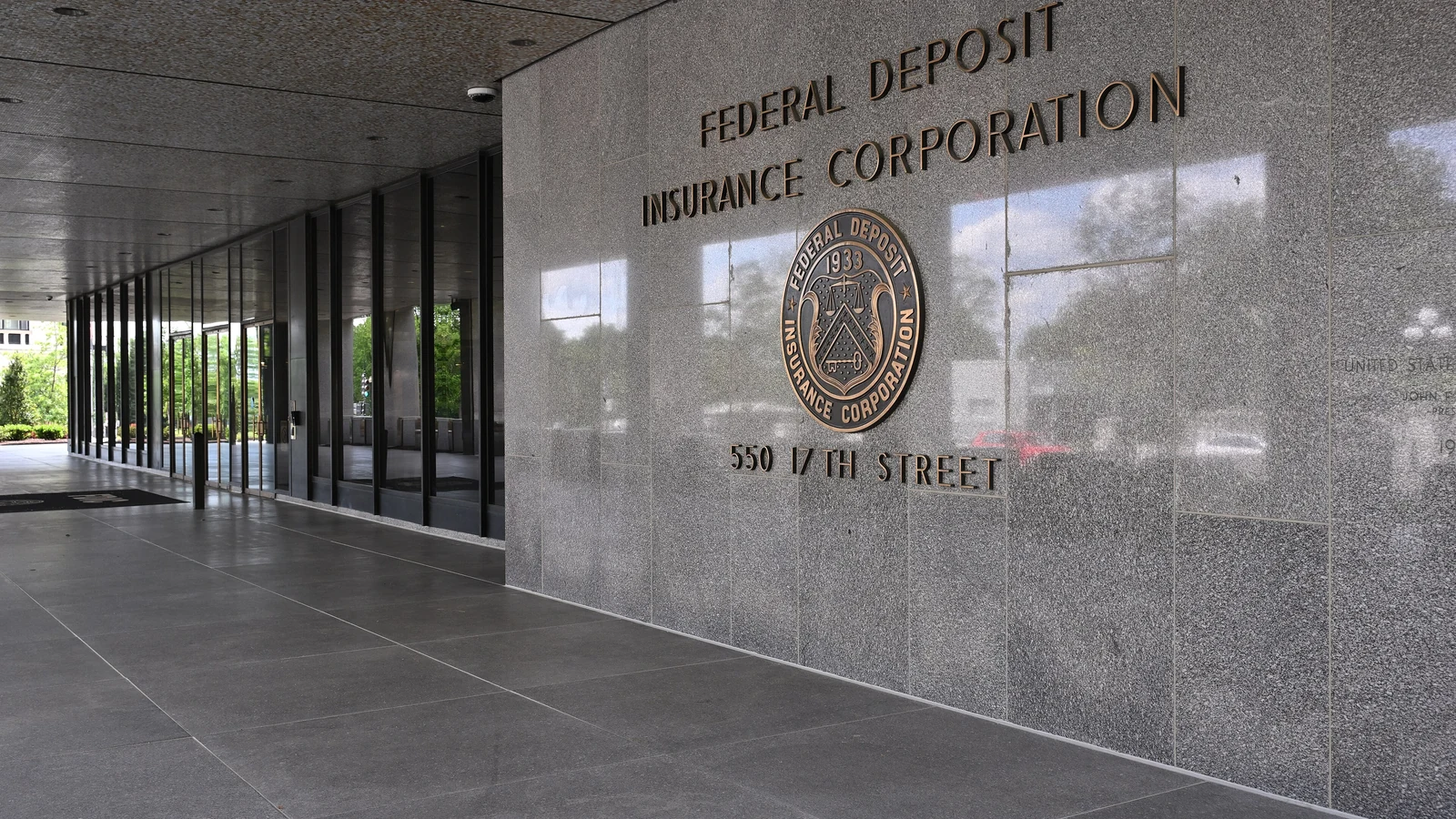
The hero photograph shows the FDIC entrance at 550 17th Street NW in Washington. Photo by G. Edward Johnson, licensed CC BY 4.0 through Wikimedia Commons.
Official records and further reading
- FDIC 2025 Annual Report
- FDIC 2026 operating budget memorandum
- FDIC Statistics at a Glance
- GAO-25-106771: Bank Supervision
- GAO-26-108958: FDIC priority recommendations
- GAO-26-107996: FDIC funds financial audit
- FDIC examiner training program
- OPM Federal Workforce Data
- Browse current federal jobs
- Explore federal workforce statistics
Continue reading
More from FederalHiringData
Data investigationsAugust 18, 2026
FEMA's Public Workforce Count Fell 22% as GAO Warned of Readiness Risks
FEMA had 5,793 fewer covered civilian employees in June 2026 than in January 2025. GAO says the agency cut staff without the workforce planning needed to assess mission capacity.

Data investigationsAugust 25, 2026
CFPB Lost 670 Covered Employees as Complaint Intake Reached 6.6 Million
Covered CFPB employment fell 38.2% while complaint intake reached 6.6 million and leadership narrowed supervision and enforcement priorities.
Data investigationsAugust 24, 2026
Federal Student Aid Lost 46% of Its Workforce. Two Loan-Servicer Checks Stopped.
Federal Student Aid stopped two contractor-oversight checks as its covered workforce fell by nearly half while the loan portfolio reached $1.724 trillion.
Federal Hiring Data Weekly
Get the biggest federal workforce changes in your inbox.
Subscribe to Federal Hiring Data Weekly for federal hiring trends, salary data, agency movements, and original investigations, with email confirmation before delivery.