August 27, 2026
Federal Jobs Open to the Public Rose 50%. They Remained 17% Below 2024.
Public-access USAJOBS announcements rose 50% from the 2025 trough, but remained 17% below 2024. Agency, occupation and grade data show where outsider access actually returned.
Published August 27, 2026Last edited August 27, 2026
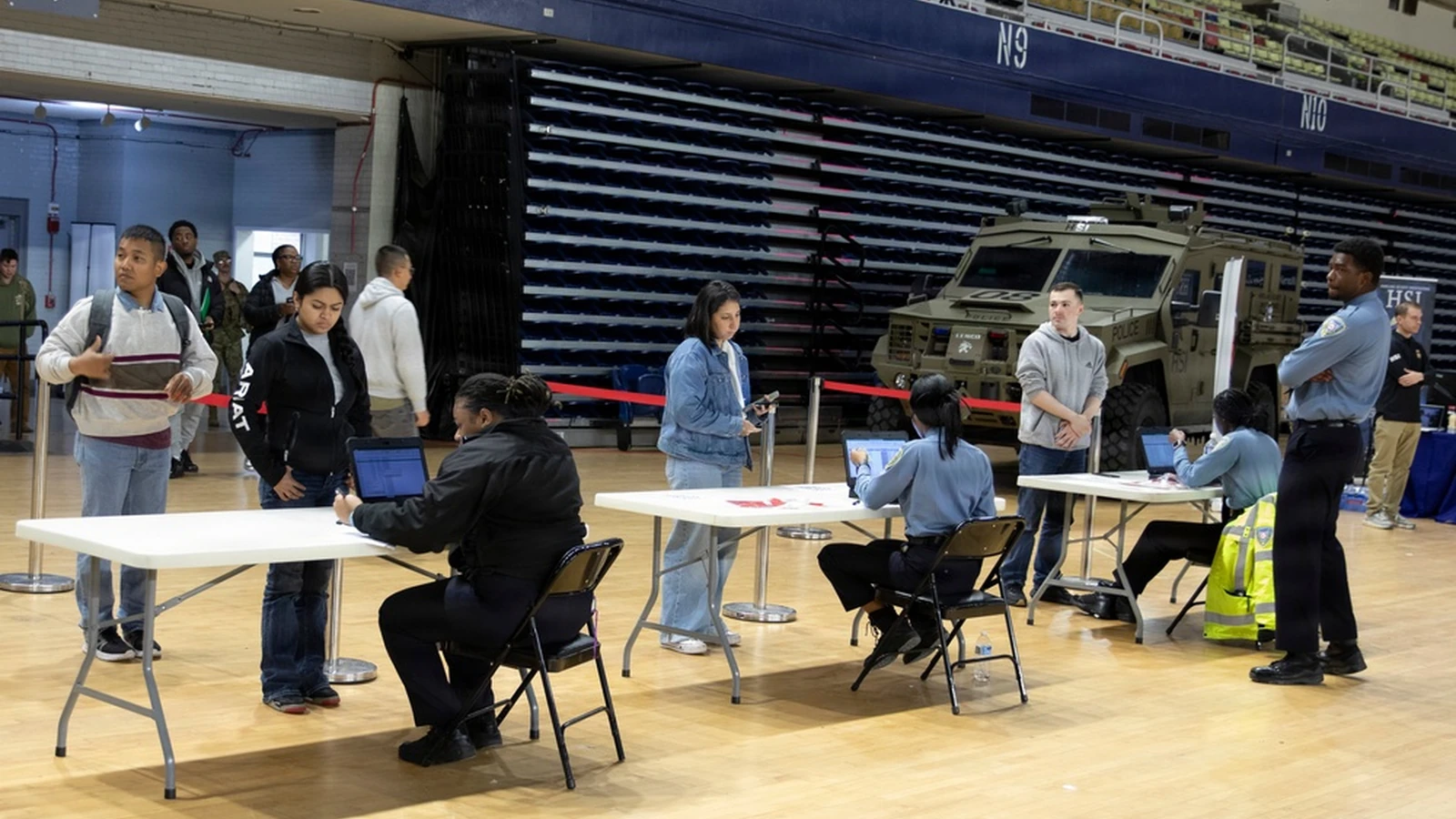
The federal job board is busier than it was during the 2025 hiring collapse. That still does not answer the question an applicant outside government needs answered: How many of those jobs can I actually apply for?
FederalHiringData counted 168,429 official USAJOBS announcements opened from Jan. 1 through Aug. 26, 2026. Of those, 83,923 explicitly named “The public” as an eligible hiring path. Public-access announcements rose 50.0% from the comparable 2025 archive period.
The rebound stopped short of restoration. The 2026 public count remained 16.7% below the 100,729 public-access announcements in the same part of 2024. Total announcement volume was further behind: 30.8% below 2024.
That split verdict is the useful one for job seekers. Federal recruiting recovered sharply from the 2025 trough, and about half of 2026 announcements admitted the public. But the outside-applicant market had not returned to its pre-cut scale. Internal, federal-employee and career-transition routes expanded at almost the same rate, so the rebound did not make USAJOBS materially more public in proportional terms.

What “open to the public” measures
USAJOBS uses hiring paths to describe who is eligible to apply. Its eligibility guidance tells applicants to read the “This job is open to” section and explains that agencies can limit announcements to particular groups. A person can be well qualified for the duties and still be ineligible under the paths named in the announcement.
For this analysis, an announcement is public-accessible only when its stored USAJOBS audience data explicitly name “The public” or an equivalent legacy all-citizens label. Veterans, military spouses, people with disabilities, students, recent graduates and displaced federal employees have important routes into government, but those labels alone do not make an announcement open to every outside applicant.
The unit is one announcement control number. It is not one vacancy. An announcement can advertise one opening, many openings or an unspecified number; it can also cover multiple locations. The counts therefore measure recruiting opportunities advertised through distinct announcements, not positions filled.
| Matched period, Jan. 1-Aug. 26 | All announcements | Explicitly public | Public share | Change in public count from 2025 |
|---|---|---|---|---|
| 2024 | 243,377 | 100,729 | 41.4% | +80.0% |
| 2025 | 111,858 | 55,938 | 50.0% | Baseline |
| 2026 | 168,429 | 83,923 | 49.8% | +50.0% |
The historical archive retained 99.89% of the official API total for the 2024 comparison and 99.15% for 2025. The 2026 cohort came directly from complete monthly Historic JOA API pulls, with returned unique controls reconciled to the API total. Those small baseline gaps are disclosed because even a large archive should not be described as perfect.
The public share did not rise with the rebound
The number of announcements open to the public increased because the whole market increased. The public share was 49.8% in 2026, essentially unchanged from 50.0% in the depressed 2025 comparison.
Internal and transition pathways grew alongside it. Announcements naming an internal agency, federal-employee, merit-promotion or CTAP/ICTAP career-transition route increased from 67,266 in 2025 to 105,430 in 2026. Those categories overlap with public access, so they cannot be added to the public count.
The monthly record shows why a simple “freeze lifted” label is inadequate. The public share of announcements was 51.9% in January 2026, moved below 50% from March through June, rose to 51.1% in July and stood at 49.2% for Aug. 1–26. Announcement volume rose substantially through spring, but the applicant-access mix stayed near an even split.

The policy environment also did not revert to the pre-2025 system. OPM guidance implementing Executive Order 14356 requires agency strategic hiring committees and staffing plans. Before an approved annual plan, the guidance applies a one-new-hire-for-four-departures limit, subject to legal requirements and listed exceptions. A larger job board can therefore coexist with centralized review of which vacancies agencies may fill.
This analysis does not claim that the controls caused any specific agency's mix. It shows the outcome applicants encountered while those controls were in place.
Public and internal routes often share one announcement
Hiring paths are overlapping lanes, not a binary switch. In 2026, 57,263 announcements named the public without one of the internal or transition signals measured here. Another 26,660 named both the public and at least one internal, federal-employee or transition route.
The remaining groups were much larger than a casual scan of public listings might suggest. There were 78,770 announcements with an internal or transition signal but no public path, plus 5,736 that had another audience or no classifiable signal.

| Mutually exclusive access pattern | 2024 | 2025 | 2026 |
|---|---|---|---|
| Public, no measured internal/transition path | 73,360 | 40,409 | 57,263 |
| Public plus internal/transition path | 27,369 | 15,529 | 26,660 |
| Internal/transition, no public path | 134,020 | 51,737 | 78,770 |
| Other audience or unclear | 8,628 | 4,183 | 5,736 |
These rows count every announcement once. They do not imply that the public-only group had no other special paths. An announcement can be open to the public and also name veterans or military spouses without being classified as internal. The internal measure includes career-transition programs because the applicant question in this story is access without federal or transition status.
Among the overlapping 2026 labels, 64,393 announcements named Career Transition Assistance Plan, Interagency Career Transition Assistance Plan or Reemployment Priority List eligibility. Veterans appeared on 41,387, military spouses on 40,655, land and base management on 31,463, people with disabilities on 26,824, and special authorities on 17,583. Students and recent graduates appeared on fewer than 1,000 announcements each.
That does not mean those groups received that many jobs. It means the announcements invited applicants through those routes. One announcement can appear in several of those label counts.
Three large systems drove much of the public increase
Related research
Put this finding in context

Hiring processAugust 26, 2026
USCIS Recruiting Rebounded 153%. Immigration Services Officer Postings Rose by Three.
USCIS recruiting rebounded from its early-2025 low, but frontline Immigration Services Officer and asylum-officer postings remained sparse.
Hiring processAugust 17, 2026
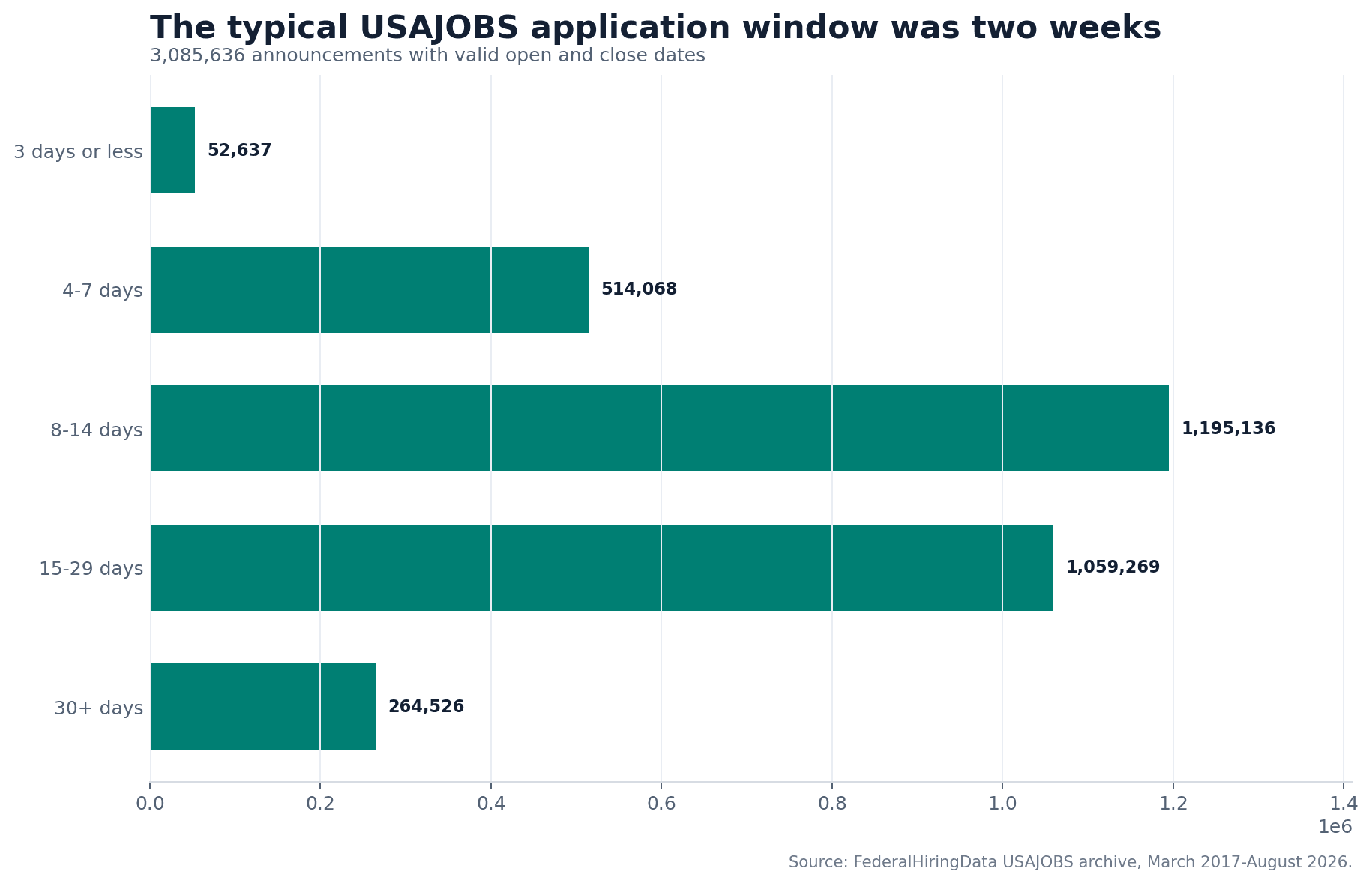
How Long USAJOBS Announcements Stay Open: 3.09 Million Records
Across 3,085,636 announcements, the median application window was 14 days and 566,705 closed within a week.
The 2026 public rebound was concentrated. Veterans Health Administration produced 29,432 public-access announcements in the matched period, 8,324 more than in 2025. United States Army Installation Management Command increased by 4,216, and military treatment facilities under the Defense Health Agency increased by 3,194.
Those three agency codes accounted for 15,734 of the 27,985 net increase in public-access announcements. In other words, more than half of the national gain came from one large health system and two defense-related systems.

| Agency | Public, 2025 | Public, 2026 | Change | 2026 public share |
|---|---|---|---|---|
| Veterans Health Administration | 21,108 | 29,432 | +8,324 | 60.8% |
| Army Installation Management Command | 353 | 4,569 | +4,216 | 88.6% |
| Military treatment facilities under DHA | 2,340 | 5,534 | +3,194 | 88.3% |
| U.S. Attorneys and Executive Office | 390 | 1,441 | +1,051 | 54.6% |
| Commander, Navy Installations Command | 3,365 | 4,361 | +996 | 71.3% |
| Bureau of Prisons | 1,599 | 2,532 | +933 | 51.7% |
| National Park Service | 718 | 1,407 | +689 | 65.9% |
| Air Force Materiel Command | 435 | 974 | +539 | 68.0% |
Stable USAJOBS agency codes were used for year-to-year matching so name changes did not create false “new agency” gains. The display table uses the latest names.
Not every large agency reopened to outsiders at the same rate. Federal Aviation Administration published 3,028 announcements in the 2026 cohort, but only 189 explicitly admitted the public, a 6.2% share. U.S. Pacific Fleet's public share was 4.5%, Army National Guard Units 14.8%, Office of Personnel Management 9.6%, and Air Force Reserve Command headquarters 5.1%.
At the other end, public access exceeded 80% at Army Installation Management Command, military treatment facilities, U.S. Army Medical Command, Space Systems Command and several smaller intelligence or legislative employers. A high share does not prove easy competition. It only means lack of current federal status was less likely to be the first barrier.
There were also outright declines. FEMA recorded 374 fewer public announcements than in the comparable 2025 period, Indian Health Service 343 fewer, Naval Facilities Engineering Systems Command 113 fewer, Army Reserve Command 107 fewer and Defense Contract Management Agency 106 fewer.
The practical lesson is that “federal hiring” is too broad a market description. Agency choice mattered as much as the national trend.
Nurses, physicians, attorneys and IT led outsider access
Occupation produced another sharp split. Nurse series 0610 added 2,546 public-access announcements from 2025 to 2026. General Attorney, series 0905, added 1,462; Medical Officer, 0602, added 1,458; Information Technology Management, 2210, added 1,392; and General Engineering, 0801, added 883.

| Occupational series | Public, 2025 | Public, 2026 | Change | 2026 public share |
|---|---|---|---|---|
| 0610 Nurse | 5,277 | 7,823 | +2,546 | 80.7% |
| 0905 General Attorney | 601 | 2,063 | +1,462 | 87.0% |
| 0602 Medical Officer | 2,650 | 4,108 | +1,458 | 92.0% |
| 2210 Information Technology Management | 1,361 | 2,753 | +1,392 | 49.5% |
| 0801 General Engineering | 465 | 1,348 | +883 | 48.0% |
| 0679 Medical Support Assistance | 1,502 | 2,261 | +759 | 62.6% |
| 0301 Miscellaneous Administration and Program | 1,006 | 1,749 | +743 | 20.9% |
| 0303 Miscellaneous Clerk and Assistant | 1,327 | 2,030 | +703 | 46.2% |
| 1101 General Business and Industry | 1,372 | 2,012 | +640 | 52.0% |
| 0185 Social Work | 2,072 | 2,681 | +609 | 67.5% |
The count and the share answer different questions. Management and Program Analysis, series 0343, produced 5,614 announcements in 2026, but only 16.5% named the public. General business and industry added 640 public announcements, yet its public share fell from 63.3% to 52.0%. Miscellaneous clerk and assistant added public volume while its share fell from 54.6% to 46.2%.
Medical occupations were more consistently accessible to outsiders. More than nine in ten Medical Officer announcements and about eight in ten Nurse announcements named the public. That helps explain why health agencies dominate both the public-access count and the high end of advertised salary ranges.
An applicant should therefore search on both dimensions: Is the occupation growing, and what share of that series is actually open to the public? A large internal market is still meaningful to current employees, but it is not a substitute for an outside route.
Lower grades were more public
Entry-grade announcements were much more likely to admit outsiders. In 2026, 66.0% of announcements starting at grades 1–7 named the public. The share was 39.3% for grades 8–12 and 38.4% for grades 13–15.

Federal Hiring Data Weekly
Get the biggest federal workforce changes in your inbox.
Subscribe to Federal Hiring Data Weekly for federal hiring trends, salary data, agency movements, and original investigations, with email confirmation before delivery.
That gap is directionally consistent with a system in which many higher-grade opportunities are filled through merit promotion, internal competition or status-based routes. It does not mean every low-grade announcement was entry level in the ordinary sense, and it does not mean an outsider cannot compete for senior work. Specialized public announcements for physicians, attorneys, engineers and other experts are visible in the occupation results.
Pay followed the grade mix. Among announcements with annualizable salary data in the study range, the median advertised maximum was about $97,087 for public-access announcements and $116,362 for internal/transition-only announcements in 2026. Those are announcement maximums, not offers or actual pay. Hourly, daily, weekly and monthly maximums were annualized using standard full-time multipliers; values outside $15,000 to $500,000 were excluded from the median calculation.
The median does not control for occupation, locality, special salary rates or full-performance grade. It describes the mix of announcements available through each route, not a pay penalty caused by public eligibility.
Direct Hire grew, but the label is an incomplete measure
A conservative title search found 1,398 public-access announcements with “Direct Hire” or “Direct-Hire” in the title in 2026. That was more than double 2025's 690, but below the 2,366 title matches in the 2024 comparison.
| Public announcements with explicit title signal | 2024 | 2025 | 2026 |
|---|---|---|---|
| Direct Hire / Direct-Hire in title | 2,366 | 690 | 1,398 |
This is a floor. Agencies can use Direct Hire Authority without putting those words in the title. A complete measure would require appointment authority codes or reliable announcement-body fields across every historical year.
OPM's Direct Hire guidance says the authority is available when OPM determines there is a severe shortage of candidates or critical hiring need. Agencies must provide public notice, and selectees still must meet citizenship, qualification, suitability and other requirements. Direct Hire removes competitive rating and ranking procedures covered by the authority; it does not mean an applicant is automatically selected.
OPM new-hire actions confirm a recovery, with limits
USAJOBS measures the recruiting invitation. OPM personnel actions measure people entering covered agency workforces.
From January through May 2026, OPM recorded 67,981 new-hire actions and 1,549 transfer-in actions. New-hire actions were 28.9% above the 52,748 recorded in the same months of 2025, but 38.6% below 2024's 110,793.

| OPM accessions, January-May | New-hire actions | Transfer-in actions |
|---|---|---|
| 2024 | 110,793 | 6,683 |
| 2025 | 52,748 | 2,164 |
| 2026 | 67,981 | 1,549 |
The comparison supports the same recovery-from-a-trough conclusion, but it is not a conversion rate for the USAJOBS announcements. OPM's FedScope definitions say new hires generally include appointments from outside government, while also counting some moves from excepted service or between types of federal service as new hires rather than transfers. An announcement's public label does not reveal which hiring path the eventual selectee used.
Timing differs too. A January–May accession can follow an announcement opened weeks or months earlier. An announcement can close without a selection, and one announcement can produce several hires. The two systems are parallel evidence about different stages of hiring.
Remote and telework are not the same access question
The Historic JOA field supplied for telework was not usable as a comparative trend in this cohort; it was uniformly coded “N” even when richer current announcement data preserved telework details. FederalHiringData therefore did not turn that field into a historical remote-work claim.
A separate current-active snapshot provides limited context. Among 8,517 active announcements explicitly open to the public at capture time, 20 were confirmed fully remote, 1,799 were telework-eligible but not confirmed remote, and 6,698 were on-site or unspecified.
Telework eligibility means some work away from the regular duty site may be permitted under agency policy. It does not mean the position can be performed from anywhere. The small confirmed-remote count also says nothing about applicant volume or competitiveness. This evidence is too sparse and too different from the historical field to support a remote-work trend article.
What an outside applicant should do with the numbers
First, treat “This job is open to” as a screening rule, not a decorative label. USAJOBS lists the major hiring paths and explains the status each requires. If “The public” is absent, look for another path you can document before investing time in the application.
Second, do not assume a public and an internal announcement are duplicates, or that they will produce the same process. Agencies can advertise related needs under different control numbers, deadlines, grades or authorities. Read each announcement's eligibility, qualifications, required documents and area of consideration.
Third, aim searches where both volume and access are favorable. In this study, medical officers, attorneys, nurses, medical support assistants and social workers combined strong public shares with substantial 2026 volume. IT and engineering offered thousands of public announcements, but roughly half of their total markets remained outside the public path. Administrative series often tilted further toward internal routes.
Fourth, use grade filters deliberately. Lower starting grades had wider public access, but experienced outsiders should not automatically search down. Public medical, legal, technical and scientific announcements reached senior grades. The right comparison is among announcements for which the applicant is eligible and qualified.
FederalHiringData's current job search can narrow active announcements by agency, occupation, grade and other attributes. The occupations directory and agency directory help establish where a field or employer is active. Historical records describe the market that existed; they are not open applications.
Methodology and limitations
FederalHiringData analyzed distinct USAJOBS announcement control numbers by position-open date. The comparison window is Jan. 1 through Aug. 26 in 2024, 2025 and 2026. That matched cutoff prevents a partial 2026 from being compared with full prior years.
The 2026 source is 168,429 records retrieved from the official USAJOBS Historic JOA API in eight complete monthly cohorts. Every returned control was unique across those files, and each file's count matched the API's reported total. The 2024 and 2025 path calculations use the FederalHiringData historical USAJOBS archive with current-job records added only when they did not overlap the archive. One overlapping control was excluded. API count checks measured 99.89% archive coverage for the 2024 matched period and 99.15% for 2025.
Public access requires an explicit public or equivalent legacy all-citizens audience label. Internal/transition includes internal-agency, competitive-service, excepted-service, current civil-service, status-candidate, merit-promotion and CTAP/ICTAP/RPL signals. The exclusive cohort table assigns every announcement to one row; the detailed special-path counts overlap.
Agency comparisons use stable USAJOBS agency codes. Occupation rows count an announcement once within each series it lists, so an announcement with multiple series can appear in more than one occupation row. Grade bands use minimum advertised grade. Salary maximums are normalized annual rates when the interval can be interpreted; they remain advertised bounds, not actual compensation.
The OPM comparison uses January–May because that is the latest complete common period in the local official accession data. New-hire and transfer-in actions are not matched to announcements or people in the USAJOBS cohort.
This article updates and materially extends FederalHiringData's earlier 2025 public-versus-internal hiring-path explainer. That article described one April–November 2025 cohort. This study asks a different question: whether outsider access recovered after the 2025 hiring contraction, using matched 2024–2026 periods, stable agency codes, occupation and grade comparisons, current active-work-arrangement context, and OPM accession records.
A July r/usajobs discussion helped identify the applicant question. Reddit comments were not used as evidence for any count or federal rule.
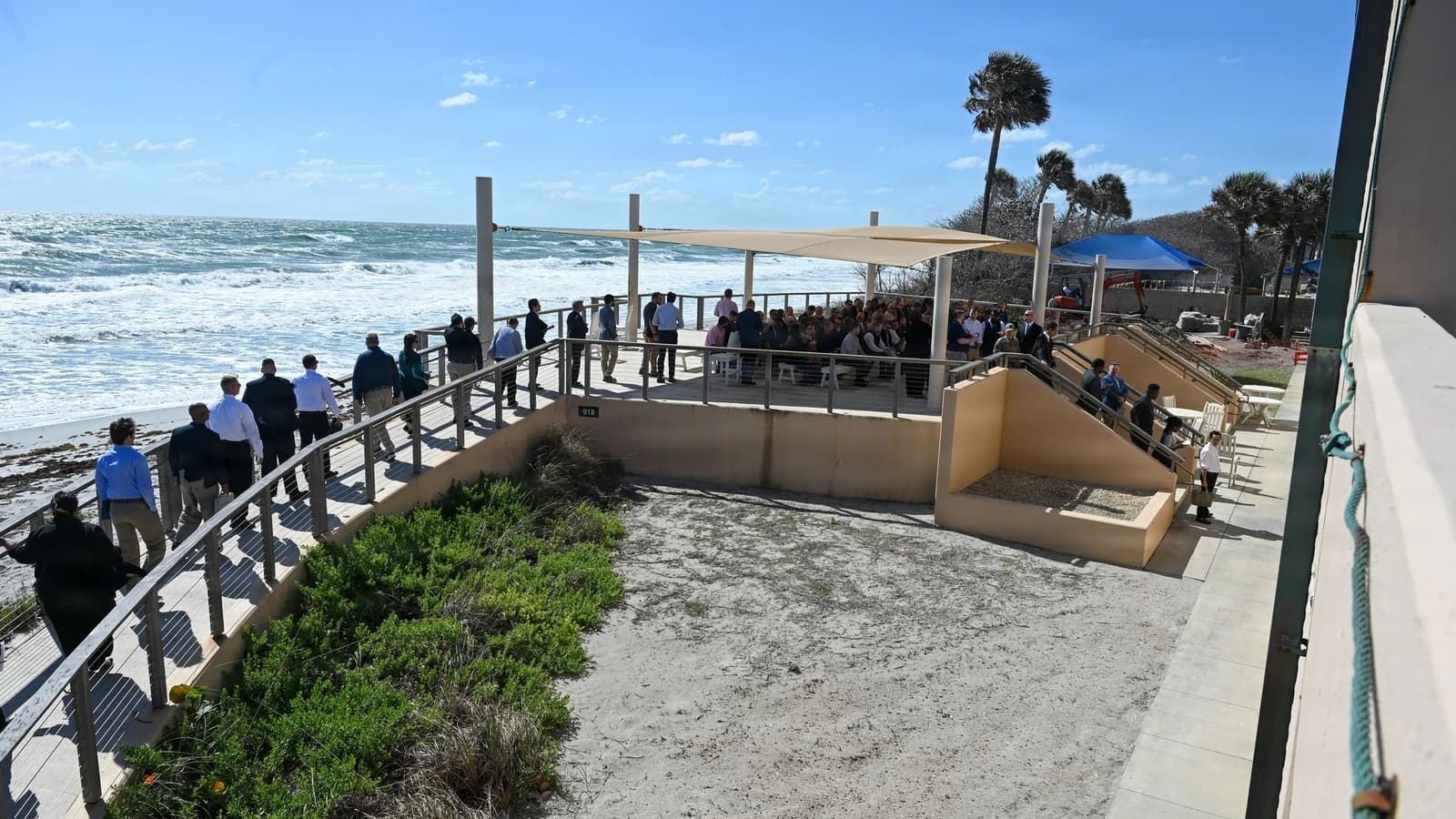
Photo: Sgt. Thomas Norris, U.S. Army National Guard, via DVIDS, public domain.
Related research
More from FederalHiringData
Federal workforceAugust 27, 2026
Federal Hiring Rebounded 27% in 2026. It Was Still 41% Below 2024.
Federal accessions and USAJOBS announcements recovered from the 2025 trough, but headcount kept falling and the rebound remained uneven.
Career pathsAugust 17, 2026
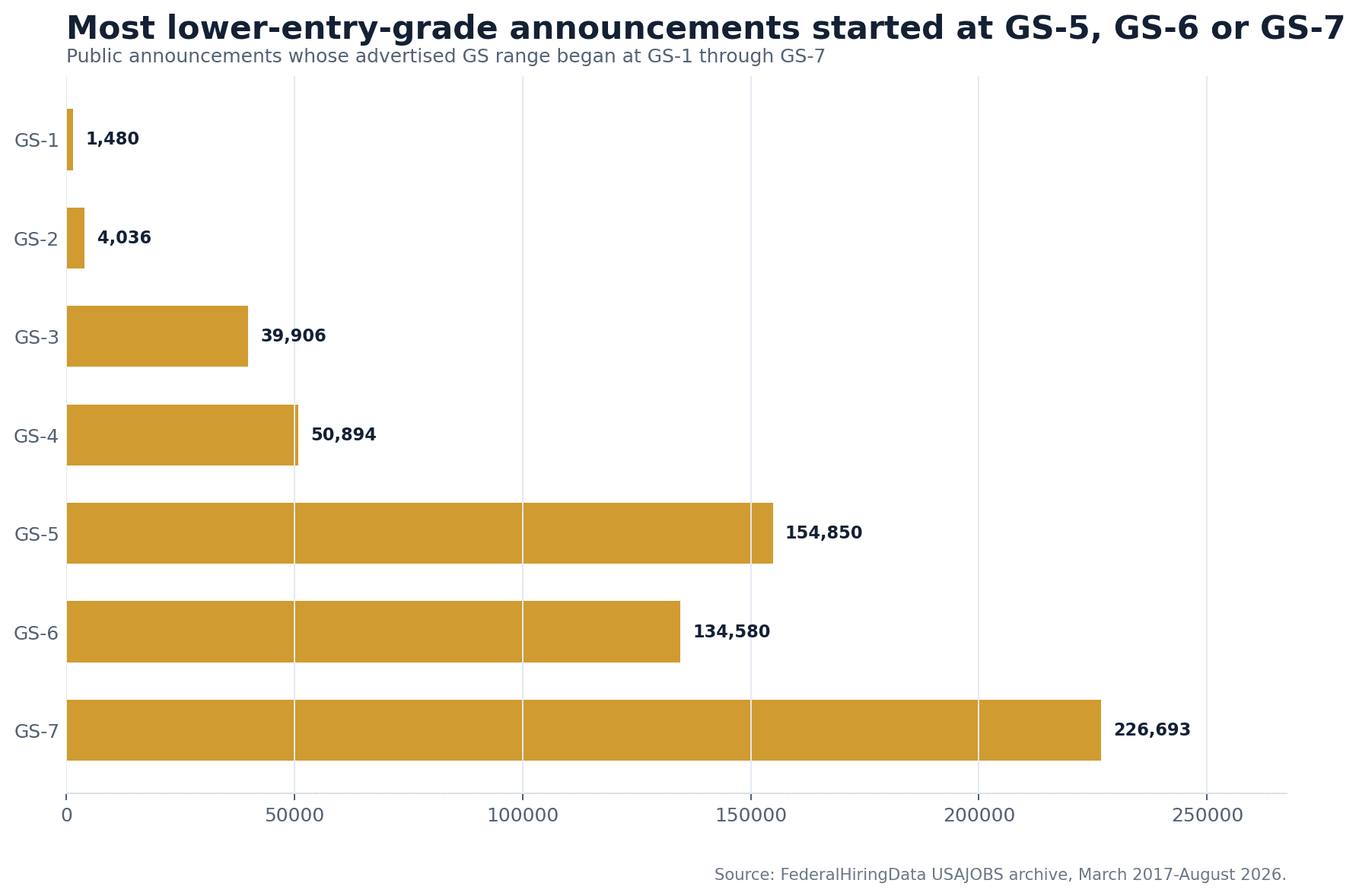
Where Federal Job Announcements Start at GS-7 or Below
The USAJOBS archive contains 612,439 public announcements whose advertised GS range began at GS-7 or below, led by clerical and health-support series.
Hiring processAugust 27, 2026
181,700 USAJOBS Announcements Used Applicant Cutoffs. Remote Postings Used Them Far More Often.
FederalHiringData found 181,700 official applicant-cutoff announcements since 2019, with especially heavy use in remote, emergency and park recruiting.
Federal Hiring Data Weekly
Get the biggest federal workforce changes in your inbox.
Subscribe to Federal Hiring Data Weekly for federal hiring trends, salary data, agency movements, and original investigations, with email confirmation before delivery.