August 28, 2026
55,135 Federal Retirement Actions in 2025 Were Below Age 60. That Is Not a FERS Supplement Count.
OPM records show a 2025 retirement surge below age 60, but age alone cannot identify who receives the FERS annuity supplement.
Published August 28, 2026Last edited August 28, 2026

Federal retirement discussions often reduce the FERS annuity supplement to one question: will it still be there? The harder question comes first. How many workers retire early enough, under the right authority and with enough service, to receive it at all?
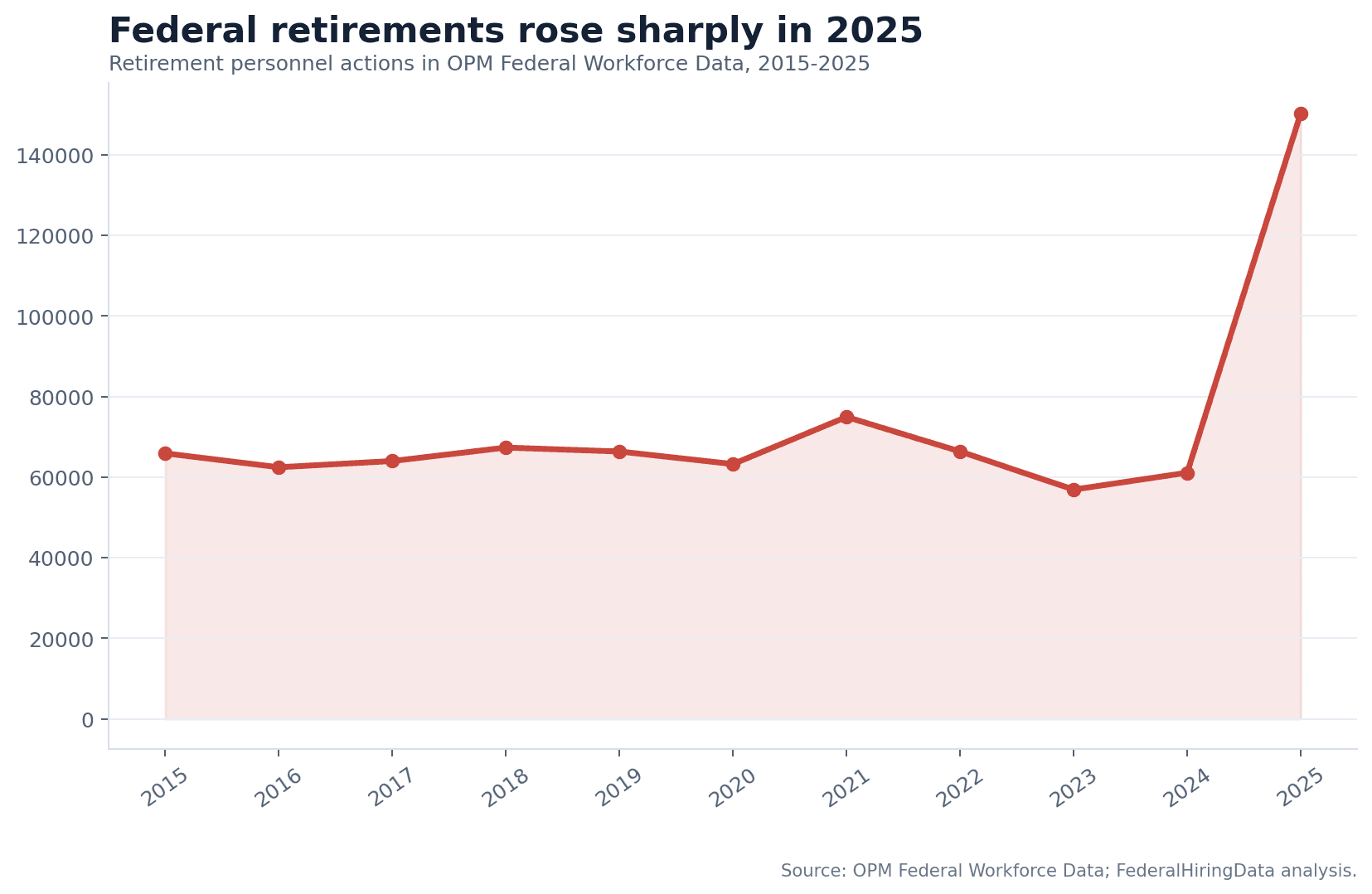
The public federal workforce data cannot produce a clean recipient count. They can, however, show why the issue became more consequential in 2025. FederalHiringData found 55,135 retirement actions in age bands below 60 that year, up from 16,051 in 2024. Early-out retirement actions rose from 196 to 27,638. The overall retirement total reached 150,299, more than double the prior year's 61,122.
Those numbers do not say 55,135 people received the supplement. They count retirement actions, not payments. The files do not identify retirement system, precise age, exact creditable service or whether post-retirement earnings reduced a payment. Some employees retire before 62 through paths that do not qualify. Others in special retirement categories follow different rules.
What the numbers establish is narrower and still important: the age group for whom a bridge to age 62 could matter expanded sharply during the government's 2025 separation wave. At the same time, a House proposal to eliminate the supplement for many future retirees and shift pension calculations from high-3 to high-5 did not become law. Current statute still authorizes the supplement. A separate 2026 bill addresses how court orders divide it, not whether the benefit exists.
The supplement is a bridge, not early Social Security
The FERS annuity supplement is paid by the federal retirement system. It is not a Social Security retirement benefit, and receiving it does not mean a person filed for Social Security before age 62. OPM computes an estimate of the Social Security benefit attributable to the retiree's FERS civilian service and pays that amount with the FERS annuity for a limited period.
For an ordinary immediate voluntary retirement, two common qualifying paths are reaching the minimum retirement age with at least 30 years of service, or reaching age 60 with at least 20 years. The minimum retirement age varies by birth year and reaches 57 for people born in 1970 or later. The supplement generally ends at age 62, whether or not the retiree claims Social Security then.
Eligibility is not simply “retired before 62.” OPM's current rules draw important lines:
| Retirement path | Basic age/service rule | Supplement treatment before 62 |
|---|---|---|
| Immediate voluntary | MRA with 30 years, or age 60 with 20 years | Generally eligible |
| Voluntary early retirement / VERA | Age 50 with 20 years, or any age with 25 years, plus agency authority | May begin at MRA |
| Discontinued service | Similar age/service threshold plus qualifying involuntary separation | May begin at MRA |
| MRA+10 | MRA with at least 10 years but fewer than 30 | Not eligible |
| Deferred retirement | Former employee claims later after leaving | Not eligible |
| Disability retirement | Separate medical and service rules | Not eligible |
| Enhanced retirement | Law enforcement, firefighters, air traffic control and certain other covered positions | Special rules; often payable before MRA, with earnings-test differences |
The table is a guide to categories, not an individual determination. Deposits, refunds, part-time service, military service, coverage codes, the separation authority and the exact annuity commencing date can change the answer. An employee should use the retirement coverage and service history maintained by the employing agency and OPM rather than infer eligibility from age alone.
The 2025 retirement wave changed the scale
OPM's public separation file records voluntary retirement, early-out retirement and other retirement as distinct personnel-action categories. FederalHiringData combined those categories for a consistent annual series from 2015 through 2025.

From 2015 through 2024, annual retirement actions ranged from 56,932 to 74,966. The below-60 count ranged from 16,051 to 23,614. Calendar 2025 broke both patterns: 150,299 retirement actions overall and 55,135 below age 60.
The lower-age group accounted for 36.7% of 2025 retirement actions. That is a conservative lower bound for retirement before 62 because everyone below 60 is also below 62. It leaves out people ages 60 and 61 who are mixed into OPM's 60-64 band.
An intentionally loose upper bound adds that entire band. On that basis, as many as 105,837 actions, or 70.4%, occurred below age 65. That is not an estimate of pre-62 retirements. It is a ceiling that necessarily includes people ages 62 through 64, after the supplement normally ends. The true pre-62 action count lies somewhere between the two bounds, but the public bands do not show where.

The early-out category explains much of the break. OPM recorded 27,638 early-out retirement actions in 2025, compared with 196 in 2024. Below-age-60 actions increased by 39,084. The two changes are not identical because early-out actions can occur at 60 or older and below-60 workers can retire voluntarily or under another category.
Monthly timing makes the surge even clearer. September recorded 53,192 retirement actions, including 14,254 early-outs. December recorded 35,299, including 6,160 early-outs. The remaining months were far closer to the recent historical range.

The first half of 2026 did not continue at the same pace. OPM recorded 27,154 retirement actions from January through June, including 852 early-outs. That partial period should not be compared with a full year, but it shows that the extraordinary 2025 total was concentrated rather than a smooth new monthly baseline.
Age bands show who was inside the surge
In 2025, the largest retirement band was age 60-64, with 50,702 actions. Age 65 and older accounted for 44,462. The age 55-59 band accounted for 35,761, and age 50-54 accounted for 15,929.

Voluntary retirement dominated at age 60 and above. Early-out actions were concentrated in the younger bands: 10,424 among ages 50-54 and 13,943 among ages 55-59. Those two bands alone accounted for 24,367 early-out actions.
That is the population-level connection to the supplement. A VERA retiree can separate at age 50 with 20 years, or at any age with 25 years, but OPM says the supplement generally does not begin until the person's minimum retirement age. A 52-year-old early-out retiree may therefore have an annuity but no supplement for several years. A 57-year-old may be at MRA, depending on birth year. The public age bands do not provide birthdays or annuity start dates.
The distinction also matters for workers who use MRA+10. Someone can retire at MRA with at least 10 years and accept, or postpone to reduce, an age-based annuity reduction. That path does not carry the supplement. Counting every 55-59 retirement as supplement-eligible would therefore combine unlike cases.
Agencies show different exposure patterns
The 2025 wave was broad, but the below-60 count and share varied substantially by agency.
| Agency | All retirement actions | Below age 60 | Below-60 share |
|---|---|---|---|
| Department Of Treasury | 13,954 | 5,333 | 38.2% |
| Department Of Justice | 7,297 | 5,036 | 69.0% |
| Department Of Homeland Security | 10,443 | 4,598 | 44.0% |
| Department Of The Army | 14,395 | 4,367 | 30.3% |
| Department Of Veterans Affairs | 16,888 | 4,040 | 23.9% |
| Department Of The Navy | 12,945 | 3,921 | 30.3% |
| Department Of Agriculture | 8,767 | 3,815 | 43.5% |
| Department Of The Air Force | 10,078 | 2,962 | 29.4% |
| Department Of Health And Human Services | 7,212 | 2,880 | 39.9% |
| Department Of Defense | 9,489 | 2,572 | 27.1% |

Treasury recorded 5,333 below-60 retirement actions, the largest count. Justice recorded 5,035, or 69.0% of its retirement actions. Homeland Security recorded 4,598, or 44.0%. The Army, Veterans Affairs, Navy and Agriculture each recorded more than 3,800.
Those differences cannot be interpreted as agency supplement rates. Agencies have different age structures, occupational mixes and use of enhanced retirement systems. Justice and Homeland Security employ large law-enforcement populations with earlier mandatory or optional retirement patterns. Treasury's 2025 total also reflects the timing and composition of that year's workforce reductions. The action file does not say who applied for or received an OPM supplement payment.
Special retirement groups must remain separate
Federal Hiring Data Weekly
Get the biggest federal workforce changes in your inbox.
Subscribe to Federal Hiring Data Weekly for federal hiring trends, salary data, agency movements, and original investigations, with email confirmation before delivery.
The clearest warning against governmentwide generalization appears in occupation series. In 2025, 98.9% of retirement actions in series 1811 criminal investigation were below age 60. The shares were 97.6% in Border Patrol enforcement series 1896 and 98.3% in correctional officer series 0007. Air traffic control series 2152 had a 76.0% below-60 share.
| Selected occupation series | All retirement actions | Below age 60 | Below-60 share |
|---|---|---|---|
| 0343 Management And Program Analysis | 10,783 | 4,693 | 43.5% |
| 0301 Miscellaneous Administration And Program | 10,524 | 4,051 | 38.5% |
| 2210 Information Technology Management | 9,454 | 3,253 | 34.4% |
| 1811 Criminal Investigation | 2,870 | 2,838 | 98.9% |
| 0201 Human Resources Management | 3,528 | 1,669 | 47.3% |
| 1102 Contracting | 3,265 | 1,413 | 43.3% |
| 1896 Border Patrol Enforcement Series | 676 | 660 | 97.6% |
| 0007 Correctional Officer | 530 | 522 | 98.5% |
| 2152 Air Traffic Control | 637 | 484 | 76.0% |

By comparison, management and program analysis series 0343 had a 43.5% share, information technology management 2210 had 34.4%, and contracting 1102 had 43.3%.
The red bars in the chart are occupation series commonly associated with enhanced retirement coverage, but a series code is not proof that every position is covered. Coverage depends on the duties and official position determination. Still, the pattern explains why a single “federal retiree” average would be misleading. Enhanced law-enforcement officers, firefighters and air traffic controllers may retire under age and service rules designed for those careers. OPM's 2025 guidance also says their supplement is not subject to the earnings test until they reach MRA; after MRA, the test applies.
Ordinary FERS retirees do not receive that pre-MRA exception merely because they leave young. A VERA retirement may begin before MRA, but the supplement waits. A deferred or MRA+10 annuity does not receive it. These are benefit-law distinctions that the personnel-action file cannot resolve.
How many current employees are approaching a possible path?
FederalHiringData also screened OPM's June 2026 employment file by broad age and recorded length of service. The result is useful for scale and deliberately not labeled eligibility.
| Broad screen | June 2026 headcount |
|---|---|
| Age 55-59, 30+ service years | 36,599 |
| Age 60-64, 20+ service years | 75,801 |
| Age 50-54, 20+ service years | 93,969 |
| Under 50, 25+ service years | 26,892 |

The largest screen is 93,969 employees ages 50-54 with at least 20 recorded service years. That resembles the age-and-service threshold used for VERA, but most agencies are not continuously under VERA authority, and the file does not establish FERS coverage or retirement-credit service. Another 75,801 employees were ages 60-64 with at least 20 years, but the band includes ages 62-64, when the supplement normally is no longer payable. The 36,599 employees ages 55-59 with at least 30 years are the closest broad screen to MRA+30, yet even that group includes people younger than their MRA and people outside FERS.
The current employment denominator is 1,953,300 employees represented in OPM's June 2026 public file. It excludes some security-sensitive and non-covered populations and does not include the Postal Service in the same way OPM's retirement fund reports do. Service-computation-date leave can differ from retirement-credit service. None of the four screening counts should be added together and called future supplement recipients.
The honest conclusion is a range of exposure, not a forecast. Tens of thousands of current employees sit in age-and-service combinations relevant to immediate or early retirement. Actual eligibility depends on coverage and separation facts not published in the file. Actual dependence on the supplement depends on household finances and post-retirement work, which no federal workforce dataset shows.
Work after retirement can reduce the payment
The supplement carries an earnings test modeled on Social Security's retirement earnings test. For 2026, the lower annual exempt amount is $24,480. OPM generally reduces the supplement by $1 for every $2 of earnings above the applicable limit.
“Earnings” does not mean every source of income. OPM's guidance focuses on wages and net self-employment income. Pensions, annuities, investment income and many other payments are not earnings for this test. The reduction affects the supplement, not the retiree's basic FERS annuity.
Timing can surprise retirees. OPM generally uses reported earnings to adjust later payments, which can produce a lag between work and a reduction. Special-provision retirees are exempt from the supplement earnings test until reaching MRA, according to OPM's November 2025 benefits letter; after MRA they are subject to it, with limited statutory exceptions.
Related research
Put this finding in context

Pay and benefitsAugust 28, 2026
1.64 Million Federal Workers Pay 4.4% Into FERS. The 0.8% Cohort Is No Longer the Majority.
OPM's actuarial counts show the 4.4% FERS-FRAE tier became the majority in 2023, while the same-pay deduction gap reaches $3,600 at $100,000.

Pay and benefitsAugust 27, 2026
Eight GS-15 Steps Pay the Same in San Francisco. Federal Pay Compression Has Spread to 37 Localities.
FederalHiringData found 21,453 identifiable GS-15 employees in officially capped steps as the 2026 ceiling flattened upper rates in 37 locality tables.
This is another reason a recipient count would not equal the population financially receiving a full bridge. An eligible retiree can have a partial or zero supplement after the earnings test. Conversely, investment withdrawals or a basic pension do not by themselves trigger the same reduction. Individual calculations belong with OPM and an agency benefits office, not a population analysis.
The 2025 elimination and high-5 proposal did not become law
The House-reported version of the 2025 reconciliation bill proposed eliminating the supplement for many future retirees while preserving specified enhanced-retirement groups. It also proposed changing the average-pay period used in CSRS and FERS pension calculations from the highest three consecutive years to five.
Those provisions generated understandable concern because they appeared in official legislative text. They were proposals, not self-executing policy. The final enacted Public Law 119-21 omitted both the supplement-elimination section and the high-5 pension section. Current 5 U.S.C. 8421 still provides the annuity supplement, and OPM's current retirement guidance still describes high-3 average pay.
As of publication, S. 4290, introduced April 14, 2026, is the current bill carrying the “Retirement Annuity Supplement Clarity Act” title. Its subject is court orders. The bill would specify how a decree or agreement divides a supplement and address certain retroactive payments. It does not propose general elimination, and introduction is not enactment.
That legal history supports two conclusions. Employees should not plan as though a discarded 2025 provision already changed their pension. They also should not treat the absence of enactment as a promise that Congress will never revisit the supplement. Current-law planning should identify current law, the date checked and any pending proposal separately.
What the public data can and cannot answer
The 2025 records show a real shift. Below-age-60 retirement actions more than tripled from 2024. Early-out actions reached more than 140 times their 2024 level. Justice, Homeland Security and several enhanced-retirement occupations show why some parts of government are far more likely to produce younger retirees than others.
But the public records stop short of the question many readers want answered: exactly how many people receive the supplement, for how long and at what amount. FederalHiringData found no current official public table that connects OPM's individual annuity payments with age, retirement type, agency and occupation. The retirement fund's aggregate financial reports do not supply that recipient cross-tab.
That absence should not be filled with a proxy. Below 60 is not below 62. Below 62 is not eligible. Eligible is not paid in full. A retirement action is not a unique annuitant payment. The strength of the analysis is the boundary around what it does not claim.
For employees, the practical questions remain personal and document-based: retirement coverage code, minimum retirement age, creditable service, retirement authority, annuity commencing date and expected earned income before 62. For policymakers, the public data show that a change would not land on a uniform workforce. It would affect ordinary MRA+30 and age-60+20 retirees, early-out cohorts and enhanced groups in different ways.
The supplement matters to a defined slice, not to every FERS retiree. In 2025 that potentially exposed slice became unusually large. The best defensible number is not an invented recipient count. It is a set of measured retirement actions, bounded ages and explicit eligibility rules: 55,135 actions were definitely below 60, another 50,702 sat in a band that straddles age 62, and the law narrows both groups further.
Methodology and limitations
FederalHiringData analyzed OPM Federal Workforce Data separation records from calendar 2015 through June 2026. The historical charts combine three published separation categories: voluntary retirement, early-out retirement and other retirement. Counts are sums of OPM's record-level count field. The full separation warehouse covers April 2013 through June 2026, but 2013-2014 retirement observations are incomplete and excluded from the comparable annual trend.
“Below age 60” includes OPM's published bands from less than 20 through 55-59. It is a lower bound on retirement before age 62. “Below age 65” adds the entire 60-64 band and is an upper bound, not a pre-62 estimate. OPM does not publish exact age in this file. Calendar 2026 is partial through June and is never compared as a full year.
Agency and occupation tables cover calendar 2025. Occupation series 1811, 1896, 0007 and 2152 are shown as enhanced-retirement context, but series membership does not establish covered-position status. The public separation file does not expose retirement plan, supplement application, payment, earnings-test result or a unique annuitant identifier.
Current-workforce screens use OPM's June 2026 employment file and recorded age band and length of service. That file represented 1,953,300 employees. The screens do not establish FERS coverage, exact age, minimum retirement age, creditable retirement service, agency VERA authority or intent to retire. They are not eligibility or forecast estimates.
Current-law descriptions were checked against OPM's FERS retirement guidance, CSRS/FERS Handbook Chapter 51, VERA guidance, Benefits Administration Letter 25-103, 5 U.S.C. 8421, the House-reported 2025 H.R. 1 text, enacted Public Law 119-21, and introduced S. 4290. The 2026 earnings exempt amount comes from the Social Security Administration.
This article provides population analysis, not retirement, tax, legal or financial advice. Readers should verify individual service and benefit records with their agency benefits office and OPM.
The downloadable research data include the annual retirement series and current age/service screening counts used in the charts.
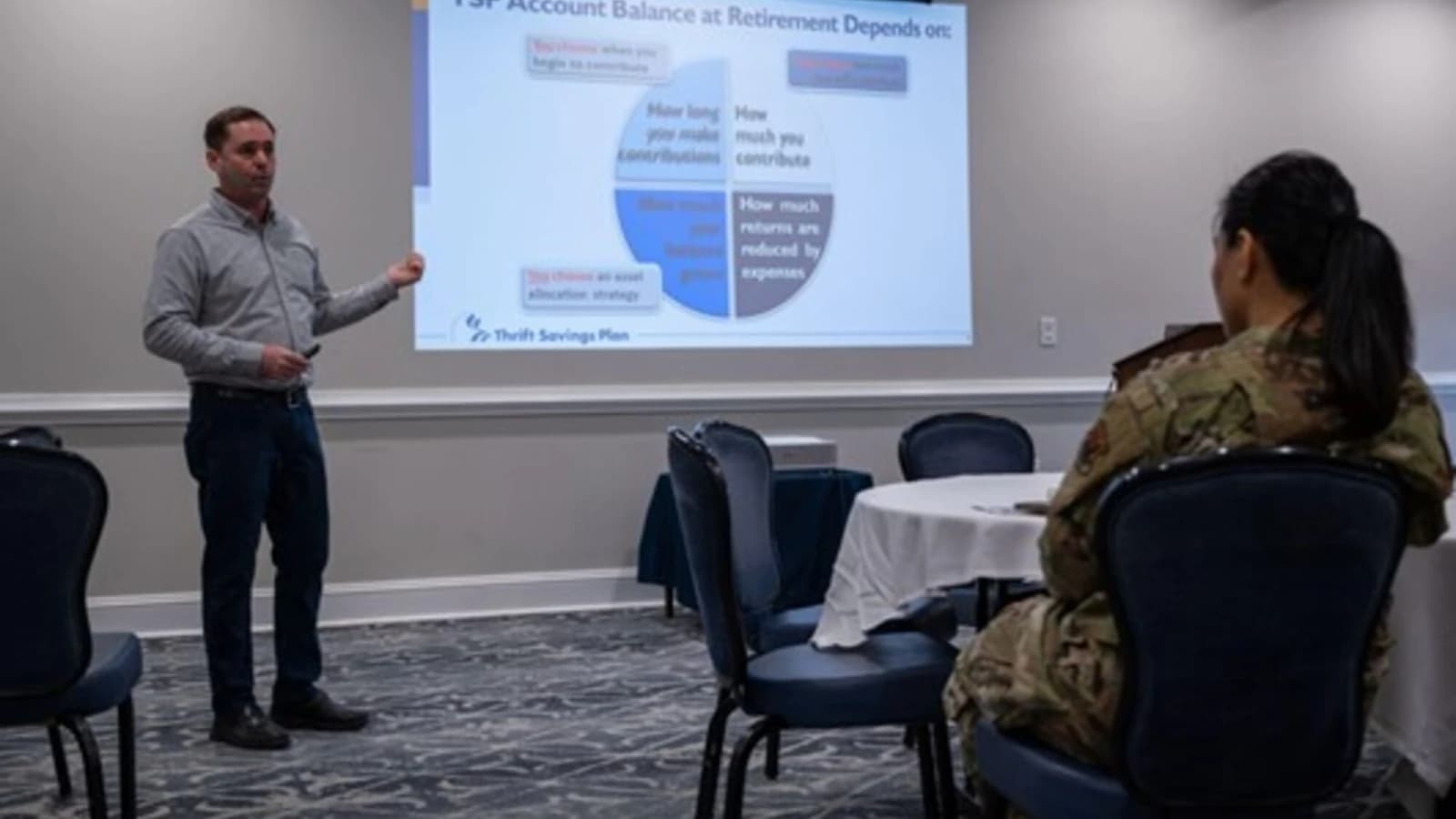
Photo: Sgt. 1st Class John Fries, U.S. Army Reserve, via DVIDS, public domain.
Continue reading
More from FederalHiringData
Pay and benefitsAugust 27, 2026
The TSP Now Lets Ages 60-63 Save $35,750. FERS Savers Ages 60-69 Averaged 10.8%.
The TSP raised contribution ceilings and added Roth rules in 2026, but FRTIB and OPM data show why the changes reach federal savers unevenly.

Pay and benefitsAugust 27, 2026
The Median FEHB Family Increase Took 94% of a Rest-of-U.S. GS-7 Raise
OPM plan-level rates show the median 2026 family premium increase absorbed 94% of one Rest-of-U.S. GS-7 step 5 scheduled raise.
Workforce trendsAugust 17, 2026
Retirement Was 38% of Federal Separations in 2025. Quits Were Still More Common.
OPM data record 390,934 federal separation actions in 2025. Retirements accounted for 150,299, while quits remained the largest single category.
Federal Hiring Data Weekly
Get the biggest federal workforce changes in your inbox.
Subscribe to Federal Hiring Data Weekly for federal hiring trends, salary data, agency movements, and original investigations, with email confirmation before delivery.