August 26, 2026
OFAC's Last Comparable Public Staffing Count Was 204. The Sanctions System Kept Expanding.
OFAC's last comparable office-specific public series ended at 204 actual FTE, while sanctions programs, list entries and operational demands continued to expand.
By Evan Mercer
Published August 26, 2026Last edited August 26, 2026
On Aug. 24, the Treasury Department announced an Iran sanctions campaign that it called Operation Economic Outcast. The announcement described nearly 60 individuals, entities and vessels as targets. It also identified five sectors for additional sanctions exposure: digital assets, technology, gold, aviation and shipping.
That is what a large sanctions action looks like in public. Names are added to lists. Industries are identified. General licenses can be suspended or issued. Financial institutions, exporters, charities, lawyers and companies around the world must work out what the rules mean for particular transactions.
Less visible is the federal workforce that has to make the system function.
The Office of Foreign Assets Control, or OFAC, develops and administers Treasury sanctions. Its employees investigate targets, draft regulations, review license applications, answer compliance questions, maintain lists and systems, analyze economic effects, and coordinate with other agencies. The office's Aug. 24 work was not a single list update. Treasury said the campaign also involved sector determinations, licensing changes, guidance and coordination across the government.
Yet the latest comparable office-specific staffing series FederalHiringData could locate ends at the start of fiscal 2020. It shows 204 actual OFAC full-time equivalents against 259 authorized, a gap of 55. Treasury's newer budget documents publish the much larger total for Terrorism and Financial Intelligence, the departmental organization that contains OFAC and several other components. That total cannot reveal OFAC's current size.
The sanctions system did not stop expanding when the public staffing series stopped. Treasury reported that net OFAC sanctions designations rose from 912 in 2000 to 9,421 in 2021, a 933% increase. The current OFAC site listed 37 active sanctions programs on Aug. 26, 2026. Treasury's fiscal 2027 budget says the annual rate of new sanctions has increased more than 1,000% since the period after Sept. 11, 2001.
Those numbers do not prove that OFAC is understaffed today. Designations are not hours of work. Program definitions changed. Technology, contractors and partner agencies can increase capacity. Public recruiting rebounded in 2026. Treasury is replacing an aging case-management system.
They do establish a narrower accountability problem: the government publishes evidence that the sanctions machinery has grown, but no longer provides a current office-specific workforce denominator that would let the public evaluate the staff behind it.
The last comparable public series showed a persistent gap
The Government Accountability Office's 2020 sanctions report provides the clearest recent view of OFAC staffing. GAO collected authorized and actual FTE from Treasury at the start of each fiscal year from 2014 through 2020.
Authorization increased from 173 FTE in fiscal 2014 to 259 in fiscal 2020. Actual FTE increased from 163 to 204. The growth was real: 41 additional actual FTE, or 25%, over six years. So was the gap. OFAC had 55 fewer actual FTE than authorized at the start of fiscal 2020.

The vacancy rate moved between 6% and 26% during the period. It was about 21% at the fiscal 2020 endpoint. GAO attributed the hiring challenge to competition with other agencies and the private sector, along with the time needed to complete security clearances.
FTE is not the same as employee headcount. It measures labor over a period, while headcount is the number of people on board at a point in time. GAO's series is also a start-of-year measure. For fiscal 2019, the chart used the authorization in place at the start of the year; appropriations later increased it. FederalHiringData preserves those definitions rather than mixing them with employee counts from a different source.
The date matters most. 204 is not OFAC's current workforce. It is the last comparable actual FTE point in the office-specific series FederalHiringData found. Presenting it as a 2026 employee count would be false.
Newer Treasury budget documents report staffing for Terrorism and Financial Intelligence, or TFI. The fiscal 2026 enacted level was 659 FTE. The fiscal 2027 request is 665. TFI includes OFAC, but it also includes the Office of Terrorist Financing and Financial Crimes, the Office of Intelligence and Analysis, management functions and other work. The broader total cannot be assigned to OFAC.
| Workforce measure | Published value | What it means | What it does not mean |
|---|---|---|---|
| OFAC actual FTE, start of FY2020 | 204 | Office-specific labor measure reported to GAO | Current 2026 employees |
| OFAC authorized FTE, start of FY2020 | 259 | Approved office-specific FTE ceiling at that point | Filled positions |
| TFI enacted FTE, FY2026 | 659 | Broader Treasury national-security organization | OFAC staffing |
| TFI requested FTE, FY2027 | 665 | President's budget request for the broader organization | Enacted or onboard OFAC staff |
This distinction is not bookkeeping trivia. It determines whether a public number can answer the question being asked. The TFI total shows that Treasury has national-security resources. It does not show how many investigators, licensing officers, economists, attorneys or data specialists work at OFAC.
Licensing and compliance carried the largest vacancy rates
GAO also published a functional snapshot for selected OFAC roles at the start of fiscal 2020. It found 13 vacancies among 62 authorized sanctions-investigator FTE. Three of 18 enforcement-officer positions and two of 15 policy-analyst positions were vacant.
The largest proportional gaps were in two functions that connect sanctions rules to the public. Nine of 25 licensing-officer positions were vacant, a 36% rate. Six of 14 compliance-officer positions were vacant, a 43% rate.

Licensing officers evaluate requests to conduct transactions that sanctions would otherwise prohibit. Compliance staff engage with the institutions and people expected to follow OFAC rules. Investigators develop the records behind possible designations or enforcement matters. Policy analysts and attorneys help translate foreign-policy choices into legally supportable rules and guidance.
The functions are connected but not interchangeable. An extra investigator does not automatically clear a license queue. A lawyer cannot simply replace a data engineer maintaining a sanctions system. The 2020 vacancies therefore say more than the office-wide total alone: the public-facing parts of the sanctions regime were among the hardest positions to fill.
The data still cannot establish the current gap. People may have been hired, duties may have been reorganized and technology may have changed the work. The value of the 2020 detail is that it provides a baseline and shows which competencies were under pressure before the next wave of sanctions expansion.
The number of sanctions programs grew, but the series is not seamless
OFAC does not administer one sanctions program. It manages authorities aimed at countries, governments, criminal networks, terrorism, proliferation, cyber activity, corruption and other threats. Each program can involve executive orders, statutes, regulations, general licenses, FAQs, reporting rules and lists.
Treasury publications provide a set of historical snapshots. In 2001, Treasury testimony referred to 21 economic sanctions programs. A 2006 testimony described 30. Treasury's fiscal 2011 annual report referred to 33 major programs. On Aug. 26, 2026, the OFAC active-program page listed 37.

This is context, not a continuous annual series. Treasury used different wording, and programs can be created, renamed, consolidated or ended. Syria's former program, for example, moved to OFAC's inactive archive in 2025. A count of 37 active programs in 2026 is not perfectly comparable with a reference to 33 major programs in 2011.
Even with that limitation, the snapshots show that OFAC's operating environment did not contract to a narrow set of country embargoes. The current list includes programs related to cyber activity, election interference, transnational crime, hostages, international courts, human rights, terrorism and proliferation alongside country and regional programs.
Every active program does not require equal staffing. A program can remain legally active while producing little current action. Another can generate repeated designations, licenses and guidance. Counting programs is therefore a measure of breadth, not a staffing formula.
List entries multiplied much faster than the last published office count
Treasury's fiscal 2023 TFI budget justification provides a different measure of scale. It reported 912 net OFAC sanctions designations in 2000 and 9,421 in 2021, an increase of 933%.

The term needs care. These are net designations or list entries, not 9,421 sanctions actions in one year. They are not necessarily 9,421 unique people. Entries can include individuals, companies, vessels, aircraft and other property. Names can be added, amended or removed. One action can add many entries.
The endpoint still captures a major operational change. A larger sanctions list must be maintained and published accurately. Names, aliases, addresses, identification numbers, ownership relationships and program tags have to be managed. Financial institutions and companies download those records into screening systems. Errors can freeze lawful transactions or allow prohibited ones to proceed.
The work extends beyond list maintenance. A designation begins with research and legal review. Once issued, it can generate interpretive questions, license applications, enforcement referrals, petitions for removal, litigation and diplomatic coordination. A sector determination may affect transactions involving companies that were not individually named. General licenses and FAQs can change the compliance burden without changing the number of list entries.
That is why FederalHiringData does not divide 9,421 by 204 and call the result a caseload. The years differ, the measures differ, and the work attached to each entry differs. Such a ratio would look precise while saying very little.
The Aug. 24 Iran action shows how workload spreads across functions
Federal Hiring Data Weekly
Get the biggest federal workforce changes in your inbox.
Subscribe to Federal Hiring Data Weekly for federal hiring trends, salary data, agency movements, and original investigations, with email confirmation before delivery.
The Aug. 24 Treasury announcement illustrates the layers of work more clearly than a single aggregate.
Treasury said the opening phase of Operation Economic Outcast targeted nearly 60 individuals, entities and vessels. It also announced determinations covering five Iranian sectors: digital assets, technology, gold, aviation and shipping. Those determinations were designed to increase sanctions exposure for people operating in those sectors. Treasury described general-license suspensions and additional guidance as part of the campaign.
Each element calls on a different part of the system.
- Target development requires investigators, analysts, lawyers and intelligence support.
- Sector determinations require policy and legal work defining the covered activity.
- List publication requires structured data, quality control and technology operations.
- Licensing changes require staff to draft, review and administer authorizations.
- Public guidance requires compliance expertise and communication with regulated parties.
- Enforcement requires evidence, process and coordination with law-enforcement partners.
Treasury also described the campaign as whole-of-government. The FBI and other agencies provide capacity, information and authorities. The State Department uses separate sanctions authorities. The Justice Department brings criminal cases. Commerce administers export controls. Those contributions matter, but their employees are not OFAC employees and should not be added to OFAC's staffing count.
Nor does the announcement establish that the campaign will achieve its policy objectives. Sanctions effectiveness depends on target behavior, enforcement, international cooperation, evasion, market substitution and the clarity of the policy goal. This article examines administrative capacity and public workforce evidence, not whether the Iran policy will succeed.
Public recruiting shows the roles, not the workforce
FederalHiringData searched its historical USAJOBS archive for Treasury announcements whose agency explicitly identified OFAC or whose title contained a standalone sanctions, OFAC or Foreign Assets Control reference. The strict rule found 245 distinct announcements from March 2017 through Aug. 26, 2026.
To compare years fairly, FederalHiringData counted announcements opened from Jan. 1 through Aug. 26 in each year. The count was 10 in the partial 2017 archive, 17 in 2018 and 25 in 2019. It ranged from 13 to 19 in 2020 through 2024, fell to four in 2025 and rose to 14 in 2026.

An announcement is not a vacancy or a hire. One announcement can advertise several positions, locations or grades. Agencies can post the same role under different hiring paths. A posting may close without a selection. Internal hiring and details may not appear in the public channel.
The series nevertheless reveals the recruiting vocabulary of the sanctions workforce. Across the full matched archive, investigations and implementation accounted for 64 announcements. Compliance and enforcement also accounted for 64. Licensing and regulations had 50, while policy and coordination had 46. The remaining titles covered leadership, law, administration, information and other work.

The categories are reproducible title rules, not OFAC's organization chart. A sanctions coordinator can do policy and implementation work. An enforcement officer can spend time on compliance. Technology staff may be advertised under a generic Treasury title that does not mention OFAC and therefore would not pass the strict filter.
The 2026 announcements still show useful breadth.
| 2026 public title | Grade range shown | Function signaled by title |
|---|---|---|
| Sanctions Policy Analyst | GS-12 to GS-14 | Policy |
| Government Information Specialist | GS-9 to GS-13 | Public information / records |
| Sanctions Compliance Engagement chief | GS-15 | Compliance leadership |
| Sanctions Regulations Advisor | GS-12 to GS-14 | Regulations |
| Enforcement Officer | GS-11 to GS-13 | Enforcement |
| Supervisory Sanctions Investigator | GS-14 to GS-15 | Investigations |
| Sanctions Licensing Officer | GS-9 to GS-13 | Licensing |
| Senior Sanctions Coordinator | GS-14 | Coordination |
| Supervisory International Economist | GS-15 | Economic analysis |
| Deputy Assistant Director, Regulatory Affairs | GS-15 | Regulatory leadership |
FederalHiringData also found an Aug. 6 announcement for a GS-15 Sanctions Investigations Manager under Treasury, Departmental Offices. The public channel had not disappeared. The rebound from four same-window announcements in 2025 to 14 in 2026 is counterevidence to a claim that OFAC had simply stopped recruiting.
It is not evidence that every earlier vacancy was filled. The archive does not show selections, onboarding, departures or the number of people ultimately hired. It is one observable input to the workforce, not the outcome.
Treasury is investing in systems and broader capacity
Staffing is not the only source of capacity. Treasury's fiscal 2027 TFI budget requested $3.719 million to continue replacing OFAC's Administrative System for Investigations and Sanctions, known as OASIS, with a new platform called STARS.
Related research
Put this finding in context
Data investigationsAugust 23, 2026
FAA's Aviation-Weather Network Was Designed for 90 Meteorologists. Staffing Fell to 69.
The last verified federal count found 69 meteorologists in a 90-position aviation-weather design. Public records show recruiting in 2026, but not a verified recovery.

Data investigationsAugust 21, 2026
VHA's Federal Workforce Fell by 28,342. Its Care Forecast Kept Rising.
VA's health workforce contracted after late 2024 even as patient, visit and community-care demands remained large. The losses reached clinical and coordinating roles.
Treasury said OASIS was approaching the end of its useful life and that OFAC began developing STARS in April 2025. The replacement is intended to reduce legacy maintenance, improve interoperability and support a sanctions process that Treasury says must move with greater speed and precision.
The request adds no FTE to the specific modernization line. That does not mean no federal employees work on it. It means the requested increase is funding rather than new FTE. Contractors and shared Treasury technology staff may contribute, but FederalHiringData found no public contractor headcount that could be combined with the office-specific FTE series.
Treasury has also added analytical capacity. Earlier budget requests funded a Sanctions Economic Analysis Unit and broader intelligence and economic-security work. The 2021 Treasury sanctions review explicitly recommended investment in technology, workforce and infrastructure.
These investments are important counterevidence. Better data and case-management tools can reduce repetitive work, improve quality and help staff coordinate. Economic analysis can help calibrate sanctions and assess unintended consequences. Shared TFI resources can support OFAC without appearing as office-specific FTE.
But modernization creates its own management burden during transition. Old and new systems may have to operate in parallel. Data must be migrated and validated. Users need training. Public files and licensing tools must remain available. The budget request acknowledges the systems problem; it does not reveal whether the current workforce mix is adequate to solve it.
Enforcement totals cannot answer the staffing question
OFAC's public enforcement page listed six civil penalties, settlements or findings of violation in 2026 through Aug. 12, totaling about $282.7 million. One matter accounted for $275 million. That concentration demonstrates why penalty dollars are a poor productivity measure.
A large settlement may reflect the statutory maximum, transaction value, cooperation, self-disclosure and facts developed over several years. A year with fewer penalty dollars can still include intensive investigations and compliance work. Some apparent violations end in warning letters or no public action. Criminal sanctions cases belong to the Justice Department, even when OFAC evidence or regulations are involved.
Licensing counts have similar limits. A routine application and a novel transaction involving multiple jurisdictions are not equivalent units. General licenses can authorize broad classes of transactions and reduce individual applications. New sanctions can initially increase questions and applications before guidance stabilizes. Without comparable processing-time, complexity and staffing data, a single license total cannot establish productivity or shortage.
The correct approach is to publish several measures and keep their boundaries visible: office-specific staffing, vacancy duration, applications and dispositions, processing time, petitions, guidance, data-quality performance and system uptime. No one metric is a substitute for the others.
The missing denominator is the finding
OFAC may have more than 204 actual FTE today. It may have filled the licensing and compliance gaps GAO documented. TFI's 659 enacted FTE, new recruiting, economic analysis and technology investment may have materially increased sanctions capacity. The public record reviewed here does not resolve those possibilities.
That uncertainty is not a reason to guess. It is the result.
The federal government is asking private institutions to interpret and implement sanctions across 37 active programs. Treasury says the annual rate of new sanctions is more than 1,000% above the post-9/11 baseline. Its Aug. 24 Iran campaign reached nearly 60 targets and five sectors in one opening action. OFAC's lists and licensing decisions affect access to the U.S. financial system around the world.
For a system of that reach, a six-year-old office-specific staffing endpoint is not enough.
A useful public workforce account would report authorized and actual OFAC FTE on a consistent schedule; vacancies and time to fill by major function; contractor and shared-service capacity separately; licensing volume and processing distributions; and progress on the OASIS-to-STARS transition. It would distinguish headcount, FTE and funded positions. It would not disclose operational details that need protection.
That would not settle whether any sanctions policy is wise or effective. It would allow Congress and the public to ask a more basic management question with current evidence: does the office have the people, skills and systems required to carry out the authorities it has been given?
Right now, the workload is visible in fragments. The workforce is not.
Methodology and limitations
FederalHiringData used GAO-20-324 for OFAC authorized and actual FTE from fiscal 2014 through fiscal 2020 and for selected functional vacancies at the start of fiscal 2020. FTE is not employee headcount, and the values are not current staffing estimates.
Sanctions-program counts are point-in-time descriptions from Treasury testimony in 2001 and 2006, Treasury's fiscal 2011 annual report, and OFAC's active-program page on Aug. 26, 2026. The definitions changed, so the counts are not treated as a standardized annual series. Designation endpoints come from Treasury's fiscal 2023 TFI budget justification. Net designations or list entries are not unique people, annual actions or equivalent units of work.
The USAJOBS analysis counts distinct Treasury control numbers whose agency identifies OFAC or whose title contains a standalone sanctions or OFAC reference or the phrase Foreign Assets Control. The same-window comparison uses announcements opened Jan. 1 through Aug. 26. Historical coverage begins in March 2017. Announcements do not equal vacancies, applications, selections or hires.
The analysis found no current office-specific OFAC actual FTE series that could be joined to the historical GAO data. Broader TFI staffing was not relabeled as OFAC. Contractors, classified support, internal details and partner-agency personnel were excluded from the office count. No causal claim is made about staffing, processing time, enforcement outcomes or sanctions effectiveness.
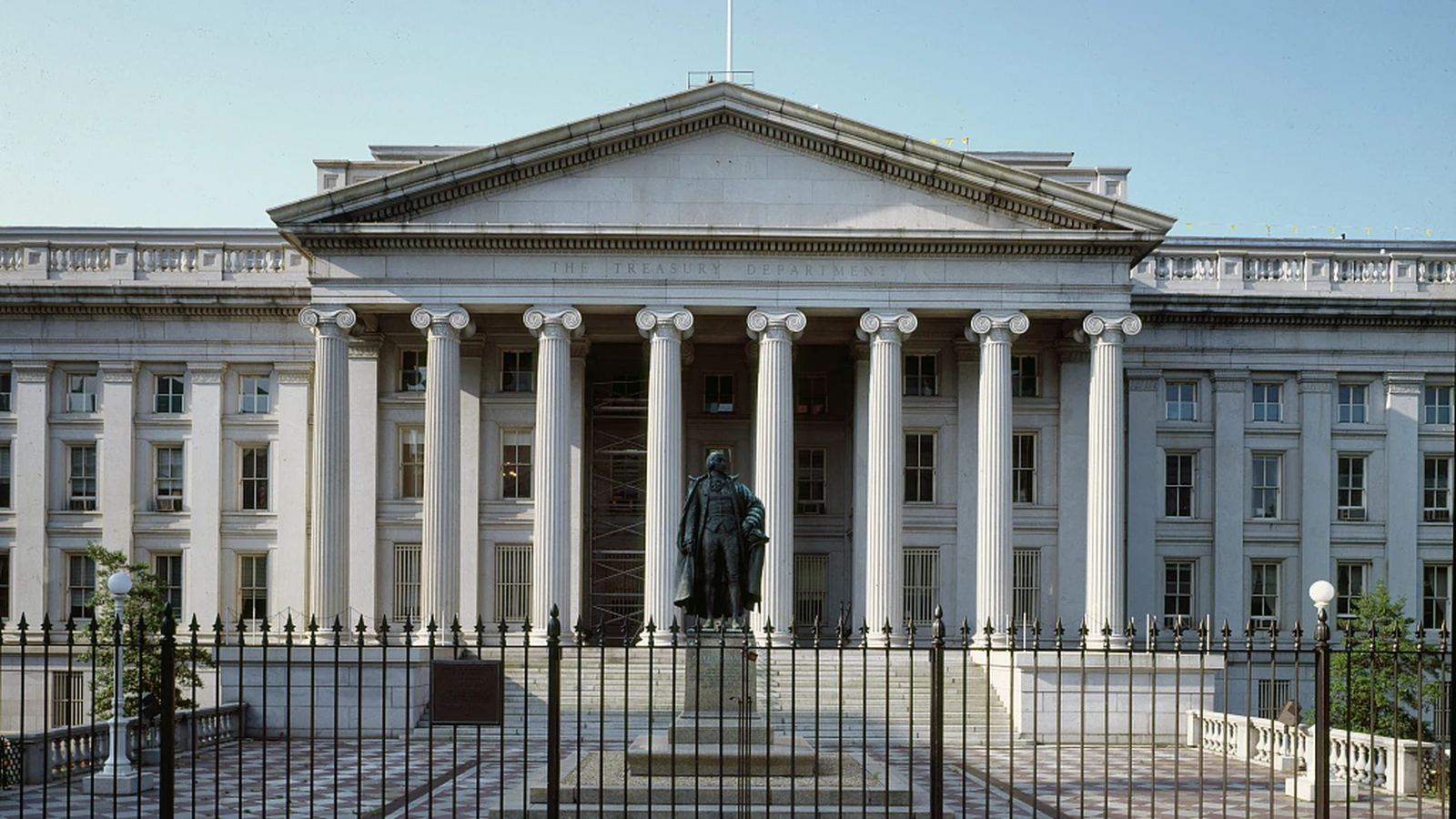
Hero image: Carol M. Highsmith, Library of Congress Prints and Photographs Division; no known restrictions on publication.
Continue reading
More from FederalHiringData

Data investigationsAugust 21, 2026
National Park Visits Rose 13%. September Staffing Fell 17%.
The park system still builds a summer workforce, but same-month OPM data show a thinner permanent base beneath 323 million annual visits.

Data investigationsAugust 21, 2026
Federal Prisons Lost 1,166 Officers. Overtime Became the Backstop.
BOP staffing has begun a small rebound, but the officer corps remains thinner and the last public operational measures show rising overtime and augmentation.

Data investigationsAugust 22, 2026
The OSHA System Had 48,000 Workers per Inspector in 1989. The 2026 Estimate Is 84,000.
The covered workforce grew far faster than the documented federal-state inspector pool, while recent federal staffing and inspection activity also declined.
Federal Hiring Data Weekly
Get the biggest federal workforce changes in your inbox.
Subscribe to Federal Hiring Data Weekly for federal hiring trends, salary data, agency movements, and original investigations, with email confirmation before delivery.