August 26, 2026
Performance-or-Discipline Removals Were 1.1% of 2025 Separations. OPM Is Rewriting the Rules.
OPM counted 4,160 performance-or-discipline removals in fiscal 2025, 1.1% of all separation actions. New rules change who rates, removes and hears appeals.
By Evan Mercer
Published August 26, 2026Last edited August 26, 2026
The Office of Personnel Management is giving federal agencies a new way to remove some employees for conduct, changing how performance ratings may be distributed and preparing to hear suitability appeals itself. Federal unions went to court on Aug. 24 to try to stop two of those changes.
The argument is sweeping. The personnel flow at its center has historically been narrow.
OPM reported 4,160 terminations or removals for performance or discipline in fiscal 2025 under the procedures governed by parts 432 and 752 of its regulations. FederalHiringData found 370,339 separation actions across OPM's broader public data for the same fiscal year. The narrow performance-or-discipline count was 1.12% of that total and 0.19% of the 2.19 million employees recorded in September 2025.
That comparison does not predict what the new rules will do. It establishes the scale of the system they are changing. Most people recorded as leaving federal employment in fiscal 2025 quit or retired. Many others left after an appointment expired, transferred, took an early retirement or were separated in a reduction in force. The public data do not cleanly identify which departures involved poor performance, misconduct or suitability.
The distinction matters because the rules do more than change a firing count. They redistribute authority. OPM's new suitability rule lets the agency decide cases involving serious post-appointment conduct and direct removal or governmentwide debarment. Its performance-appraisal rule permits OPM to require standardized distributions at the upper rating levels. A separate final rule, effective Sept. 2, moves appeals of suitability actions from the Merit Systems Protection Board to an OPM-run process.
OPM says the changes close an irrational gap, improve differentiation and reduce the cost and delay of discipline. The unions say OPM has exceeded the authority Congress gave it and weakened the Civil Service Reform Act's protections. Those claims are now before a federal court. The historical data cannot decide the legal question. They can show what is being rearranged: a small, consequential stream of adverse actions inside a much larger labor market.
Three rules, three different changes
The policies are easy to collapse into one headline about federal firings. Their legal functions and effective dates differ.
| Policy | What changes | What does not automatically follow | Status as of Aug. 26, 2026 |
|---|---|---|---|
| Suitability and Fitness, 5 CFR part 731 | OPM can act on covered employees for post-appointment conduct; agencies may or must refer defined matters; an OPM action can include removal, cancellation of eligibility or debarment | Performance problems generally remain outside suitability; the rule does not itself set a firing quota | Final rule effective July 30 |
| Performance Appraisal, 5 CFR part 430 | Removes the prohibition on standardized rating distributions; eliminates Level 2 from allowed patterns; limits grievances over ratings; requires supervisor elements and OPM certification | OPM says it intends limits on the highest levels, not quotas requiring low ratings; ratings still must rest on actual job performance | Final rule effective Aug. 6; selected rating-pattern compliance begins Jan. 1, 2027 |
| Suitability Action Appeals, 5 CFR part 731 subpart E | Replaces MSPB with an OPM-administered appeal process for part 731 actions | Other bodies retain independent jurisdiction over matters such as discrimination, prohibited personnel practices and veterans' rights | Final rule effective Sept. 2; not applicable to appeals filed with MSPB before then |
Under the suitability final rule, only OPM may take a suitability action against an employee based on post-appointment conduct. An employing agency can still use another authority, such as Chapter 75, but must notify OPM when conduct implicates the suitability factors. OPM's implementation guidance says the rule covers character and conduct, not ordinary performance issues.
That boundary is important. A worker who fails to meet a production standard is not automatically a suitability case. A performance-based reduction in grade or removal ordinarily proceeds under Chapter 43 and part 432. Misconduct actions commonly proceed under Chapter 75 and part 752. The new suitability route concerns covered conduct that OPM finds affects the integrity or efficiency of the service.
The performance-appraisal final rule addresses ratings rather than directly authorizing removals. It allows OPM to establish a standardized distribution and says agencies will apply it at an appropriate aggregate level after employees are assessed against job-related standards. OPM says it intends to cap only the highest ratings, such as Levels 4 and 5, not require a fixed share of employees to receive an Unacceptable rating.
The rule still changes the structure around performance decisions. It removes Level 2, eliminates mandatory higher-level review of Level 1 ratings, bars negotiated grievance challenges to ratings of record and requires every covered supervisor to have a critical supervisory element. Employees whose performance falls below Fully Successful remain entitled to assistance and an opportunity to demonstrate acceptable performance before reassignment, reduction in grade or removal.
The unions' complaint in *AFGE v. OPM*, filed in the Northern District of California, challenges the suitability and performance-appraisal rules. The plaintiffs allege that OPM's asserted authority conflicts with the Civil Service Reform Act, that standardized distributions can detach ratings from individual performance and that the rulemaking was arbitrary and capricious. OPM's final rules reject those interpretations and say the changes remain grounded in merit and job performance.
No court order deciding those claims was located before publication. The allegations are not findings, and the article does not predict the case's outcome.
The government's narrow count rose to 4,160
OPM supplied one of the clearest current measures in a different rulemaking: its July 2 proposed rule on employee accountability.
The proposal says agencies terminated or removed an average of 2,996 employees per year for discipline or performance from fiscal 2019 through 2025 under procedures governed by OPM regulations. It publishes exact counts for four years: 2,574 in fiscal 2020, 2,434 in 2021, 3,126 in 2024 and 4,160 in 2025. The 2025 figure was 33% above 2024.
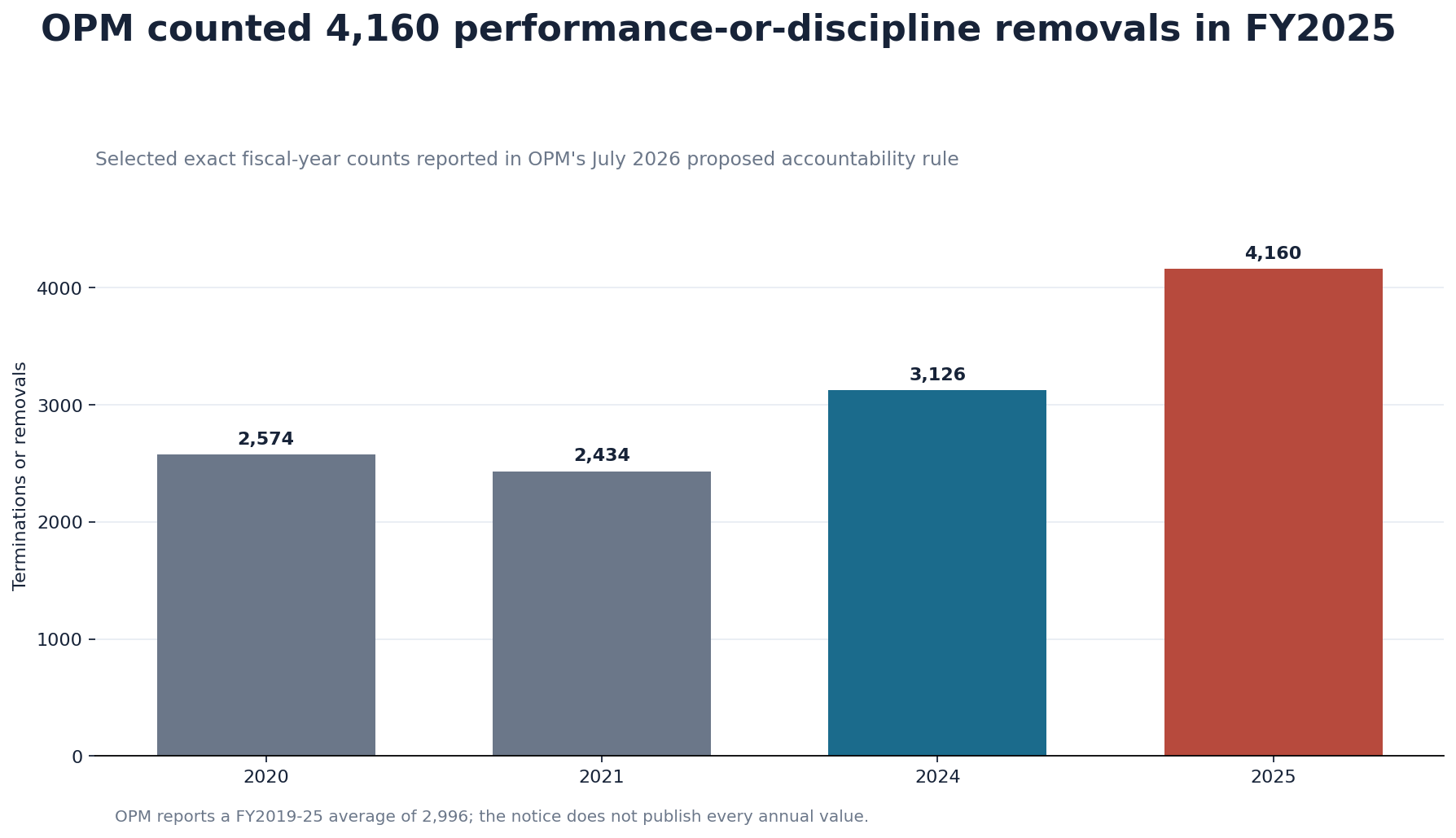
The missing annual values should not be invented. The published average does not reveal the exact counts for fiscal 2019, 2022 or 2023. Nor does the four-point sequence prove why 2025 increased. It coincided with a much larger reorganization of the federal workforce, including probationary terminations, deferred resignations, early retirements and reductions in force. The narrow parts 432 and 752 measure does not represent all of those departures.
OPM used the same series to estimate a future effect of its proposed accountability changes. It projected that covered actions could rise 20%, or about 599 annually, from the 2,996 average. That is a regulatory impact estimate, not an observed result and not a forecast for the final suitability or performance-appraisal rules.
The 2025 narrow count is also not the same as the 37,524 records in OPM's public category labeled "Termination (Expired Appt/Other)." That category combines expired appointments and other terminations. Without the underlying nature-of-action and legal-authority codes, it cannot be relabeled as poor-performance removals. Doing so would inflate the answer by nearly nine times and mix voluntary appointment endings with adverse actions.
Quits and retirements were the larger flow
FederalHiringData summed every separation action in the public OPM Federal Workforce Data cubes from October 2024 through September 2025. Quits accounted for 159,598 actions. Voluntary retirements accounted for 102,727. Early-out and other retirements added 26,210. Transfers added 16,403. Reductions in force accounted for 10,561.
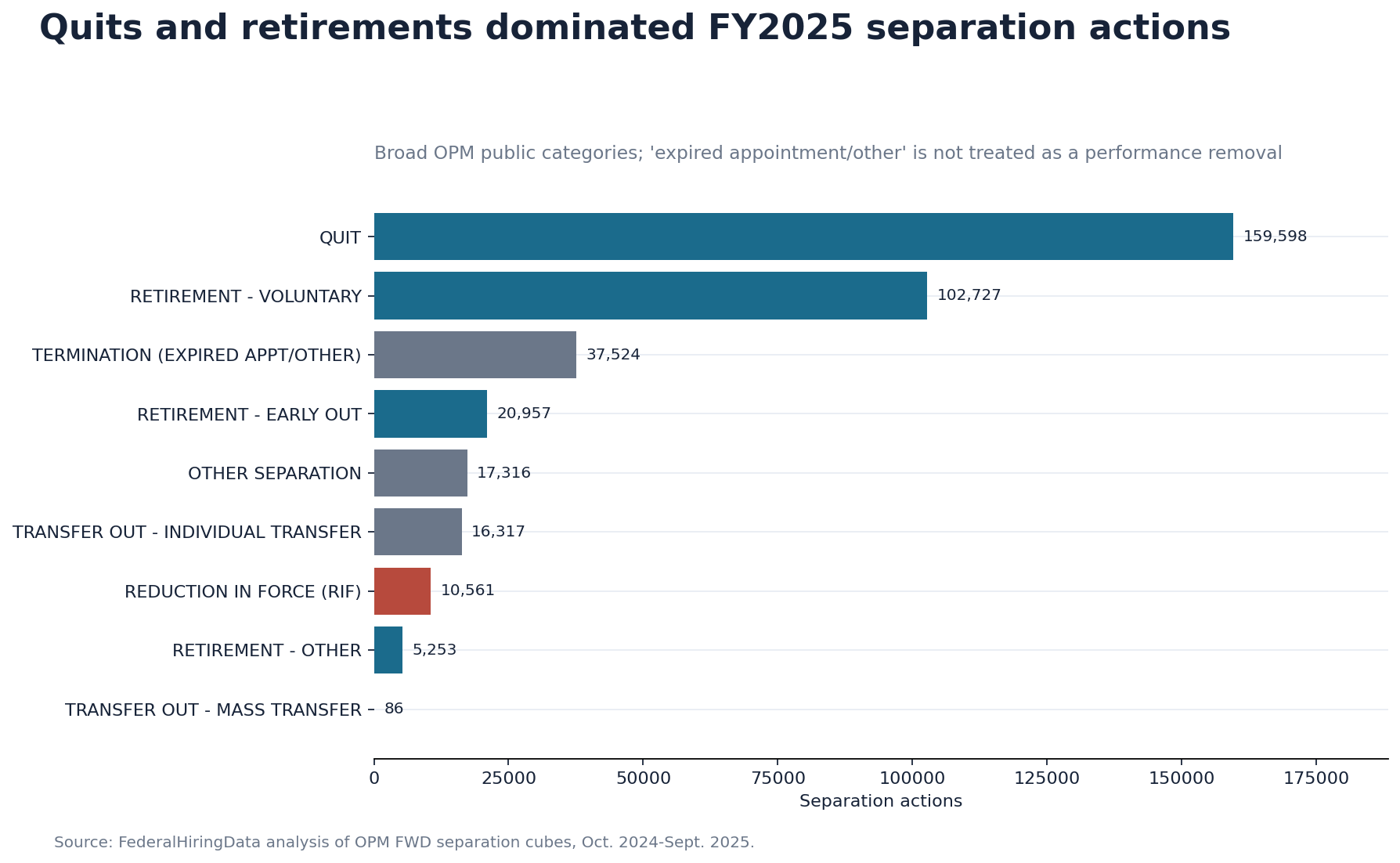
Those are personnel actions, not necessarily 370,339 different people. A person may have more than one recorded action, and an action can reflect a change between covered organizations rather than an exit from the entire federal government. Transfers are included because OPM's public separation cube records them as separations from an organization. The comparison describes the administrative flow that agencies processed, not a one-to-one count of people who left government service.
Even with that limitation, the order of magnitude is informative. The 4,160 narrow performance-or-discipline count equaled 1.12% of all recorded separation actions. It equaled 0.19% of September 2025 headcount.
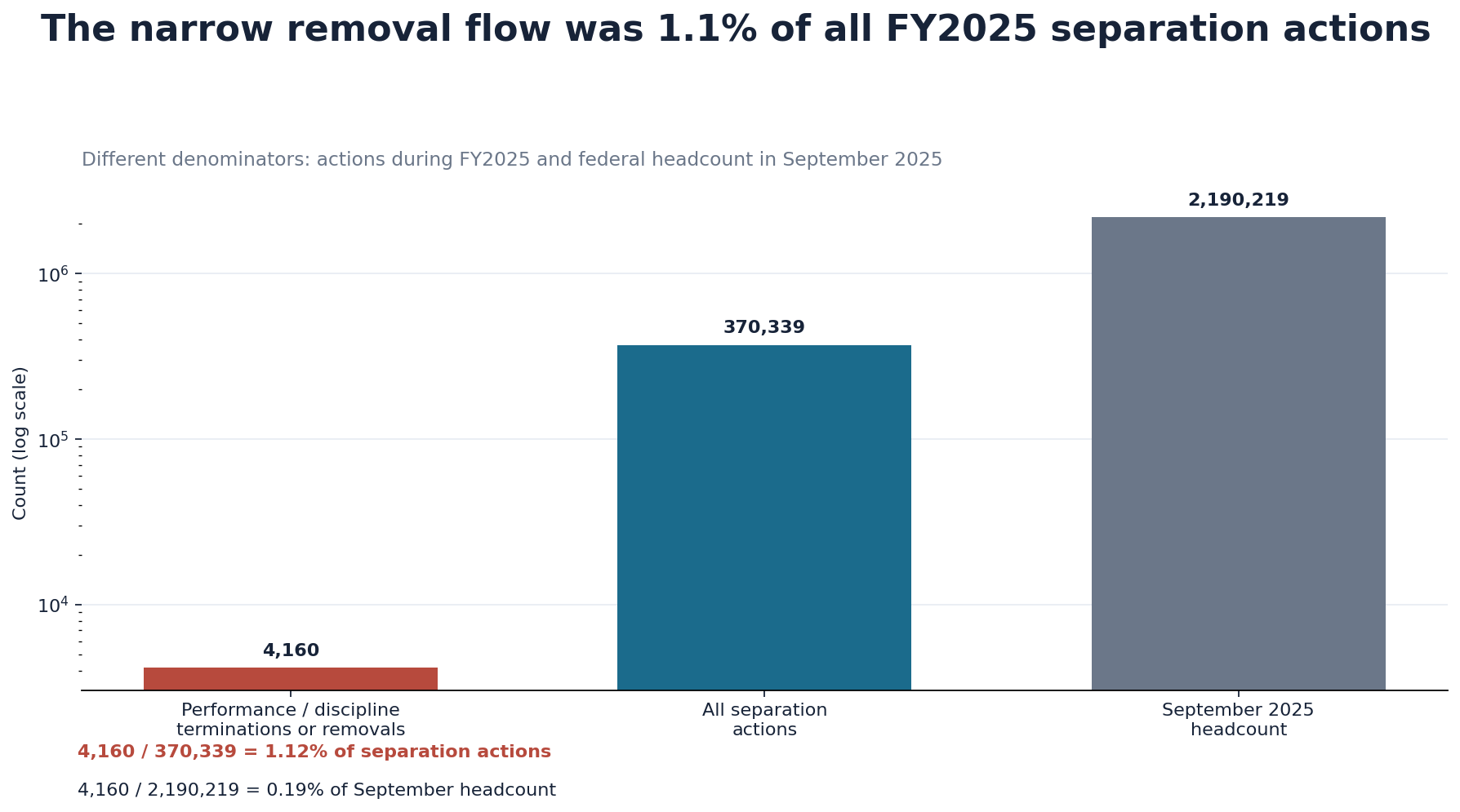
The denominator choice changes the question. Dividing by separation actions asks how much of the year's administrative outflow used the narrow performance-or-discipline channel. Dividing by headcount asks how large that flow was relative to the workforce on board at one point in time. Neither ratio is a removal rate for a fixed cohort, because the numerator is a year's actions and the headcount is a September snapshot.
The public categories also limit agency comparisons. An agency with many temporary appointments may record more expired appointments without having more poor performers. An agency with older employees may record more retirements. A large transfer count can reflect organizational restructuring. Without precise action and authority codes, ranking agencies by "firings" would turn unlike events into a false league table.
The longer record was small, but not static
The best comparable historical series comes from the Government Accountability Office, which examined Chapter 75 adverse actions using OPM's Enterprise Human Resources Integration records for fiscal 2006 through 2016.
GAO counted between 5,905 and 7,411 removals per year, between 9,656 and 11,518 suspensions, and generally around 100 to 165 demotions. The exception was 2011, when demotions reached 533. In fiscal 2016, agencies recorded 10,249 suspensions, 7,411 removals and 114 demotions.
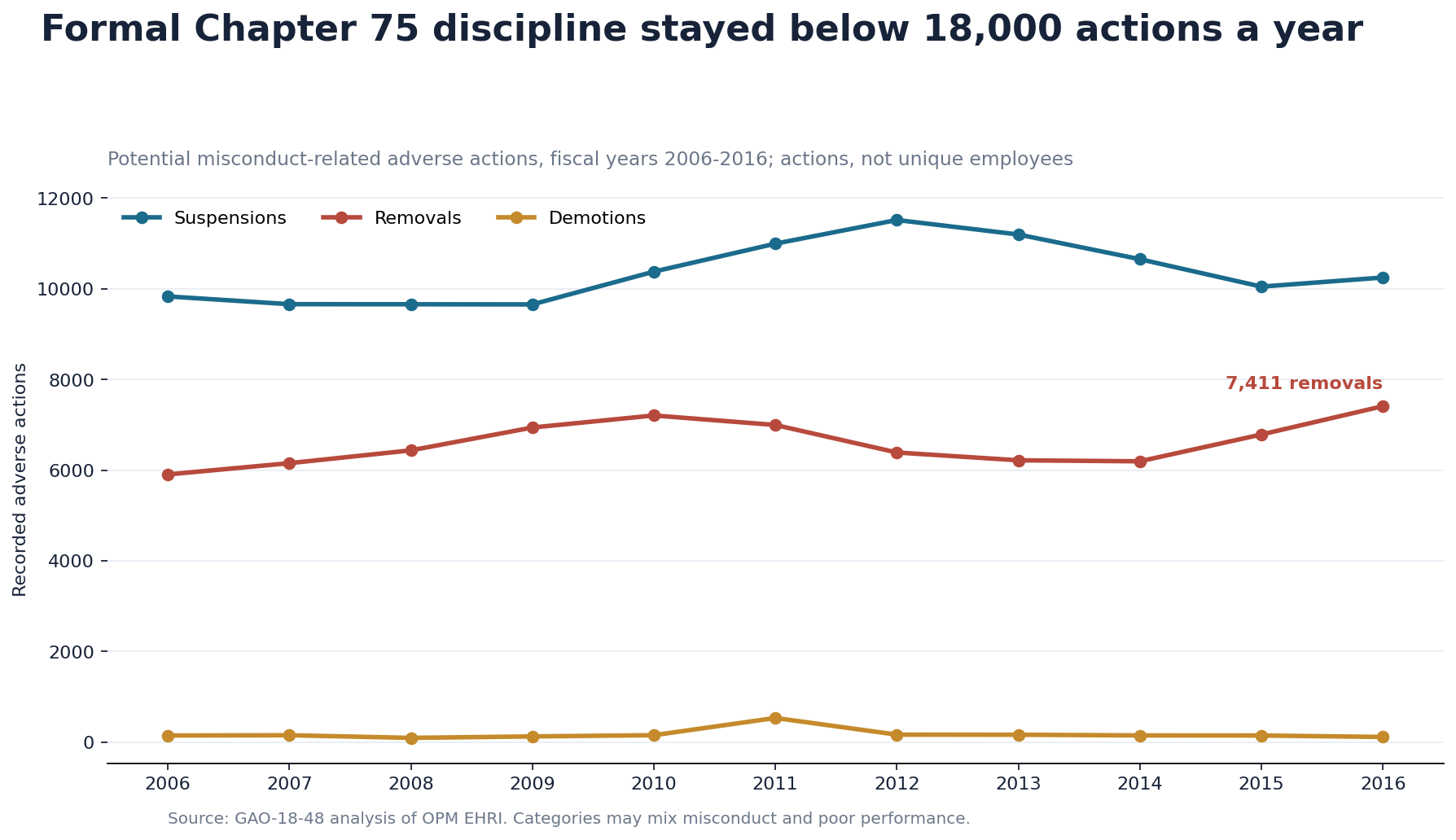
GAO described the formal Chapter 75 discipline flow as about 17,000 actions a year, involving less than 1% of the workforce. But its 2018 report also warns against precision the source data cannot support. Some nature-of-action and legal-authority combinations can encompass both misconduct and poor performance. The observational unit is an action, not an employee. A person can appear more than once.
Federal Hiring Data Weekly
Get the biggest federal workforce changes in your inbox.
Subscribe to Federal Hiring Data Weekly for federal hiring trends, salary data, agency movements, and original investigations, with email confirmation before delivery.
GAO also found that the database missed important ways discipline ends. A worker may resign or retire while an investigation is pending. An agency may use counseling, a reprimand, alternative discipline or a settlement. Those outcomes can resolve a serious personnel problem without appearing as a removal for misconduct. The formal count is therefore not the full universe of conduct concerns, and a low removal count alone does not prove that every agency tolerated poor performance.
At the same time, GAO found real management problems. Supervisors and subject-matter experts described limited training, weak human-resources support and reluctance to use disciplinary tools. OPM lacked the detailed misconduct data needed to identify the most common problems across government. GAO recommended better guidance and training; as of June 2026, it reported that OPM had implemented the training recommendation while declining the data-quality recommendation.
This creates an important counterweight to both sides of the current debate. The historical system processed relatively few formal actions, but the records cannot tell whether that was because conduct and performance were generally strong, because problems were resolved informally, because supervisors avoided the process or because data categories failed to capture what happened. The answer is not contained in one rate.
| Measure | What it can establish | What it cannot establish |
|---|---|---|
| OPM parts 432/752 terminations or removals | A narrow annual flow under defined performance and discipline procedures | Every departure influenced by performance or conduct |
| GAO Chapter 75 adverse-action series | Long-run scale of formal suspensions, removals and demotions under its code filter | A clean misconduct-only trend; unique affected employees |
| OPM public separation categories | Broad composition of quits, retirements, transfers, RIF and expired/other actions | Exact performance, misconduct or suitability cause inside broad categories |
| September employment headcount | Workforce scale at a point in time | A fixed annual cohort or annual average employment |
| MSPB decisions | Formal appeal workload and disposition | All adverse actions, because many employees and actions are outside MSPB jurisdiction or never appealed |
The GAO series and OPM's newer 4,160 count should not be spliced into one continuous line. GAO's filter is broader and older; OPM's current regulatory count is narrower and tied to parts 432 and 752. The apparent decline between 7,411 removals in 2016 and 4,160 in 2025 may reflect both real change and different definitions.
OPM expects 1,226 cases could move into suitability
The suitability final rule offers another exact number. OPM says agencies averaged 2,452 Chapter 75 or equivalent removals for post-appointment misconduct in fiscal 2022 and 2023. It estimates that approximately half, or 1,226, could be referred to OPM for suitability action instead.
That is an estimate of routing, not a claim that 1,226 additional employees will be fired. OPM says the actual share will depend on agency referrals. It also says it lacks enough data to estimate how often existing non-removal actions, such as suspensions or reductions in grade, might become removals under suitability. The final rule expressly declined to estimate a net increase in total removals.
The route can still change consequences. A Chapter 75 process gives an agency a range of penalties. OPM argues that the suitability process is designed around protection of the service and offers four actions, including removal and debarment. OPM says a case serious enough for a suitability action will always result in removal rather than a lesser penalty, and debarment can keep a person from immediately returning elsewhere in the competitive service.
The agency also presents the change as a cost transfer. It estimates that a Chapter 75 action consumes about 600 collective hours of supervisory and human-resources labor before appeals. Referring the case to OPM would move some work from employing agencies to OPM, which expects to need 18 additional adjudicators. Those assumptions are part of the rule's economic analysis; they are not measured processing times for every case.
The separate appeal rule makes the institutional shift larger. OPM expects about 318 suitability appeals annually and estimates the new OPM-run process will cost agencies and OPM about $1.52 million a year. Supporters can view that as specialized, centralized review. Challengers can view it as the same agency exercising both policy and adjudicative authority. That dispute is legal and institutional; a historical removal count does not settle it.
Performance ratings are not firing quotas
The performance rule begins from OPM's conclusion that ratings are too compressed at the top and too rarely used to distinguish poor performance.
The current OPM performance dashboard reports that 60.2% of federal employees received ratings above Fully Successful in fiscal 2025. In the final rule, OPM says only 0.3% of non-Senior Executive Service employees in five-level systems received Level 2 ratings from fiscal 2022 through 2024.
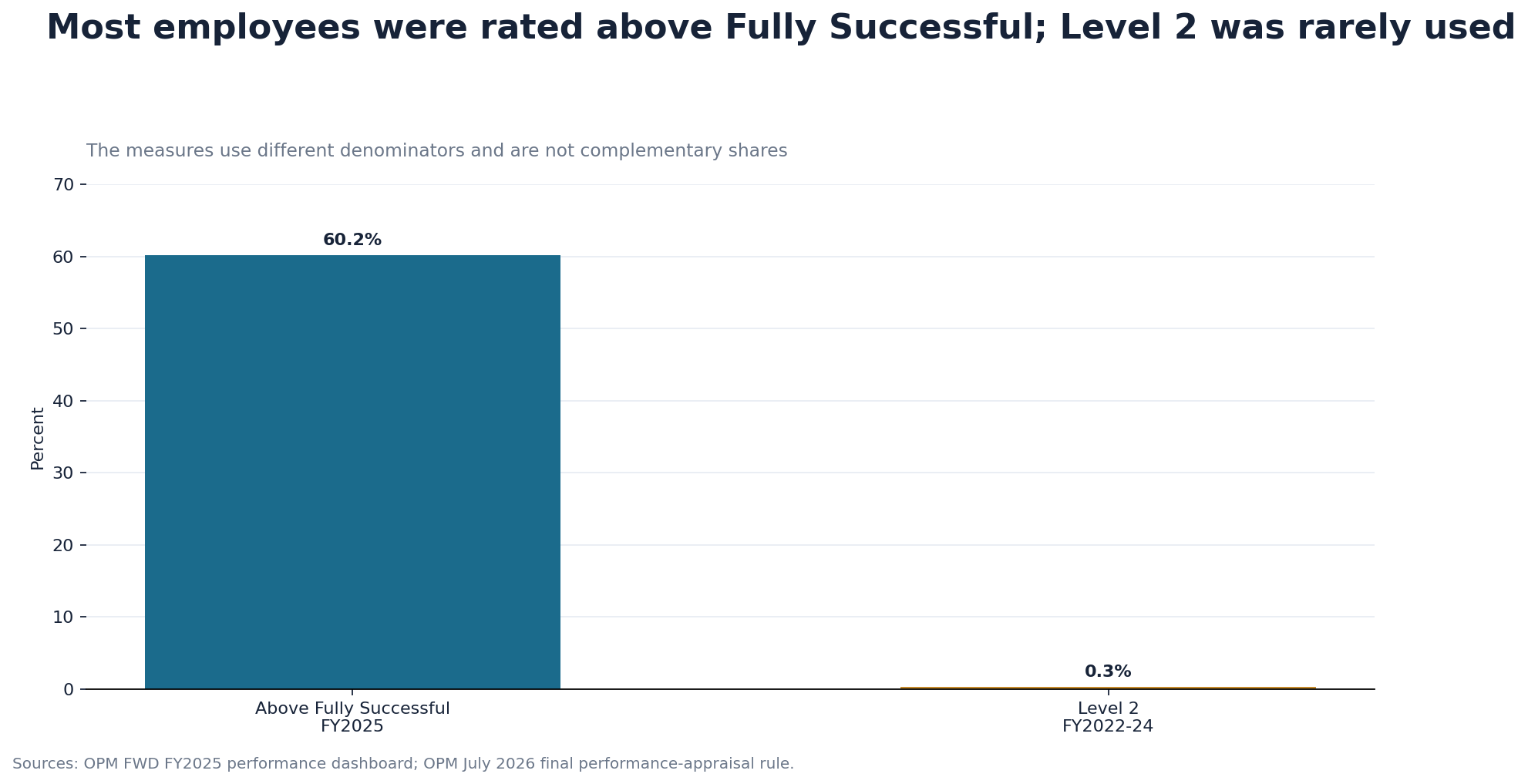
The two percentages are not complementary. They cover different years and different populations. The 60.2% measure reflects OPM's current broad performance dashboard. The 0.3% measure is limited to non-SES employees in five-level systems. A pass/fail system cannot produce a Level 2 rating.
OPM says standardized distribution will apply after supervisors evaluate employees against established standards and will be imposed at an aggregate agency or department level, not mechanically within every small work unit. It says the intended distribution will limit top ratings and will not force a share of employees below Fully Successful.
Related research
Put this finding in context
Data investigationsAugust 20, 2026
OPM's 35% Cut Was Its Deepest Since It Transferred an Entire Bureau
The federal government's HR agency now has fewer employees than at any reviewed point since 1998 while directing agencies to rebuild hiring and workforce planning.

Data investigationsAugust 20, 2026
OPM Says 7% of Federal Workers Are Early Career. Its 33% Hiring Target Counts Something Else.
Under-30 hires already topped one-third of external federal hiring in fiscal 2024 and 2025, but OPM's new target uses a broader unpublished numerator.
Commenters cited in the rule raised the opposite operational concern: upper-level caps can still force managers to lower ratings among employees whose work met the written standards, affect awards and promotion opportunities, and discourage collaboration. OPM acknowledged mixed research on forced-distribution systems but concluded that rating inflation was serious enough to justify the change. It says biennial certification will let the agency monitor implementation and require corrections.
There is no defensible conversion from an upper-rating cap to a future firing count. A Level 3 employee is Fully Successful, not a candidate for removal. A lower summary rating does not automatically establish unacceptable performance on a critical element. Agencies must still document deficiencies and use the applicable process. Any article claiming that the rule will produce a specific number of firings would be estimating a behavior that neither the rule nor historical data quantify.
Appeals show another narrow filter
MSPB data measure only the cases that enter the formal appeal system. OPM's proposed accountability rule cites 2,903 fiscal 2020 initial decisions across adverse-action, performance-action, individual-right-of-action and USERRA categories. The comparable count was 2,275 in fiscal 2022 and 1,832 in fiscal 2024.
Those totals are not removal appeals alone. They include several jurisdictions, and an initial decision can resolve procedural issues without reaching the merits. Employees also differ in appeal rights, cases settle, and some disputes proceed through grievance, equal-employment or prohibited-personnel-practice channels. The figures show that the adjudicative stream is measured in thousands, not that thousands of removals are reversed.
GAO's review of fiscal 2006 through 2016 MSPB outcomes found settlements were the largest annual outcome category in its selected appeal data. It warned that the files could include both misconduct and performance cases and multiple appeal actions. That makes settlement an important part of the historical process but not evidence that an agency's original charge was right or wrong in every case.
The new rules alter that map. Suitability appeals filed before Sept. 2 remain with MSPB. Later part 731 appeals will use OPM's process. Performance and Chapter 75 appeals that remain within MSPB jurisdiction do not move merely because the separate suitability rule exists. Readers should therefore expect future OPM and MSPB caseloads to change composition even if the total number of personnel disputes stays constant.
What the data can test next
The first test is not whether federal separations rise. Fiscal 2025 was already exceptional, with 370,339 broad actions and large flows of quits, retirements, appointment endings and RIF separations. The useful test is whether precisely coded Chapter 43, Chapter 75 and suitability actions change after the effective dates.
OPM could make that test possible by publishing de-identified monthly counts for referrals, accepted cases, proposed actions, final actions, debarments, processing time and appeal outcomes. The measures should distinguish employee post-appointment cases from applicant and appointee suitability cases. They should report how many referrals end without action and how many employees have multiple recorded actions.
Performance reporting also needs more than a distribution chart. Agencies should publish rating-pattern coverage, the number of ratings changed during calibration, occupation and grade distributions, assistance periods, performance-based actions and later appeal outcomes. Those data can show whether higher-level caps produce more differentiation without assuming that differentiation is either inherently fair or inherently biased.
The historical baseline provides a clear warning about shortcuts. "Termination" is not synonymous with poor performance. "Other separation" is not misconduct. A resignation can be unrelated to discipline or can conclude a pending case. A suitability removal is legally distinct from a Chapter 75 removal even when the same conduct could trigger either route.
OPM's new system may centralize expertise and shorten some cases, as the agency argues. It may also place too much authority inside OPM and weaken independent review, as the unions allege. What is already measurable is the size of the pre-change system: a 4,160-action performance-or-discipline channel inside 370,339 separation actions, supported by a longer record in which formal adverse discipline involved less than 1% of the workforce in a typical year.
The rules are consequential because they change the machinery around those cases, not because most federal employees historically left through it.
Methodology and limitations
FederalHiringData queried its local copy of OPM Federal Workforce Data in read-only mode. Fiscal 2025 is Oct. 1, 2024 through Sept. 30, 2025. The analysis sums `separations` in OPM's public separation categories and `headcount` for September 2025. These are aggregate personnel-action records, not employee-level files.
The 4,160 fiscal 2025 performance-or-discipline count, the 2,996 fiscal 2019-2025 average and selected annual values come from OPM's July 2, 2026 proposed accountability rule. The 2,452 annual Chapter 75-equivalent removal baseline and 1,226 estimated suitability referrals come from the June 30 suitability final rule. They are reported regulatory figures and do not exist as separable categories in the public OPM cubes.
The fiscal 2006-2016 adverse-action series is transcribed from GAO-18-48. GAO's unit is an action, and its filter can mix misconduct and poor performance. The article therefore does not join that series to OPM's newer, narrower count or call it a unique-employee series.
The performance percentages use different denominators: OPM's fiscal 2025 dashboard for Above Fully Successful and the final performance-appraisal rule's fiscal 2022-2024 measure for Level 2 among non-SES employees in five-level systems. They should not sum to 100%.
Rule status and lawsuit status were checked against the final Federal Register texts, OPM guidance and the Aug. 24 complaint immediately before publication. No later merits or injunction order was located. Court allegations are attributed and not treated as findings.
FederalHiringData preserves the source inventory, evidence ledger, analysis SQL, extracted data and chart inputs for this investigation. Browse the site's federal workforce statistics, current federal jobs and other data investigations for related coverage.
Continue reading
More from FederalHiringData

Data investigationsAugust 23, 2026
ICE Got 150,000 Applications. Its Workforce Grew by About 9,600 at the Peak.
OPM recorded 10,030 new-hire actions during ICE's surge, but tentative offers were not final hires and covered employment had receded by June.
Data investigationsAugust 25, 2026
MSHA Recorded One Mine Inspector Accession and 140 Separations in 2025. Training Takes Two Years.
MSHA's newer inspector bench thinned sharply while the agency maintained a large mandatory-inspection program whose completion data remain difficult to verify.

Data investigationsAugust 25, 2026
NRC Recorded 215 Engineering Separations in 2025. It Recorded 17 Accessions.
NRC's two largest engineering series recorded 215 separations and 17 accessions in 2025 as advanced-reactor applications and engagements expanded.
Federal Hiring Data Weekly
Get the biggest federal workforce changes in your inbox.
Subscribe to Federal Hiring Data Weekly for federal hiring trends, salary data, agency movements, and original investigations, with email confirmation before delivery.